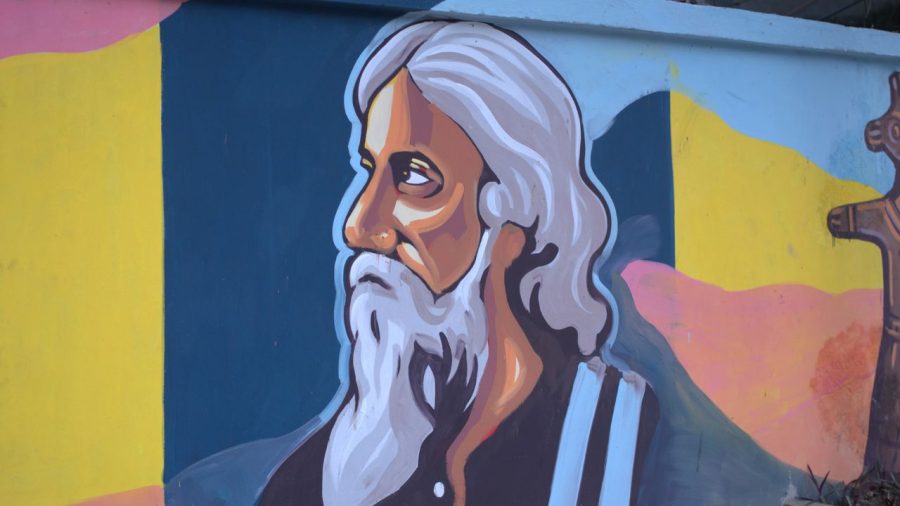



A graffiti portrait of Rabindranath Tagore in Segunbagicha, Dhaka, became the centre of controversy after a woman was filmed covering it with black paint on 10 October. The incident sparked debate over artistic freedom, cultural identity and the limits of political protest in Bangladesh.
The wall, located opposite the Bangladesh Shilpakala Academy, had recently been decorated with portraits of prominent figures from Bengali art, literature and culture. However, the defacement of Tagore’s portrait transformed the public artwork into a symbol of wider disagreements about Bangladesh’s cultural heritage and its relationship with India.
The controversy began after the Dhaka South City Corporation cleared an encroached footpath in Segunbagicha on 5 October. Following the operation, portraits of prominent cultural figures were painted on the adjacent wall. The portraits included Rabindranath Tagore, Kazi Nazrul Islam, Zainul Abedin, Satyajit Ray and Ishwar Chandra Vidyasagar. On 10 October, a woman was filmed applying black paint to Tagore’s portrait. The incident attracted public attention after videos circulated on social media.
Reports indicated that the action was connected to objections against what the protesters described as Indian cultural influence. Claims were also made about Tagore’s historical position on the establishment of the University of Dhaka, although such claims require careful examination against reliable historical evidence.
Police detained four people in connection with the incident. According to contemporary news reports, the case involved allegations including criminal conspiracy and promoting enmity between groups.
The incident has since raised a broader question: should disagreement with a historical figure justify destroying a public artwork?
Raihan, a graffiti artist, believes the incident represents a troubling example of how political disagreement can affect artistic expression.
According to him, graffiti is not merely decoration but a form of communication that brings art into public spaces.
“Graffiti allows artists to communicate directly with ordinary people. A wall can become a place where people encounter history, culture and different ideas. When someone covers an artwork with black paint, they are taking away that opportunity for discussion,” Raihan said.

He acknowledged that people have the right to question Tagore’s historical views and cultural significance. However, he argued that destroying an artwork is not an appropriate way to express disagreement.
“If someone disagrees with Tagore or believes his portrait should not be there, they should explain their position. They can organise a peaceful protest or create another artwork expressing their views. Art should be challenged through ideas, not destroyed,” he added.
Raihan also expressed concern about the message the incident could send to young artists.
“If artists feel that their work can be destroyed whenever someone disagrees with its subject, they may become afraid to express themselves. A society that values art should protect the freedom to create while allowing people to criticise it,” he added.
For Raihan, the controversy is not simply about Tagore. It is about whether artists can express themselves freely in shared public spaces.




Fahim, 24, believes the controversy reflects a wider debate about national identity and the influence of neighbouring countries on Bangladesh’s cultural life.
He said people should be allowed to question the inclusion of particular historical figures in public spaces, but such questions should be addressed through discussion rather than confrontation.
“Young people have every right to question history and discuss which figures represent our national identity. But we need to distinguish between protecting our cultural identity and rejecting everything associated with another country,” Fahim said.
He pointed out that Bengali literature and culture have developed across geographical boundaries, even though Bangladesh has its own distinct national history and political identity.
“Recognising Tagore’s contribution to Bengali literature does not mean agreeing with everything he said or did. We can respect his literary achievements while critically examining his historical views. These things are not mutually exclusive,” he added.
Fahim also criticised the tendency to react quickly to controversial videos on social media.
“People often take sides before checking the facts,” he said. “We should investigate historical claims and understand the situation before forming an opinion. Patriotism should encourage us to understand our history, not prevent us from discussing it critically.”
For Fahim, open discussion and historical research offer a better way to address disagreements over cultural representation.
Amzad, a businessman operating near the area, views the incident from the perspective of someone connected to the local community. He believes public artwork can improve the appearance of an area and create opportunities for people to engage with culture. However, he said that disagreements over artwork should not lead to its destruction.
“When a wall is decorated with portraits, it can make the area more attractive and meaningful. But when someone damages the artwork, the place becomes the centre of controversy. People start arguing about the incident instead of appreciating the original purpose of the project,” Amzad said.
He acknowledged that people have the right to express political opinions and question decisions made by public authorities.
“If someone believes that a particular portrait should not be there, they can raise their concerns peacefully. They can speak to the authorities or organise a protest. But damaging public property is not the right way to make a point,” he added.
Amzad also stressed that public spaces are shared by people with different political opinions, religious beliefs and cultural backgrounds.
“We cannot expect everyone to agree on everything. The important thing is to respect one another and find peaceful ways to resolve disagreements. Public spaces should be places where people can coexist, not places where differences lead to confrontation,” he said.
For him, protecting public property and allowing freedom of expression should go hand in hand.
The incident in Segunbagicha has brought questions about cultural identity and artistic freedom into the public debate.
Rabindranath Tagore remains one of the most influential figures in Bengali literature. His song “Amar Sonar Bangla” became the national anthem of Bangladesh, while his literary and musical works continue to influence Bengali-speaking communities in Bangladesh and India.
Nevertheless, his inclusion in public artwork can be debated, and historical figures should not be placed beyond criticism.
The central distinction is between questioning an idea and destroying the means through which it is expressed. Public discussion, historical research, alternative artwork and peaceful protest can all provide opportunities to challenge cultural representations without erasing existing work.
The views expressed by Raihan, Fahim and Amzad highlight different dimensions of the controversy. For the artist, the incident raises concerns about creative freedom. For the young person, it reflects questions about national identity and historical understanding. For the businessman, it demonstrates the importance of respecting shared public spaces.
Ultimately, the black paint on Tagore’s portrait has prompted a discussion that extends far beyond one wall. The incident raises questions about how Bangladesh can protect its cultural identity while encouraging critical thinking, artistic expression and peaceful disagreement.
The challenge is not to prevent people from questioning cultural figures. It is to ensure that disagreement becomes an opportunity for discussion rather than an excuse for destruction.
Photos: Tahjib Islam Jami