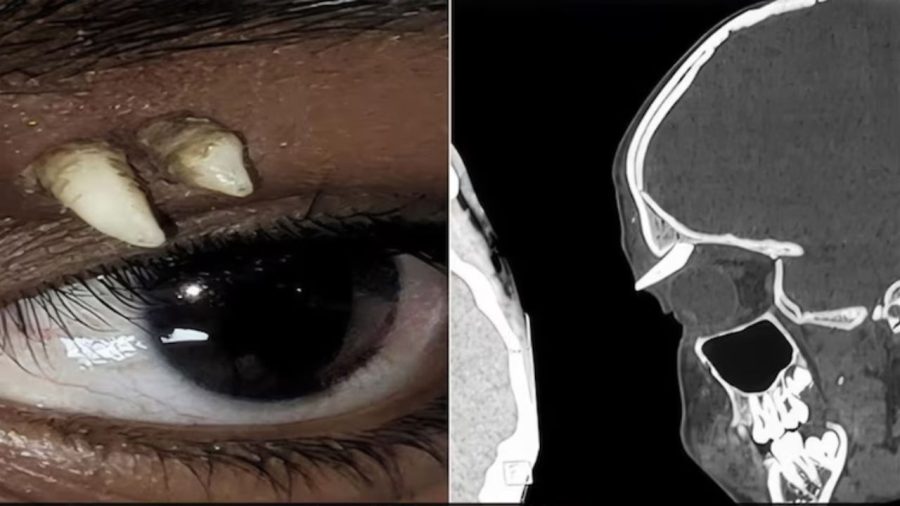



Doctors in India have discovered a fully formed tooth growing inside the upper portion of a 16-year-old boy’s eye socket in an unprecedented medical case.
The teenager sought medical attention after developing a painless swelling above his left eye. What initially appeared to be a mild lump soon developed into two hard, white points that protruded through the skin between his eyelid and eyebrow, reports NDTV.
Following preliminary examinations, doctors conducted a computed tomography (CT) scan, which confirmed the presence of a fully formed tooth in the superior orbit, the medical term for the upper section of the eye socket.

Details of the case study were published by the American Academy of Ophthalmology, while the New York Post also reported on the discovery.
An ‘ectopic tooth’ is a tooth that develops or erupts outside its normal position in the mouth. According to case study co-author Meghana Tanwar, this was “the first and only ectopic tooth reported in the superior orbit”.




Medical experts highlighted that this was the first known instance of an ectopic tooth developing in this specific part of the eye socket.
Although teeth occasionally develop in unusual anatomical locations, such as the roof of the mouth or deep inside the nasal cavity, such cases are rare and may result from previous trauma or developmental problems. However, a tooth growing inside an eye socket has no known precedent.
Researchers are still trying to determine the cause of the anomaly, as the teenager had no history of genetic disorders or facial injuries. Medical scans also confirmed that no other extra teeth were present elsewhere in his skull, indicating that the tooth had developed in the eye socket as an isolated occurrence.
Doctors successfully removed the tooth through surgery, resolving the swelling and preventing potential long-term medical complications.
Reflecting on the unusual discovery, Tanwar said, “This was a first not just for us but the world over.” She added, “We were very surprised by it”.