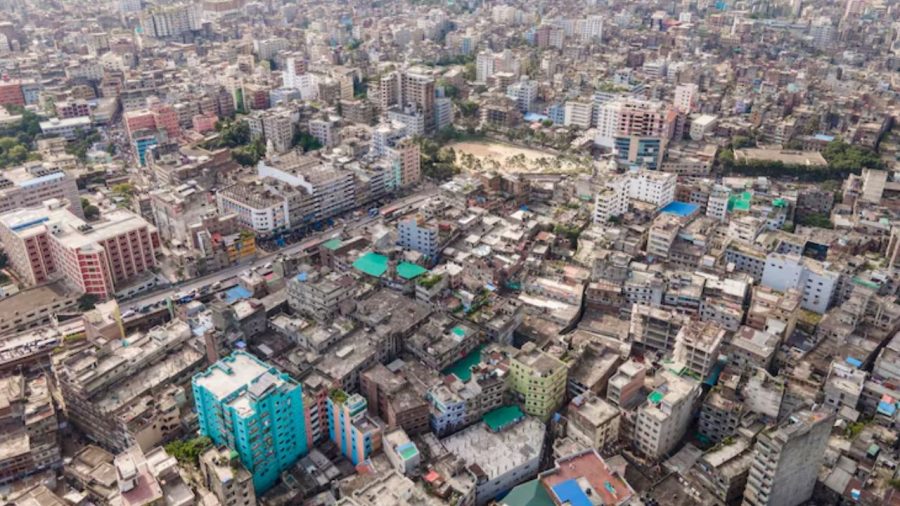



Economic growth is often presented as evidence of national progress. New roads, elevated expressways, commercial towers and expanding urban centres provide visible proof of development. Yet there is a question that deserves equal attention: are these changes making urban life healthier, safer, more affordable and more dignified? A city may grow wealthier without becoming more liveable. Bangladesh’s declining performance in international city rankings suggests that this distinction can no longer be ignored.
The 2026 Global Cities Index by Oxford Economics places Dhaka at 515th among 1,000 cities worldwide, down from 482nd the previous year. No Bangladeshi city has secured a place among the world’s top 500. Rajshahi has suffered the sharpest decline, falling 66 positions to 779th, while Chattogram has dropped 14 places to 763rd. These rankings are not a definitive verdict on every aspect of urban life, but they offer a warning about the direction in which our cities are moving.
The important question is not why Dhaka has slipped below an arbitrary numerical threshold. It is why the economic energy of our cities has failed to translate into a comparable improvement in the conditions of everyday life. Development is often discussed through the language of investment, construction and growth. Citizens, however, experience it through a different vocabulary: hours lost in traffic, housing prices, clean water availability, and the quality of public services they receive.
This difference exposes a fundamental weakness in our understanding of urban progress. We are accustomed to seeing infrastructure as an end in itself rather than a means of improving human welfare. Commercial expansion may increase economic activity, but its social contribution remains limited if workers cannot afford decent housing or if the surrounding neighbourhood lacks basic amenities. Concrete can change a city’s appearance without necessarily improving its character.

Dhaka’s economic and human-capital rankings are considerably stronger than its overall position, standing at 286th and 178th respectively in the Oxford Economics index. Yet its overall ranking remains far lower, while its environmental position is 930th. The contrast suggests that economic concentration and educational opportunities cannot compensate indefinitely for environmental deterioration and inadequate urban management. These costs are not always reflected in conventional calculations of economic growth. When a worker spends hours commuting, a family pays an excessive share of its income for accommodation, or a child grows up with limited access to open spaces, the consequences extend beyond personal inconvenience. Lost time reduces productivity, pollution damages public health, and housing insecurity weakens household finances. The city continues to generate economic activity, but a substantial portion of its potential is consumed by the conditions under which that activity takes place.
The figures mentioned suggest that environmental stress is not simply a problem of the capital. The urban heat island effect, intensified by dense construction and the loss of vegetation, can make nights uncomfortable. Such conditions are not peripheral environmental concerns. They determine whether cities remain physically sustainable and economically productive. Nor can the problem be solved by treating environmental protection as an obstacle to development. This approach assumes that pollution and ecological damage are temporary prices that a growing economy must pay. But the costs may persist long after construction is complete. Once trees are removed, wetlands filled or natural drainage obstructed, restoring ecological balance becomes difficult and expensive. Prevention is generally more sensible than attempting to repair the consequences of unplanned expansion.




The pressure on Dhaka also reflects a national imbalance. When employment, higher education, healthcare and major economic opportunities are concentrated in one city, migration towards it becomes a rational response to unequal opportunities elsewhere. Decentralisation must mean more than establishing administrative offices outside Dhaka. Districts and municipalities need productive investment, reliable transport connections, quality educational institutions, healthcare facilities and employment opportunities that allow people to build sustainable lives locally. If these conditions improve, migration can become a choice rather than a necessity.
The shortage of affordable accommodation is not merely a consequence of population growth; it is also connected to land prices, uneven planning and the limited purchasing power of ordinary households. When housing becomes increasingly inaccessible, people are pushed towards overcrowded settlements or distant neighbourhoods, often at the cost of longer commutes and reduced access to services.
Governance is the thread connecting these problems. A city cannot become liveable through infrastructure spending alone if planning rules are weakly enforced, public spaces disappear, drainage systems remain inadequate, and responsibilities are fragmented among institutions. Existing infrastructure must be maintained and managed efficiently, while new development should follow coherent plans that protect environmental resources and prioritise public needs. Planning documents have limited value unless their recommendations shape actual decisions about land, transport, construction and public investment.
A city’s position can change over time, and different indices measure different aspects of urban life. Bangladesh should examine the underlying indicators rather than pursue a higher numerical rank as an end in itself. The objective should be to improve the conditions that rankings attempt to capture, not merely to improve the country’s position on a list.
The views expressed in this article are solely those of the author
The writer is an academic, journalist, and political analyst. Email: [email protected]