


If the mythical world of thousands of years ago had social media, email and instant messaging, how would the Gods’ inbox be filled up? As the demons were getting stronger, it was only a matter of time before more emergency meetings would come in quick succession. The myth gives a surprising observation. Not one God had enough power to solve the problem. They brought their own weaponry, abilities, and power. It was from this collective force that Durga came out.
Read past the supernatural story, and you will find a remarkably contemporary concept. When crises go beyond what anyone can do, people need to join forces and unite their strengths. This is called collective action by social scientists. The Gods may not have read sociology, but their message is one constant: a team is stronger than an individual. It can also be interpreted that Durga’s birth is a tale of collective creation. The Gods give up their individual power, and it combines into one. The Goddess is not a supernatural being. She is the strength of countless. In this reading, Durga symbolises culture of co-operation, co-ordination and common capacity.
Durga is also the daughter of the Himalayas, Himalayaduhita – a mysterious name, like that of the world’s greatest mountain chain, a family home. Now that would be a cool thing to put in a modern social media bio: “Father: Himalayas; Home: Kailash!” Her parental home will not be matched for elevation even after her marriage.
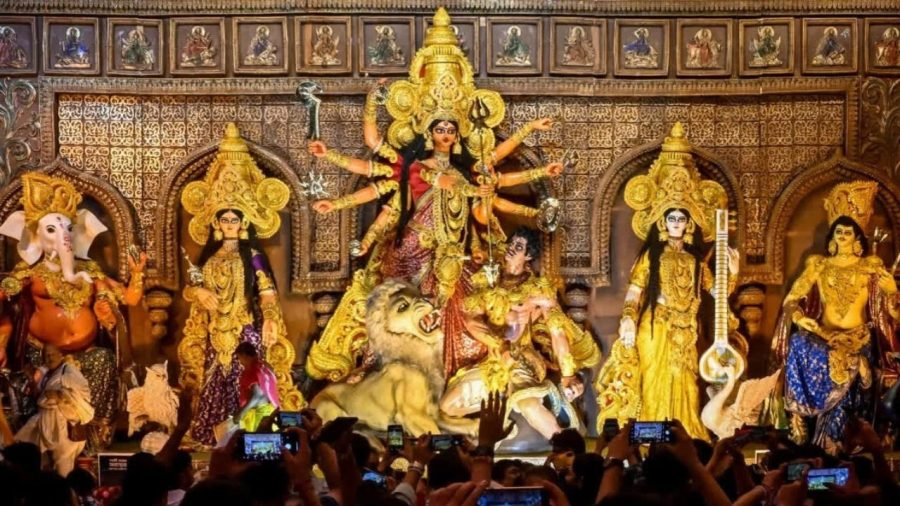
Pay attention to animals and symbols depicting the Goddess. The visual world of Bengal’s Durga Puja includes lions, mice, peacocks, owls and snakes, along with various plants. The surrounding area turns into a miniature world of living beings. However, such a harmonious relationship doesn’t always occur in nature. It would not be safe for a mouse to sit by a lion. It’s not an ecological lesson; it’s more like a cultural symbol to read this scene. When human imagination creates a world where different beings, even predators and prey, can exist together in the same space.

The story of Durga and Mahishasura goes beyond a simple battle between good and evil; it invites deeper reflection on coexistence and identity. While traditional lore celebrates Durga’s divine victory, Mahishasura’s character presents a complex narrative. Over time, the concept of Asura evolved in Vedic and Puranic literature, showing that the relationship between devas and Asuras is not strictly binary. Mahishasura is a multifaceted figure – his power, ambition, and hybrid form enrich the mythological landscape. Though portrayed as the adversary, his presence lends substance to Durga’s overarching story. Furthermore, Mahishasura is perceived differently across India. While central Puranic texts depict him as the defeated demon, various regional traditions and folk histories view him through alternative lenses, such as an ancestral symbol. Ultimately, myths shape collective memory and cultural values. Rather than viewing Mahishasura solely through the rigid framework of good versus evil, examining how and by whom his story is told offers a more nuanced understanding of cultural communication.
However, a warning: no disparagement of religious views is intended in describing other cultural perceptions of Mahishasura. Similarly, there will be no attempt to interpret traditional religious stories in a different way from other memories and interpretations. In a pluralistic society, there can be more than one version of the same mythological character. Equally, the significance of interfaith studies is knowing other interpretations without discounting any.


So, one ought not to succumb to the temptation of seeing a contemporary ‘Mahishasura’ as any one religion, caste or community. The use of mythological characters as actual humans, even living humans does restrict critical analysis. Instead, the story could be considered a discussion of power, domination, conflict and the construction of ‘the other’. It also reminds us that with every story of victory comes the memory of the defeated. This rivalry may be just what adds to Mahishasura’s appeal. He’s not just a mythological figure who was defeated by the Goddess. He also poses a challenging query: What does it tell about a society when it names someone an Asura?
Mythology can then serve as a mirror to the world of today. If it is in the name of religion that violence is committed, searching for Asura in another person is not as significant as considering the Asura-like tendencies in our behaviour. However, we need to question who is being the ‘other,’ for what reason, and whether or not we are willing to hear their story.
This is where the social beauty of Durga Puja is observed. A number of reasons are given for entering a pandal. Some come for the ritual, others for the idol, the lighting or the artwork. Friends meet up, tour the food stalls, and people stay up all night and roam the city. Religion is intertwined with city life, art, business, entertainment, memory and relationships. The Pandal turns into a temporary public area where individuals from various backgrounds unite to experience a festival. The term Sharodiya Utsav (autumn festival) hence has a more social connotation. Durga Puja isn’t merely a range of religious ceremonies. It’s a shared cultural event. People come together, talk, eat, roam around, take pictures, make memories. It is an annual event at which society speaks to itself, if you will.
If the purpose of the festival is only to celebrate religious sentiments, then allowing the lights of the pandal to burn would be uncalled for, as would be the case if the sound of the dhak or the joy of the dhunuchi dancing were only to raise such religious sentiments. Other ways of communicating at the festival that make it meaningful include eating with strangers, spending an entire night with friends, meeting neighbours or looking at another artist’s work.
At the end of the day, the recitation of Durga could be a vehicle for a simplistic moral message. Rather, it is a chance that we have to look at that old story over again every year. The birth of the Goddess out of the strength of the Gods reminds us of the importance of working together. Her battle against the Asura brings up questions of power and the building up of the ‘other’. The public space of the festival points to the fact that society is not just constructed of conviction but also by communication and interaction with each other.
Mythology, therefore, is not a set formulaic story of old. It is a ‘mirror of culture’ and a mirror to our own times. Durga is here, and Mahishasura is here. Victory has a story to tell, so does the one who lost. The question is, will we see the image that we want to see and believe nothing more, or will we see it, but try to see it as a whole and understand its meaning?
The views expressed in this article are solely those of the author
The writer is an Associate Professor, Department of Communication and Journalism, University of Chittagong. Email: [email protected]