


“We are not demanding any irregular or illegal process,” Md Tuhin told reporters at Dhaka’s National Press Club on 24 September.
The coordinator of the Europe Visa Seekers Unity Council wanted only this: people holding valid visas and real jobs be allowed to travel ‘without unnecessary barriers.’ Their problem sits in a government office, not an embassy.
Hundreds of Bangladeshis hold work visas for Serbia, North Macedonia and Moldova, but they say the Bureau of Manpower, Employment and Training (BMET) has stalled their emigration clearance. They formed a demonstration outside the National Press Club after the press conference. Twelve days later, Expatriates’ Welfare Minister Ariful Haque Choudhury met a group of protesters and then told reporters that the claim was ‘completely false.’
Two accounts, one stalled queue. The gap between them is the Serbian work visa dilemma. A visa alone does not get a migrant worker through the airport. BMET’s emigration clearance, the smart card, does. Under standard protocol, a Bangladeshi embassy usually attests the foreign employer’s demand letter, and the recruiting agency then obtains clearance on the worker’s behalf.
There is a loophole. A ‘small-batch exemption’ lets up to five workers skip embassy attestation. An estimated 70 to 75 percent of migrants travel this way, and trafficking syndicates reportedly split big recruitment orders into small batches to dodge scrutiny. That detail explains the council’s sixth demand. More than five workers at the same company now need extra approval and attestation of demand letters.

The delay is pushing hundreds of visas toward expiry. Coordinator Ibrahim Sardar said the workers are joining jobs voluntarily through agency agreements and are ready to sign written undertakings.
The tightening makes more sense against what went wrong elsewhere this year. Bangladesh cleared 15,921 workers for Cambodia in 18 months. BRAC says more than 1,000 ended up trapped in scam compounds. About 30 recruits for Russian construction jobs were reportedly pushed into military service, and three agencies had licences suspended. For Cambodia, Laos and Brazil, the government decided to end exemption-based migration. State Minister Md Nurul Hoque said proper work visas and full verification would be mandatory before clearance.
On 30 July, he went further. He said most of Bangladesh’s nearly 3,000 licensed agencies were involved in irregularities, and that only 400 to 500 licenses would survive proper enforcement. Experts have long said BMET’s checks are weak. In 2023, its then director general said that verifying so many letters was nearly impossible with existing staff.




On 6 October, with the state minister and Secretary Mokhtar Ahmed beside him, Minister Choudhury said a syndicate of travel agencies had taken about Tk 8 lakh each from hundreds of young men in exchange for Serbian visas. He said some protesters were themselves in the agency business and could not show proper papers. Visa holders were being told that BMET was refusing clearance, which he called false. He also said overseas missions verify demand letters and that the state recruiter BOESL was almost ready to take on this.
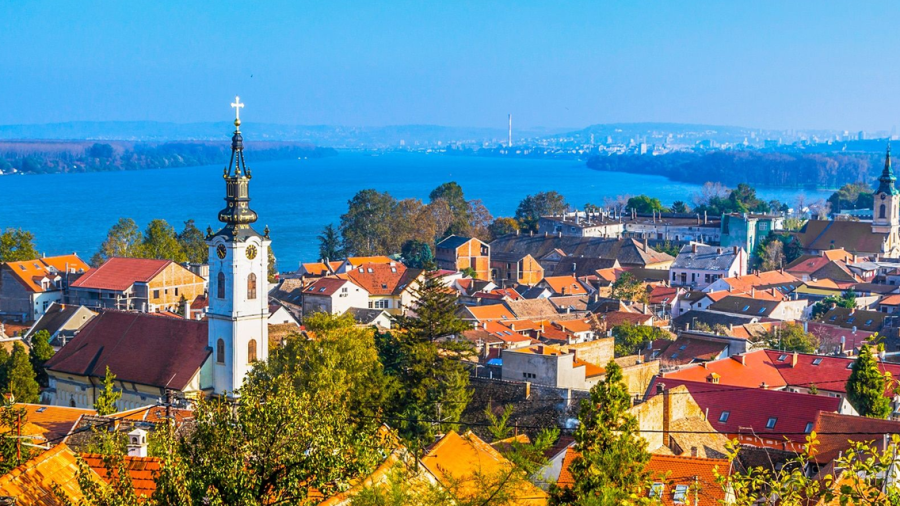
Serbia as a destination was almost invisible to Bangladeshi recruiters. In June 2021, nine workers flew to Serbia for an energy firm, BEDEM, through Link-up International. The ministry had approved 13 visa holders under 17 conditions. By September, Serbia’s labour minister said her country wanted trained and semi-skilled Bangladeshis. In October 2021, Former Foreign Minister AK Abdul Momen offered IT staff, electricians and plumbers, and President Aleksandar Vucic asked for an institutional mechanism.
In 2022, Serbia’s foreign minister said construction and agriculture were the needs. Foreign workers in Serbia rose 24 per cent to 64,672 by the end of 2025, led by Russians, Chinese, Indians, Turks and Nepalis. Bangladeshis appear only among ‘others,’ roughly 13,000 workers of mixed nationalities. Foreign workers there cluster in construction, hospitality and delivery work.
Bangladesh closed its embassy in Belgrade in 1992. Since 2005, it has had only non-resident ambassadors. The closest official consular office handling regional matters is the Consulate General of Bangladesh in Budapest, Hungary. Serbia handles Bangladesh from its embassy in New Delhi. Therefore, no resident Bangladeshi office in Serbia can vet a job listing or give a stranded worker legal advice. Even, we don’t have any labour agreement between Bangladesh and Serbia.
In April 2026, the prime minister told parliament that initiatives were under way with Serbia and several other countries. The only 2022 documents on record with Serbia’s foreign ministry are a memorandum and a visa waiver for diplomatic and official passports. Dhaka’s push is also real. Gulf recruitment fell 38.2 per cent in early 2026, and Europe’s legal intake rose 46.4 percent to 18,220 in the first half. Serbia is among the rising destinations.
According to BMET country clearance data, around 7956 migrant workers went to Serbia from February 2023 to September 2026. How many Bangladeshis went there under a government-to-government deal? Migrant workers appeared to have travelled on ministry approvals and private recruitment. This weakness is documented elsewhere. In the Cambodia case, an embassy attested only 210 workers while BMET registered 3,127.
Is the Ministry of Expatriates’ Welfare and Overseas Employment verifying employers new? Mostly it is an old rule, newly enforced. Embassy attestation has long been protocol. In December 2024 the government demanded Saudi attestation for letters covering more than one worker, and agency owners complained it cut deployment. If clearance waits for proof, honest workers with expiring visas lose money they may have borrowed. If it flows without proof, brokers use the same process for recruitment scams.
The ministry says those with correct papers will go. Between them are a few hundred people holding visas, and a bureaucracy that has never published how it tells the real ones from the fake.
Two facts would settle much of this: how many clearances have been held and for how long, and how Bangladesh will verify a Serbian employer without an embassy there. None was available when this was written.
The views expressed in this article are solely those of the authors
Both the authors are Adjunct Faculty, Department of Media Studies and Journalism (MSJ), University of Liberal Arts Bangladesh (ULAB)