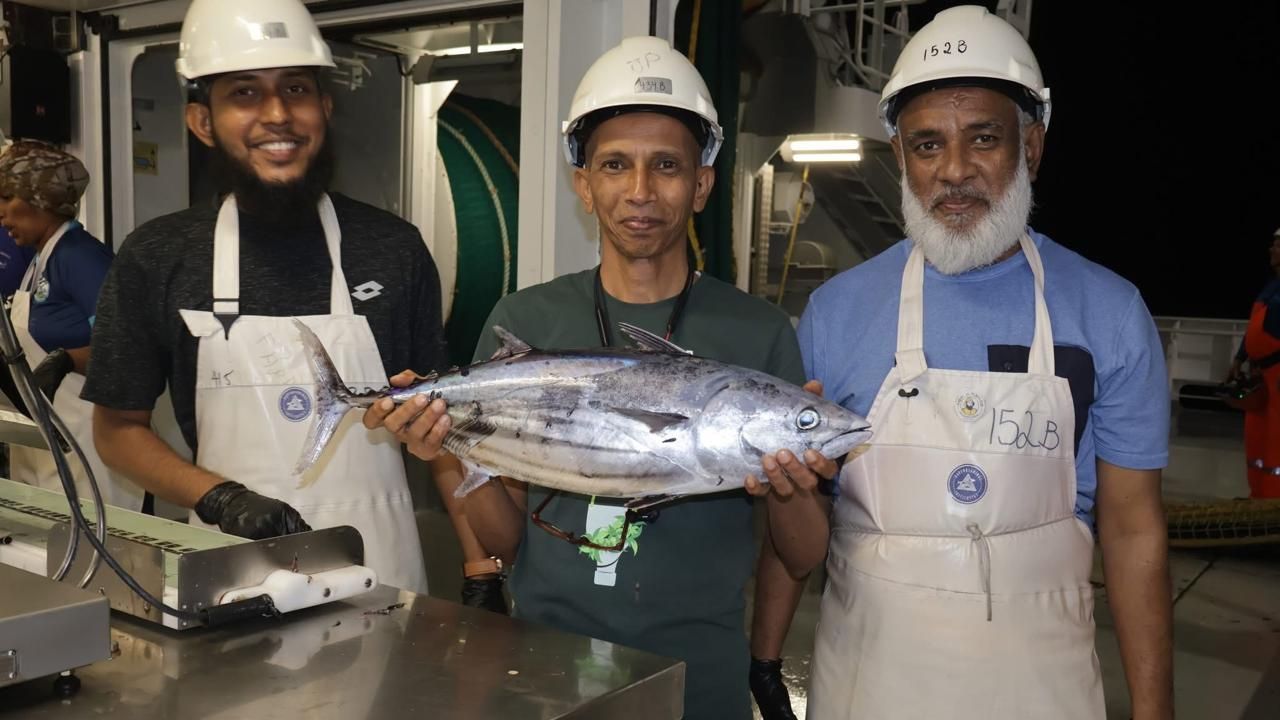

Bangladesh’s ambition to tap into deep-sea tuna remains a distant goal. After five years of a pilot project that struggled to get off the ground, officials are now seeking two more years to gather the knowledge and capacity they say are still missing.
The Department of Fisheries has asked for an extension of its Tk61.06 crore pilot, Exploring Tuna and Pelagic Fishes from the Deep Sea in the Bay of Bengal.
Launched in 2020 and revised twice, the project is now proposed to continue until June 2027. Its aim is to move beyond shallow coastal fishing and test the country’s ability to harvest tuna and other pelagic species from deeper waters and nearby high seas.
Progress, however, has been slow. Procurement of longline vessels stalled, training plans fell behind schedule, and the research surveys essential to determine tuna stock have yet to be completed.

“The vessel planned for purchase under the tuna pilot project proved too costly, so we now aim to rent one or two for a year,” said Project Director Dr Md Zubaidul Alam.
He explained that the surveys and stock assessments must be carried out before domestic companies are authorised to land tuna. The project director estimated the additional cost of the extension would be around Tk 55 crore.




Officials argue that further seasons of data collection are critical. Bangladesh, a member of the Indian Ocean Tuna Commission (IOTC) since 2015, is obliged to submit scientifically credible data on tuna stocks, abundance, and bycatch. Without this, commercial operations cannot move forward.
Bangladesh is already the world’s 11th largest marine fish producer, harvesting around 700,000 tons annually, most of it from shallow waters. Policymakers hope that deep-sea fishing could raise the industrial catch from 95,000 to more than 500,000 tons, contributing more to GDP.
Since 2018, 34 local entities, including the Navy, have received licences for tuna and pelagic fishing. Yet the effort has remained largely symbolic. Weak stock assessments, limited investment, and lack of expertise have kept Bangladeshi vessels from competing with neighbours like India and Sri Lanka, which have developed profitable tuna export industries.
The potential, however, remains significant. Deep-sea fishing is seen as a priority under the government’s Vision 2041 and as a contribution to Sustainable Development Goal 14 on the conservation and sustainable use of oceans.
Entrepreneurs remain cautious. Mohammad Shahjalal, Secretary General of the Bangladesh Marine Fisheries Association and head of Blue Harbor Fishing Limited, said the risks are high.
“Advanced, costly vessels are required, but investors are unwilling to take on this risk until proper stock assessments confirm the potential for a profitable return,” he said.
The hesitation contrasts with the performance of neighbouring countries. In 2023, Sri Lanka earned $42.1 million from yellowfin tuna exports, while India’s tuna exports grew by 32 percent to $88 million.
Bangladesh, despite its long coastline and large Exclusive Economic Zone, has yet to prepare itself for the same waters.