Bangladesh’s spinning industry is facing an “existential crisis” due to foreign yarn dumping, soaring production costs and growing global competition, according to industry people.
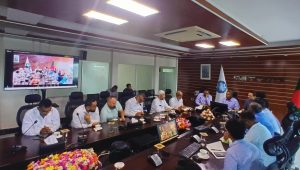
So, the government should immediately introduce protective measures to save the sector from further collapse, they urged while speaking at a press briefing at the Jatiya Press Club in Dhaka on Thursday.
The spinning mill owners also outlined the severity of the crisis and demanded a set of policy interventions, including the imposition of anti-dumping tax and safeguard duty on yarn imports.
Engineer Azhar Ali, chief operating officer of Salma Group, said many countries are exporting yarn at artificially low prices because of government subsidies.
“As a result, locally produced yarn is losing competitiveness. Yarn is being imported at prices lower than our production cost, which amounts to dumping,” he said.

“To protect local mills and ensure fair competition, imposing anti-dumping duties or safeguard duties on yarn imports has become essential,” he added.
Citing the dire situation of the industry, Azhar said nearly 40 percent of spinning mills have shut down operations in recent years due to the post-pandemic slowdown, the Ukraine war, dollar shortages and repeated hikes in fuel and electricity prices.




“Around 100,000 workers have already lost their jobs. The mills that are still running are operating at only 50–60 percent capacity,” he said.
Ruhul Amin, executive director of Greentex Composite Mills Ltd and chair of the event, warned that dumping is rapidly shrinking the market for locally produced yarn.
During the briefing, spinning mill owners placed several specific demands.
They proposed a 10 percent incentive for exporters who use locally produced yarn, alongside a 10 percent safeguard duty on yarn imports to protect domestic producers.
Azhar Ali also highlighted the burden of rising production costs.
“Gas and electricity prices have increased by 350 percent over three consecutive rounds, but prices of textile and backward linkage products have not been adjusted. This has pushed many mills into losses,” he said.
He called for a 30 percent bill rebate and a two-year emergency incentive package for export-oriented factories.
To restore the sector’s competitiveness, industry leaders also urged policymakers to reinstate the discontinued Export Development Fund (EDF) facility for the next two years, raise mandatory local raw material use to 70 percent after LDC graduation, offer an additional 5 percent incentive for recycled and sustainable products, and introduce a special 10-year loan package at 5 percent interest for modern machinery installation.
They also demanded measures to restore import capacity, which has weakened due to the depreciation of the taka.
Among others, Shahinul Haque, director (operations) of Mosharraf Composite Group; Abul Kalam Azad, director of Armada Group; Shantimoy Dutta, adviser to Ahmed Group; and ABM Sirajul Islam, director of Jamuna Group, spoke at the event.