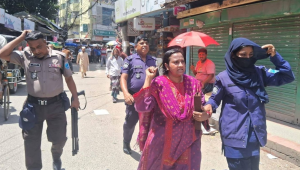
“Political interference still plagues police,” ran a front-page article in a fairly recent issue of the Times of Bangladesh. And therein lies a loaded commentary on the state of politics in a Bangladesh that has turned the reasonably mature age of 50-plus. But this piece is not about the article per se, but rather of the loaded headline, particularly when viewed in light of the accompanying page headline, “Promotion, posting, chaos fuels rift, ruins policing.” The task of maintaining law and order all across Bangladesh on any given day is, for the police force in general, a trying assignment on any given day.
Given the nature of their mission on a day-to-day basis, the police in any country requires a load of mental and physical support from the government and the public in general to be able to carry out their duties in a cool-headed manner. Keeping law and order on any given day can be stressful for mind and body without having to go through undue political interference and in-house turmoil. A disciplined, dedicated police force is the first line of defence on a daily basis against chaos, disorder, lawlessness, and negative activities on a daily basis. At least, those are the general areas of human activity that impede the life, liberty, and the pursuit of happiness by the general populace.
A cursory look at recent happenings in the United Kingdom, which boasts one of the most efficient police forces in the world, will show that the organisation has been complaining of certain grievances to themselves and to the general public; and both opposition politicians and members of the force have been grumbling about their lot and working conditions. Now it is up to the elected government to address their grievances. The outcome of these grievances versus genuine public complaints relating to law-and-order situation is expected to bring about positive outcomes relating to both the public and the government.

The United States’ law-and-order situation has been complicated by President Trump’s interference in the working of the law-and-order forces that have called into question, from various quarters of the political arms of the government and, even worse, from the opposition, that are likely to ask pertinent questions of the age-old democratic polity of the United States. The point being made is that even a pioneer of representative democracy, the US, may be saddled with political anomalies.
And Bangladesh is a relatively nascent democracy that is still powering its way through the intricacies of the democratic political system (at least on paper), and also in practice, even if falteringly. Not too surprisingly, caught in the doldrums of regime changes over the years, the police forces at different levels, including the seniors, have faced challenging situations of myriad kinds, which affect the chain of command that invariably has a negative effect on the morale and, consequently, the efficiency of the force, when the crying need is for a disciplined, efficient police organisation as a body of trained officers, entrusted by a government with the maintenance of public peace and order, enforcement of laws, and prevention and detection of crime, as succinctly described in an Internet explanation.




According to the assessment by the Daily Times of Bangladesh, three key issues being the efficient working of the key elements in good governance. The first is a replay of the national scenario which has existed for a long time: factional rivalry weakens the chain of command so BNP, Jamaat loyalists vie for power; nothing much of a surprise here since the goal of these parties is to be in administrative power. The second deals with a potentially disturbing issue: national polls at some future date. Senior officers undergoing resentment may cripple policing ahead of national polls. Finally, and this could be the key factor among the three, commotion over OC postings split police association into rival factions.
Just wonder: unless the three issues are sorted out to the general satisfaction of the potentially affected officials, the upcoming polls (whenever they are held) will be contested partly because the key officials in charge of security may not be able, or choosing not to do so, to deliver satisfactory law and order. And that is a situation that Bangladesh does not need or want.
It would be a travesty of good governance and the very functioning of liberal democracy. Surely Bangladesh could do without such a pathetic conundrum.
The writer is an MALD (Fletcher School of Law and Diplomacy) and PhD (Boston University)