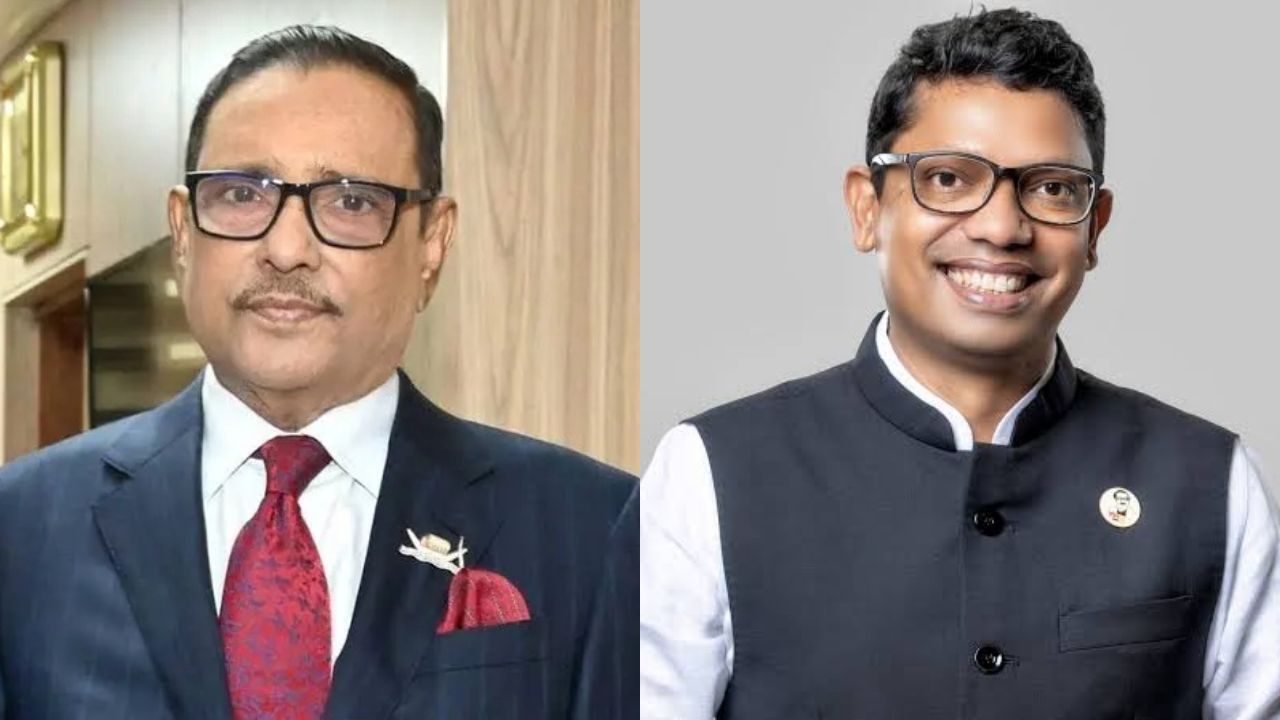



The prosecution has presented a fresh call record before the International Crimes Tribunal-2 (ICT-2) involving Obaidul Quader, general secretary of the now-restricted Awami League, and seven others in a case concerning crimes against humanity during July mass uprising.
The recording reveals that Quader instructed Zunaid Ahmed Palak, the then state minister for iInformation and communication technology, to reduce internet speeds, while Palak insisted on obtaining permission from the then prime minister Sheikh Hasina.
Arguments were placed on Sunday, the third day of proceedings, by Prosecutor Gazi MH Tamim, supported by prosecutors Faruque Ahammed, Shahidul Islam Sarder, and Sultan Mahmud.
According to the transcript submitted to the tribunal, Quader told Palak, “Slow down the net a bit.” In response, Palak asked, “Should I take permission from netri [Sheikh Hasina]?” to which Quader replied, “Take it.”

Palak later confirmed that the action would proceed only with Hasina’s approval. The prosecution maintains this dialogue serves as critical evidence of state-mandated internet control during the movement.
Prosecutor Tamim further argued that the deposed prime minister Sheikh Hasina operated in a climate of total mistrust, using the National Telecommunication Monitoring Centre (NTMC) to monitor and record the phone calls of various individuals.
He noted that the call record between Quader and Palak is documentary evidence that the order to limit internet services was issued on 16 July 2024 and subsequently implemented by Palak following Hasina’s clearance.




The tribunal heard that this was not merely a verbal exchange; at 6pm on 16 July, the government issued directives to shut down 3G and 4G networks across 59 universities.
Additionally, social media platforms including Facebook, WhatsApp, and TikTok were blocked, which the prosecution labelled as part of a “system crime.” Evidence was also cited from United Nations reports indicating that injured protesters seeking hospital treatment were arrested during this period.
The prosecution further alleged that a conversation between Quader and the then Mayor of Chattogram, AJM Nasir Uddin, was immediately followed by the fatal shooting of three individuals, including Wasim, by Awami League leaders on 16 July.
Records also suggest that Sheikh Hasina, Obaidul Quader, and former Foreign Minister Hasan Mahmud discussed “tagging” protesters as terrorists, militants, BNP-Jamaat, and religious activists.
Hasan Mahmud reportedly noted that the term “militant” carries international weight and would help garner global support for the government’s stance.
A particularly inciting quote attributed to Sheikh Hasina was presented, “They have burnt many of our things. Burn all their houses. Do they have businesses? Burn those too. Now there is only one job, wait for the right time and set fire to their houses.”
Explaining how these recordings were obtained, Prosecutor Tamim told journalists that while Hasina may not have directly submitted her calls to the NTMC – then headed by Ziaul Ahsan – her conversations were captured because the individuals she spoke with were under active surveillance.
The prosecution concluded that numerous call records show Awami League leaders instructing subordinates to use lethal weapons and helicopters to fire upon protesters. Evidence was also presented showing Quader discussing with a Joint General Secretary how to fund party activists across the country to resist and attack protesters.