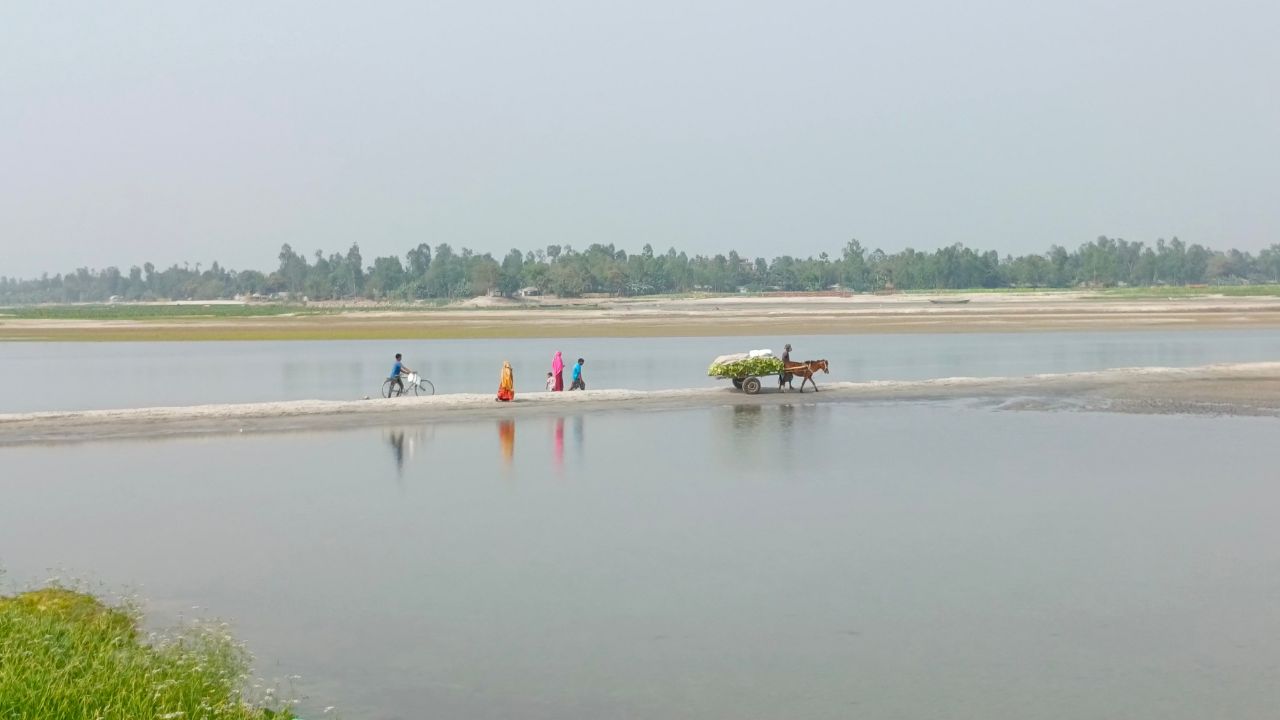



Hundreds of sandbars have emerged across the Teesta River as water flow drops sharply in the dry season, leaving farmers without irrigation and fuelling fresh demands for immediate implementation of the long-promised Teesta Master Plan.
Residents along the river say the once-mighty river has turned almost waterless, exposing more than a hundred sandbars across its bed and threatening agriculture, biodiversity and livelihoods across northern Bangladesh.
The crisis has deepened across the river’s 115-kilometre stretch inside Bangladesh, particularly in Lalmonirhat’s Hatibandha, Kaliganj, Aditmari and Sadar upazilas, where irrigation canals linked to the Teesta Barrage have largely dried up.
Officials say the water level at Dalia point in Hatibandha has fallen so sharply that canals of the irrigation project now resemble a desert.
According to Bangladesh Water Development Board officials, the river requires at least 5,000 cusecs of water during the dry season to sustain irrigation, but current flow has dropped to only 300–400 cusecs.
The shrinking river has also pushed groundwater levels down to alarming depths, leaving many shallow tube wells unable to pump water and threatening boro cultivation across the northern region, a key contributor to the country’s food supply.

The 315-kilometre river originates in India’s Sikkim, of which around 115 kilometres flow through Bangladesh, historically serving as the lifeline of the northern districts.
Under international water law, including the 1966 Helsinki Rules and the 1997 United Nations Watercourses Convention, downstream countries have equitable rights to shared rivers and upstream withdrawals should not damage downstream ecosystems.
Local residents blame India’s upstream Gazaldoba Barrage for diverting most of the water during the dry season, leaving Bangladesh’s northern region to bear the consequences.




They say the riverbed has filled with sediment, causing the river to spread three to five kilometres wide during the monsoon when excess water is suddenly released from upstream, triggering floods and severe erosion.
Khuniagachh Union resident Mohsin Ali, in his sixties, said he had lost his home to the river 11 times and now survives by sharecropping on other people’s land.
“We heard promises of the Teesta Master Plan during previous governments and again before the last election. We voted, now we want to see the work,” he said.
Safia Khatun, 45, from the same area said residents do not need relief assistance but want the river project implemented so they can survive.
Char Harinchhara resident Chabed Ali said the river holds so little water that people now cross it on foot and the remaining water cannot be used for irrigation.
In Hatibandha’s Goddimari char, Rabiu Hossein said he lost 14 acres of land to erosion over the past five years and rebuilt his home on a sandbar.
“Leaders come during elections promising river control projects, but when the river takes our homes, everyone stays silent,” he said.
Residents are demanding urgent river dredging, implementation of the Teesta Master Plan and efforts to secure Bangladesh’s fair share of water from India.
Teesta Bachao Nodi Bachao Sangram Parishad Lalmonirhat President Bir Muktijoddha Shafiqul Islam Kanu said three governments had changed but the suffering of Teesta-side residents remained the same.
“Candidates make promises before every election. The time has come to implement them and end the suffering of the people along the Teesta,” he said.
Bangladesh Water Development Board Lalmonirhat Executive Engineer Sunil Kumar Roy said sediment accumulation had raised the riverbed by about two to three metres over the past decade, making the river prone to sudden flooding during the monsoon.
He said the Teesta master plan could restore the river’s navigability and significantly improve the region’s economy if implemented.
Disaster Management and Relief Minister Asadul Habib Dulu, who also leads the Teesta River Protection Movement, said during a recent visit to Lalmonirhat that the government had begun discussions on the issue with the Ministry of Water Resources.
“The aspirations of nearly 20 million people in northern Bangladesh are linked to the Teesta. Work is under way to address this demand,” he said.