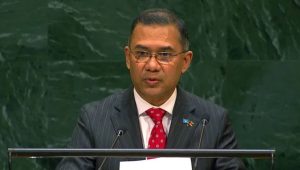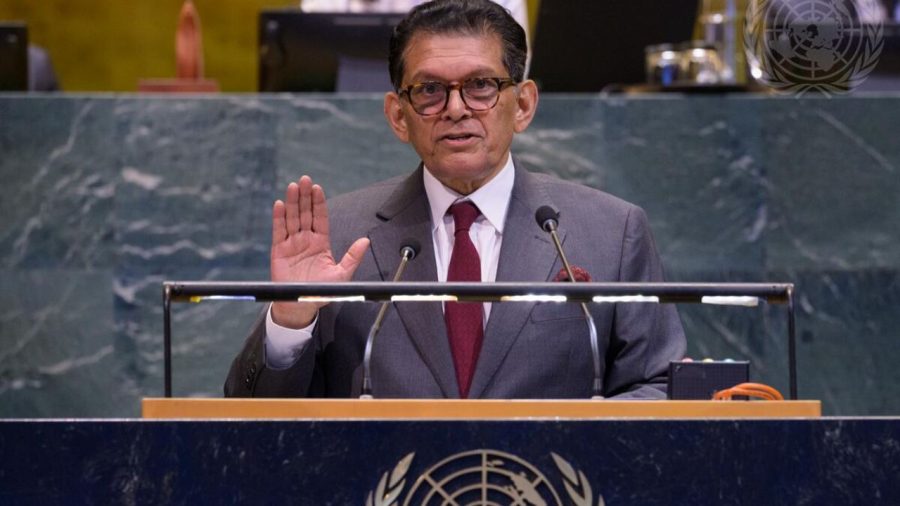

President of the UN General Assembly’s 81st session Khalilur Rahman has described the Rohingya crisis as a “grave human crisis” and said violence will not solve any problem.
“The lesson I carry is this: violence will not solve any problem. It will only defer it and make it worse. Only through talks and negotiation, only by coming together, we can resolve these issues,” he said.
The UNGA President said it is a grave human crisis – a population attacked, their homes bombed, their villages burned, chased out by their own country’s people while pregnant mothers’ abdomens cut open and the fetuses thrown into fire.
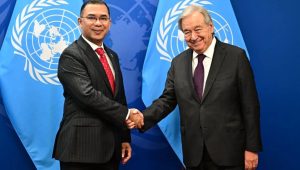
“But I also saw their resilience, their ability to survive and their yearning to go home. When the Secretary-General visited Cox’s Bazar last year, more than 100,000 refugees gathered on a Ramadan evening to share breakfast with him, each holding a placard reading: we want to go home,” Khalilur said.
“That’s why I see such value in the assembly – a place where people gather at the highest levels, in a safe environment, to work out the best way forward,” he said.
As high-level week gets underway – the busiest week of the UN calendar, the largest gathering of world leaders in one place anywhere on the planet – Rahman sat down with UN News recently to discuss what a “much needed transformation” would actually look like, why he believes artificial intelligence poses a test unlike anything the UN has faced before and what lessons from his work on the Rohingya crisis he is carrying into the role.
Bangladesh is hosting over 1.3 million Rohingyas in Cox’s Bazar and Bhasan Char Island, a senior official told UNB, noting that Prime Minister Tarique Rahman, during his General Assembly address, will seek to draw renewed international attention to the protracted Rohingya crisis and mobilise stronger global cooperation towards its resolution.

He is scheduled to attend a Bangladesh-hosted side event on the Rohingya issue on 23 September where he will seek effective international cooperation for the earliest possible repatriation of the forcibly displaced Rohingyas to Myanmar.
Foreign Secretary Asad Alam Siam on Sunday described the Rohingya issue as an “ongoing problem” and said Bangladesh would once again use the gathering of world leaders to highlight its magnitude and the challenges it poses.
“We will once again present to the global community the magnitude of the Rohingya issue, the challenges it poses and the international cooperation, assistance and support Bangladesh requires,” Siam said.
Bangladesh has repeatedly maintained that the safe, voluntary, dignified and sustainable return of the Rohingyas to Myanmar is the only viable and lasting solution to the crisis.
The UNGA President addressed critics who argue the assembly is toothless compared with a gridlocked Security Council, and reflected on the moment, more than four decades after serving his own foreign minister during a previous Bangladeshi presidency of the assembly, that brought him back to lead it himself.



He took the gavel as President of the UN General Assembly’s 81st session amid what he calls a crisis of confidence in the organisation he has served – in one capacity or another – for 35 years.
The top Bangladeshi diplomat and sitting foreign minister has staked his one-year presidency on a single ambition: restoring trust.
It’s a theme he returns to often, tracing it back to the optimism of the UN’s founding in 1945 and the gap between what Member States expected then and what the organization has delivered since.
United Nations General Assembly high-level week provides a unique opportunity to hear directly from world leaders about how they see the world, their regions and their own countries, and what they expect from the United Nations, said UN General Assembly President Khalilur.
“One of the things I’m looking for most closely is what they say about reviving trust in the organisation,” he said, describing it as the highlight of his presidency. “I’ve made it my own theme, and I want to draw on their views as a guide for my work on this agenda,” he said.
Reflecting on the creation of the United Nations in 1945, Khalilur recalled the meeting in Yalta where US President Franklin D Roosevelt, Soviet leader Joseph Stalin and British Prime Minister Winston Churchill met for about eight days.
Alongside arrangements for ending the Second World War, they conceived of a world organisation whose primary purpose was to prevent a repeat of the conflicts seen in the two world wars, he said.
“When the UN was formally created in San Francisco, delegations gave it a standing ovation and kept standing for a while. That represented the aspiration that the UN would be able to give peace,” he said.
He said the world has avoided a large-scale global conflagration in the eight decades since the UN’s creation.
“And I’m happy to say that in the eight decades since, we’ve avoided a large-scale global conflagration,” he said.
Countries that were not at the table at the time of the UN’s creation have since emerged from colonial rule and built a robust development pillar within the UN, Khalilur said.
“At the same time, we haven’t prevented many conflicts, and progress on development has often been sluggish,” he said.
“We have to work hard to ensure that the Security Council works more coherently and delivers as it was expected to,” he added.
Khalilur said both the peace and development pillars carry major unmet expectations, which has contributed to frustration and a sense that the UN is not doing what people expected of it.
“That has fed declining trust,” he said. Khalilur also highlighted human rights as the UN’s third pillar.
“I should also mention human rights, our third pillar: we spend only four per cent of our total spending on it. We’ve made major strides, but much remains to be done,” he said.
“We have to work hard along all three pillars to bring back the confidence the organization had at its creation. It’s a major challenge, and it will require all member states and stakeholders to work together,” Rahman said.