The existing Disaster Management Act and standing orders do not clearly define the role and obligations of the Ministry of Health during emergencies, State Minister for Health and Family Welfare MA Muhit has said, urging for their swift review.
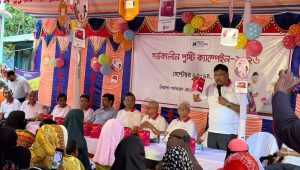
Speaking as chief guest at a roundtable titled “Disaster, Climate Change and Urban Health” at a Banani hotel on Monday, the state minister warned that a major earthquake in Dhaka would not only cause massive casualties but could collapse the capital’s entire service system, describing it as the country’s “nerve centre”.
Citing the Rana Plaza tragedy, Muhit said, “Rana Plaza was just a 10-storey building. After that collapse, we witnessed over 1,000 deaths and 2,500 injuries.”
“God forbid, if 100 or 200 buildings collapse in a densely populated mega city like Dhaka, it is difficult to even imagine the catastrophic situation,” he added.

He noted that hospitals could collapse, power and water systems could fail, and blocked communication systems would make emergency rescue and medical care extremely difficult.
Emphasising the need to remove legal ambiguities regarding disaster responsibilities, the state minister said, “Our disaster law needs to be reviewed.”



“If lawyers, public health experts, and engineers working in this sector formulate specific recommendations to update the law, the government will take swift initiative to implement it,” he added.
He also stressed the need for an integrated action plan among the Disaster Management, Social Welfare, and Health ministries for long-term post-emergency rehabilitation.
Muhit noted that in any disaster, people are not only physically injured but also mentally devastated, and even rescue volunteers suffer severe psychological trauma.
“Psychosocial counselling is often neglected in our overall planning, and it is essential to incorporate it,” he said.
He emphasised forming a “Volunteer Force” by engaging hundreds of thousands of young people to tackle Dhaka’s earthquake risk, along with professional training.
The state minister informed that the “Institute of Disaster Management and Research” was launched in Gazipur just weeks ago.
Noting Bangladesh’s long experience in disaster management, he called for more field research centres in rural flood-prone areas, saying Bangladesh could become an international “hub” for disaster management.
The roundtable was organised by the Bangladesh Urban Health Network, with DAB Secretary General Zahirul Islam Shakil and UNICEF Chief of Health Malai Ahmadzai among the speakers.