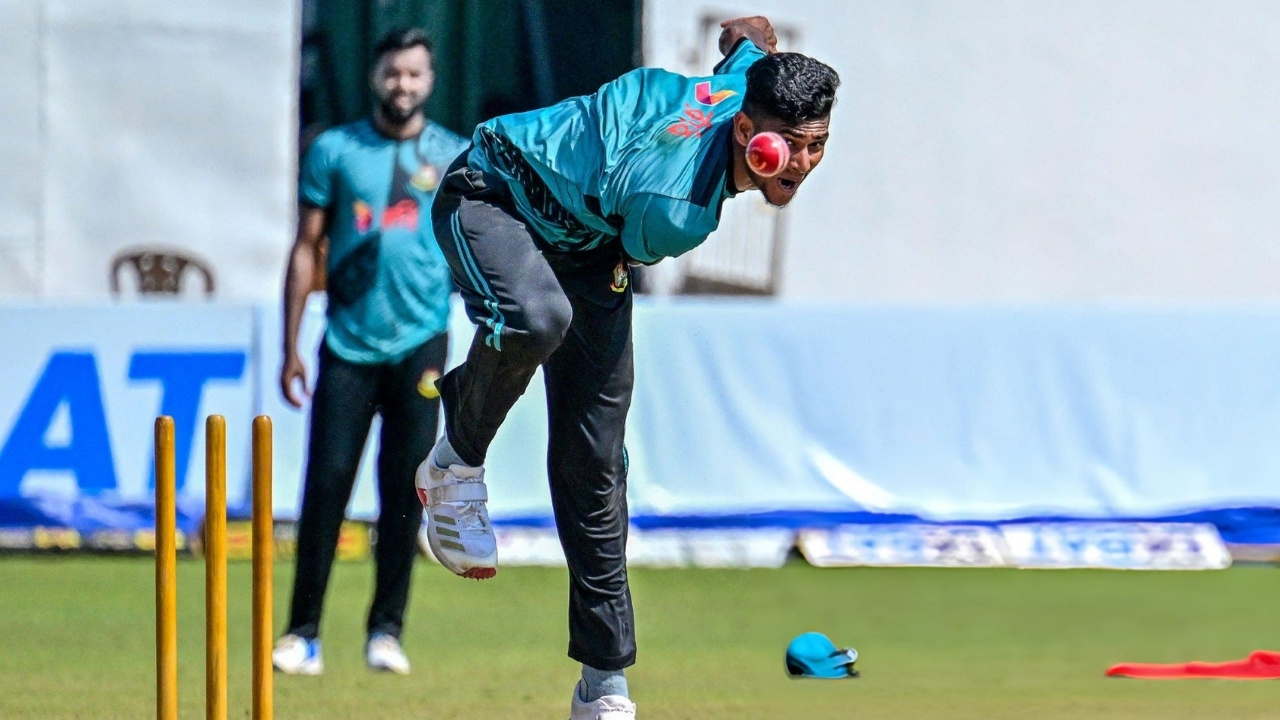



The handling of Nahid Rana’s workload management has raised questions about whether Bangladesh are repeating the mistakes that once contributed to Mashrafe Bin Mortaza’s long battle with injuries.
During Bangladesh’s tour of New Zealand in 2001, Mashrafe bowled 27 overs in the first Test in Hamilton and another 16 in the second Test in Wellington. The workload placed significant stress on his body and knee, marking the first major setback in what would become a career repeatedly disrupted by injuries.
His career was never quite the same afterwards. With workload management and support infrastructure still underdeveloped at the time, the right-arm pacer endured years of pain, setbacks and surgeries. Yet he repeatedly fought his way back and went on to become one of Bangladesh’s greatest cricketers.
More than two decades later, the same questions have been raised about Nahid Rana after the 23-year-old pace sensation was ruled out of Bangladesh’s two-Test series against Australia. Rana suffered a Grade 2 side strain during the T20I series in Zimbabwe, ruling him out of Bangladesh’s first bilateral series in Australia in 23 years.
The injury has prompted questions over whether Rana’s wordload has been managed properly and whether Bangladesh are once again risking a rare fast-bowling talent through overuse. Like Mashrafe, Rana is a frontline pacer capable of bowling at extreme pace, and there has been a similar desperation to keep him on the field.
According to a team management source, senior BCB officials were keen for Bangladesh to salvage the T20I series in Zimbabwe after back-to-back series defeats. Rana was therefore included in the first two matches despite the upcoming Australia tour.

“We did not bring him in simply for game time. The situation demanded it because we were losing,” the source told TIMES of Bangladesh.
Rana had been in the spotlight since the Australia itinerary was announced. Australian media had also built up the young pacer, who is currently the leading wicket-taker in international cricket across formats this year. With the spicy pitches expected in Darwin and Mackay, his raw pace could have posed a serious challenge to the Australian batters.
The question now is whether Rana has been overused despite efforts to manage his workload. He has already played the second-most international matches among Bangladeshi bowlers this year. In 16 matches, he has taken 44 wickets, the most by any bowler in international cricket across formats during the period.




A former Bangladesh pacer who was Mashrafe’s contemporary and has also worked closely with Rana believes the youngster has been overused.
Asked whether Rana’s handling brought back memories of Mashrafe’s injury ordeal, the former pacer told TIMES on condition of anonymity,“When someone is special, his treatment should also be special, and so should the way he is handled. We have definitely overplayed him. There is no doubt about that. And I believe that with the training method we have, the way we train him, there are issues.”
He also stressed that Rana’s ability to bowl at close to 150kph requires a specialised approach. “We have to acknowledge that Nahid Rana is special. Producing that kind of pace, close to 150 kilometres per hour, is no joke. There is a lot of specialised muscle work behind it. There is also a vast and mysterious world of biomechanics involved,” the former pacer added.
A bowling coach working under the BCB also believes Rana requires a specialised programme. “Only a few people in the world can bowl that fast. What Nahid has done is special. So, his treatment and practice plan need to be special as well. Alongside the practice plan, the nurturing process is also extremely important,” the coach said.
Rana has taken most of his wickets this year with short-of-a-length deliveries, meaning the same muscle groups are repeatedly placed under significant stress.
The bowling coach further said. “When he sees that he is succeeding with short-of-a-length deliveries, he will naturally continue to use them. If the muscles involved in delivering those balls do not receive proper recovery and treatment, or if the people responsible for his care do not look after him properly and simply send him back out there, then these problems will keep happening,”
He urged the team management to be particularly careful with Rana because of the rarity of his skill.
“It is an extremely unique phenomenon. Someone working with that kind of unique power has to be handled very sensitively. If things become a little disorganised, that is not unusual. But the management has to be extremely careful with him.”
Rana’s absence will be a major blow to Bangladesh in Australia, but Mashrafe’s former teammate believes it will also be a significant personal loss for the youngster.
“Imagine a player being sidelined for eight weeks. Proving yourself in a place like Australia means proving yourself against the very best. I believe more players should be eager to take on that challenge and test themselves against the best,” he said.
Former Bangladesh captain Raqibul Hasan also expressed his frustration over Rana’s injury and its management.
“I think it is bad luck for us that this has happened to Rana. The doctors have examined the injury and everything else. Missing one series should not define Nahid Rana. He is currently one of the best fast bowlers in the world and will continue to be one. So why should we use him carelessly, bring him back when he is only half-fit and put him straight back into the team?”, he told TIMES.
Asked whether Rana’s injury and its management brought back memories of Mashrafe, Raqibul said: “Players sometimes insist on playing. During Mashrafe’s career, he underwent six knee surgeries and even played with his knees heavily strapped. I have never seen anyone in any country play cricket that way. It was the result of both Bangladesh cricket management’s decisions and Mashrafe’s own insistence on playing.”
The BCB said Rana is expected to require approximately four weeks for tissue healing, followed by a further two to four weeks of gradual bowling workload progression. His overall recovery period is estimated at six to eight weeks from the date of injury.