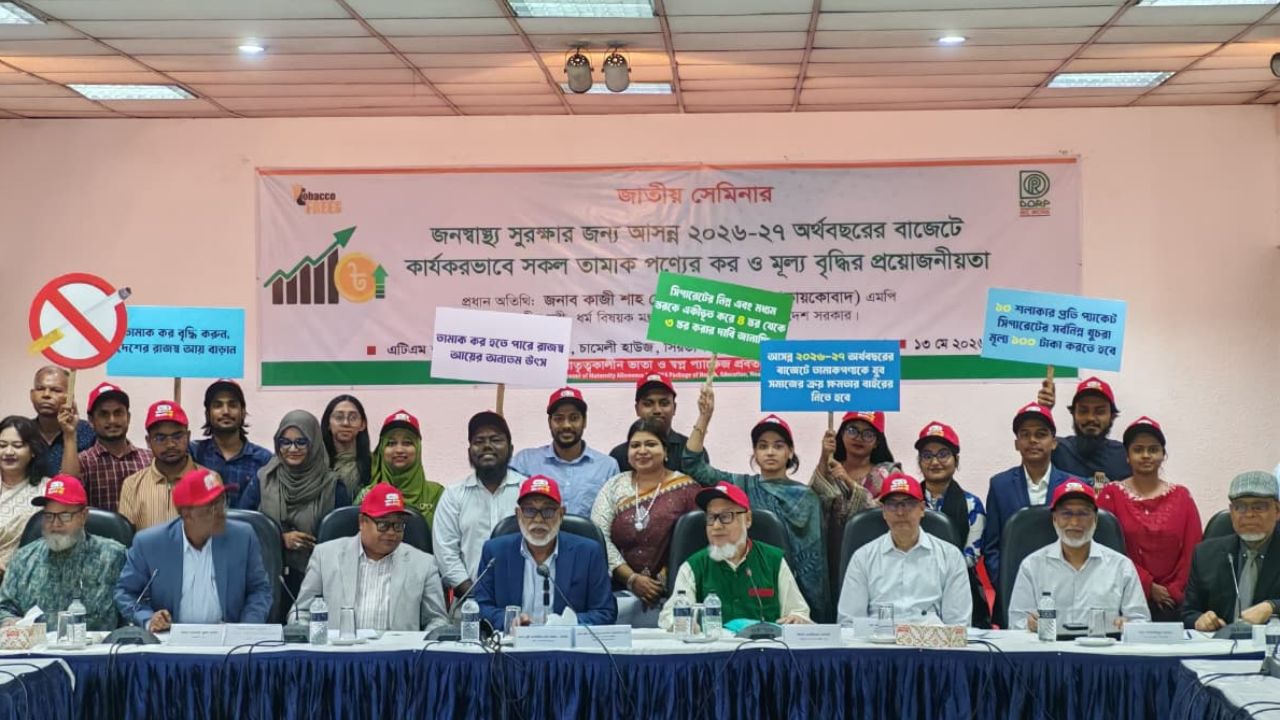

A national seminar has called for an effective increase in taxes and prices on all tobacco products in the upcoming national budget for the 2026–27 fiscal year to safeguard public health.
Organised by the Development Organisation of the Rural Poor (DORP), the event titled “The Necessity of Effectively Increasing Taxes and Prices on All Tobacco Products in the Upcoming FY 2026–27 Budget for Protecting Public Health” was held on Wednesday morning at CIRDAP Auditorium in the capital.
Addressing the seminar as chief guest, Munshi Alauddin Al Azad, secretary of Ministry of Religious Affairs, said tobacco products in Bangladesh remain significantly cheaper than essential commodities.
Citing data from the Department of Agricultural Marketing, he noted that while prices of essential goods such as sugar, potatoes, flour, eggs, and soybean oil rose by 27 to 89 percent between 2021 and 2023, cigarette prices increased by only 6 to 15 percent. This accessibility to youth and low-income populations has led to an alarming rise in smoking rates.

He emphasised that tobacco prices must increase at a rate higher than inflation and income growth to mitigate these public health risks.
Nahid Nowshad Mukul, first secretary (VAT Monitoring and IT) of National Board of Revenue, attended as a special guest and revealed that the current tobacco tax structure is costing the government an additional Tk44,000 crore annual revenue.



He highlighted that these funds could significantly bolster the education, healthcare, and social protection sectors, describing effective taxation as a powerful tool to reduce smoking while increasing government revenue.
Presenting the keynote paper, Shafiun Nahin Shimul, director of the Institute of Health Economics at the University of Dhaka, pointed out that nearly 90 percent of cigarettes sold in Bangladesh belong to the low and medium tiers of the current four-tier pricing system.
To counter the rapid addiction of young people, he proposed merging the low and medium tiers in the upcoming fiscal year.
The proposal includes setting minimum retail prices at Tk100 per 10-stick pack for the merged tier, Tk150 for the high tier, and Tk200 for the premium tier, while maintaining a 67 percent supplementary duty and adding a specific tax of Tk4 per pack. Such measures could discourage over 372,000 youths from smoking and prevent more than 185,000 premature deaths in the long term.
Md Akhtaruzzaman, director general of National Tobacco Control Cell, noted that Bangladesh has the highest tobacco use rate in South Asia at 35.3 per cent, with approximately 200,000 people dying prematurely every year from related diseases. In 2024, the economic and environmental damage caused by tobacco reached nearly Tk87,000 crore – more than double the revenue generated by the sector.
He cited successful international models, such as the Philippines’ Sin Tax Reform, which saw a 28.1 percent decline in cigarette sales and a tripling of tax revenue, and South Africa, where revenue increased ninefold following strengthened policies.
The welcome speech was delivered by AHM Noman, founder and CEO of DORP, while the session was moderated by Mohammad Jobayer Hasan. Concluding remarks were provided by Mohammad Nurul Amin. Other distinguished guests included Md Mostafizur Rahman, former chairman of BCIC, and Jeba Afroza.