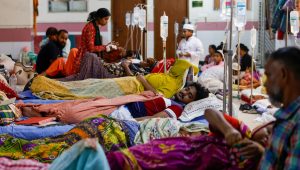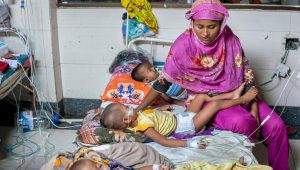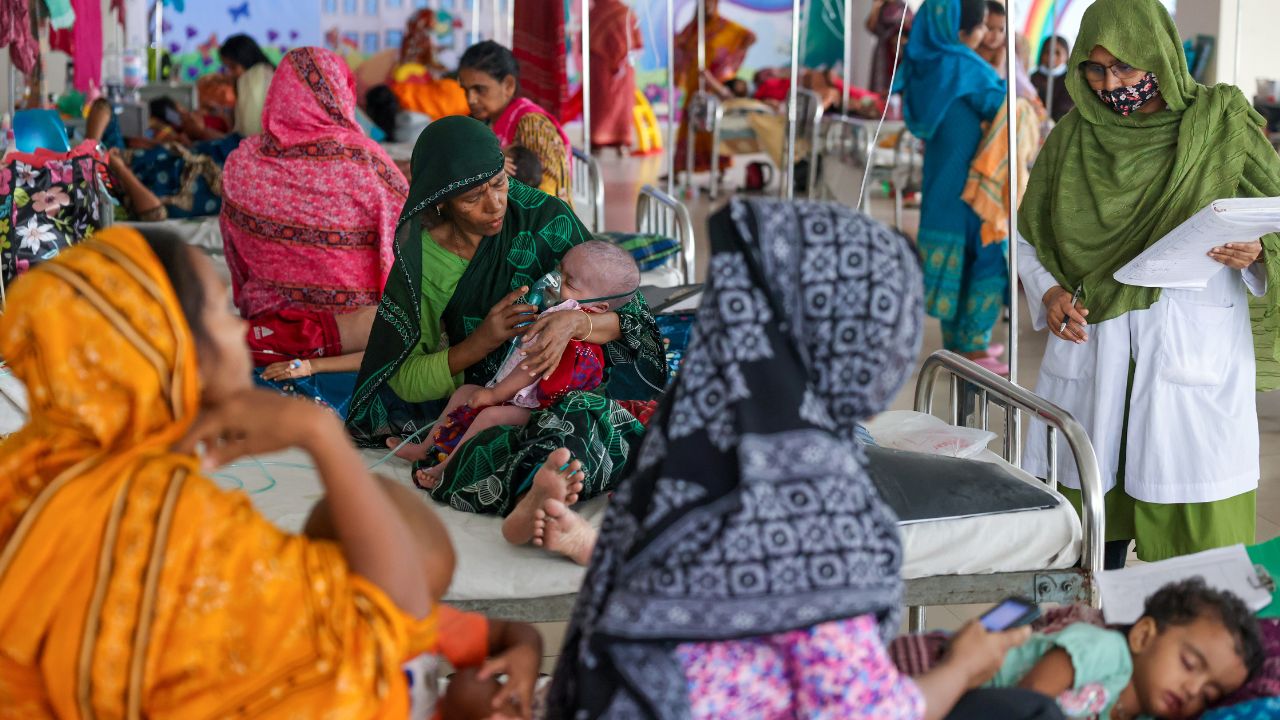


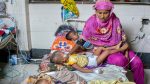
In one corner of the medicine ward at the second building of Sir Salimullah Medical College Mitford Hospital, lies six-year-old Aman. There is the familiar, strong smell of disinfectant that marks every government hospital. His small chest rises and falls rapidly, as though every breath demands a battle from his little body.
The sound of the nebulizer shakes the transparent plastic mask fixed over his face.
Sitting by his head, Aman’s mother speaks with anxiety in her voice: “Never thought I’d have to see him like this. He’s our beloved boy.” Meanwhile, Aman’s father rushes back and forth, sometimes looking for a nurse, sometimes running to the doctor’s chamber.
Aman’s story represents the reality for countless children across Bangladesh. According to the World Health Organization, pneumonia remains the leading infectious cause of death among young children. Every year, around 2.1 million people die of the disease worldwide, more than half of them children.
According to research by icddr,b, around 677,000 children in Bangladesh are hospitalised with pneumonia every year, and about 24,000 of them die from the disease. Pneumonia accounts for 24% of all deaths among children under five in the country — a rate higher than the global average.

For the past five years, the under-five mortality rate has remained stagnant at 7.4 per 1,000 live births.
The direct causes are poverty, overcrowding, and lack of hygiene. Indirectly, the very living conditions of children are also to blame as revealed by a 2025 study published in the ‘East West Medical College Journal’.
Explaining this situation, Dr Shafiun Nahin Shimul, Professor and Director at the Institute of Health Economics, University of Dhaka, observes that pneumonia among children in poor families is deeply linked to poverty-induced malnutrition and unhealthy environments. In his words, “It’s a vicious cycle. From poverty comes disease, and from disease comes more poverty.”

He further notes that due to the limited dietary diversity among low-income families, children’s immune systems become weak, making them more vulnerable to infections, especially respiratory ones.
The influence of living conditions on pneumonia risk is even clearer in a recent study published in the Journal of Teachers Association. It states, “Children of families living crowded together in small rooms, where cooking smoke fills the air or where ventilation is poor, face a significantly higher risk of pneumonia. In other words, the home environment itself makes them sick.”
These impoverished populations often live in densely populated, unsanitary areas where infections spread easily. At the same time, they tend to delay seeking medical help, which worsens the illness and leads to long-term financial loss.
With the arrival of winter, the risk of pneumonia increases further. In densely populated areas like Dhaka, people tend to keep windows and doors closed during cold weather, reducing air circulation and allowing infections to spread more easily. When families crowd together in small rooms, a simple cold or cough from one person can quickly spread to others.
Moreover, low-income families often cannot afford warm clothing, nutritious food, or adequate heating to keep their homes warm. In such cold and damp conditions, children’s immune systems become weaker. According to public health experts, winter also brings increased levels of smoke and dust particles, which inflame the respiratory tract and accelerate the spread of pneumonia.
On treatment costs, Dr Shimul told TIMES of Bangladesh, “Because their income is low, spending on treatment becomes a heavy burden. A large portion of their earnings must go toward healthcare, leaving less for other essential needs.” According to him, this spending can often be “catastrophic”— pushing families even deeper into poverty.
A study conducted this year in several Dhaka slums, titled “Determinants of Care Seeking for ARI/Pneumonia-like Syndrome,” found that among children under two who showed pneumonia-like symptoms, nearly half were taken to pharmacies only. However, pharmacies cannot provide proper diagnosis or consultation. The poorer the family, the less likely they are to seek qualified medical treatment.
In this context, public health expert and adviser at the Institute of Epidemiology, Disease Control and Research (IEDCR), Dr Mohammad Mushtaq Husain told TIMES of Bangladesh, “Children naturally have weaker immune systems, which makes them more susceptible to infections.” Added to that is the problem of nutritional deficiency.
Moreover, living in polluted and overcrowded environments accelerates the spread of germs, and children’s weakened immunity further increases the risk of pneumonia.
For children in low-income or slum areas, the main problem isn’t just lack of awareness, but economic constraints. Therefore, beyond awareness, what’s needed is community support like integrating food, healthcare, and housing as core rights. Although pneumonia has been included in the Integrated Management of Childhood Illness (IMCI) programme, there are still significant obstacles to its proper implementation.
Regarding long-term solutions, Dr Husain said pneumonia prevention among children must be recognized as part of the national social protection policy. He also emphasizes the need to establish community-based medical support centres, so that parents don’t have to rush to large hospitals for every emergency.