


Political leaders on Sunday underscored urgency of giving the July Charter a legal foundation saying that adherence to constitutional processes were essential to build a democratic Bangladesh.
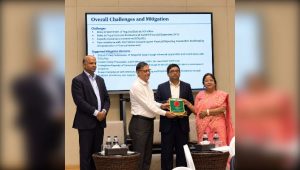
They came up with the remarks at a programme marking the fourth founding anniversary of Gono Odhikar Parishad at the Institution of Diploma Engineers in Dhaka.
At the programme, BNP Standing Committee Member Salahuddin Ahmed cautioned that all parties must remain within lawful and constitutional boundaries.
He also said the next step for the National Consensus Commission is to send recommendations to the government so that the legal framework could be drafted to make the July Charter binding on parliament.
Even though some might question whether constitutional principles had been perfectly upheld after the interim government was formed under article 106 of the constitution, legitimacy would ultimately be established through parliamentary ratification, he added.

“In Bangladesh, our constitutional tradition is that any deviation is later legitimised through parliament. That is how the system has evolved,” he said.
Salahuddin emphasised that this process must be respected to prevent future disputes or judicial questions over the legality of actions taken in the name of the July mandate.
Urging all political parties, he said, “Let us not make any proposal that may later be questioned in court or used to declare our total process illegitimate — not today, not in five, ten, or even fifteen years from now.”
“We must not step outside the legal or constitutional process,” he said, warning that emotionally driven actions or orders issued without legal basis could later be challenged in court.




BNP Standing Committee Member Amir Khosru Mahmud Chowdhury, who was also present at the programme, urged the political actors to reject confrontational and vengeful politics.
He said, “We cannot return to a culture of violence and revenge. Each party has its own vision and philosophy — if we wanted everything to be the same, we would have become one party, like BAKSAL.”
“We will go to the people with our own mandates, and through elections and parliamentary processes, the changes will come. Many of these changes will not happen overnight but will develop through public discourse,” Amir Khasru said.
Gono Odhikar Parishad President Nurul Haque Nur said that as the July Charter had already been signed, the national election should now be held as soon as possible.
“We should not wait until February – elections could even be held in January,” he said, adding that there was no alternative to maintaining unity among the July uprising stakeholders in order to build a prosperous and developed Bangladesh.
Calling Jatiya Party an associate of Awami League, activity of which is currently banned, Nur cautioned that if Jatiya Party was allowed to participate in the election, Awami League supporters could use the party’s networks in their traditional strongholds.
National Citizen Party (NCP) Member Secretary Akhter Hossen said, “We have agreed on a number of fundamental reforms, including giving the July Charter a legal basis. However, that legal certainty has still not been achieved.”
Stressing that the country’s crisis cannot be resolved without the full implementation of the July Charter, Akhter said, “If any party’s self-interest stands in the way of providing a legal basis for the July Charter, that party must be urged to move away from that stance.”
Jamaat-e-Islami Secretary General Mia Golam Parwar said, “If we remain united, no internal or external force will be able to obstruct the election or the process of building a new, democratic Bangladesh.”
He also urged all to uphold the spirit of the July uprising in the days ahead.
Ganosamhati Andolon Chief Coordinator Zonayed Saki said, “Without elections, no reform can be implemented. Blocking the electoral process will not bring good to anyone.”
BNP Joint Secretary General Shahid Uddin Chowdhury Anee, AB Party Chairman Monju, and other leaders were also present at the programme.