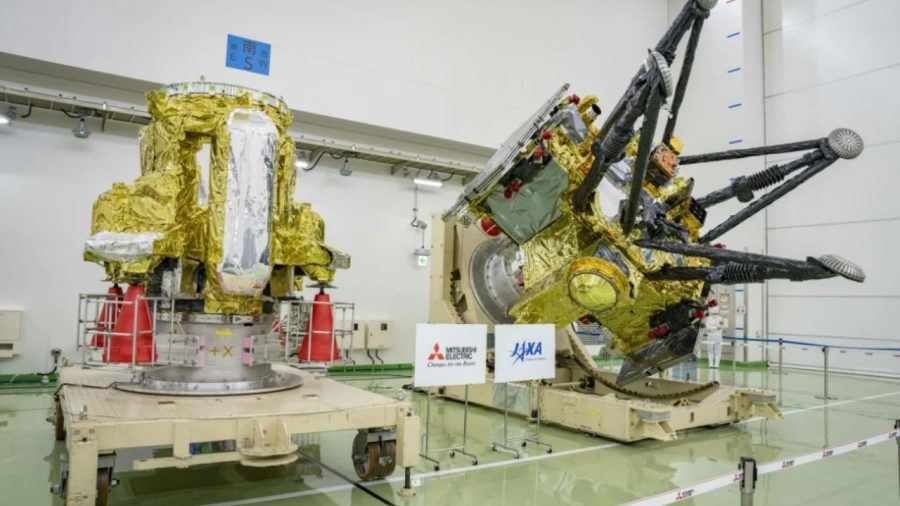



A Japanese spacecraft has embarked on a world-first mission to collect surface samples from one of Mars’s moons, in an effort that could help scientists uncover secrets about the origins of the Solar System and terrestrial life.
The unmanned Martian Moons eXploration (MMX) probe blasted off aboard Japan’s flagship H3 rocket from the Tanegashima Space Centre at 4:41am on Tuesday (1941 GMT Monday), according to a live broadcast by the Japan Aerospace Exploration Agency (JAXA), reports AFP.
More than an hour later, JAXA announced during the broadcast that the probe had successfully separated from the H3 booster and begun its journey towards the Martian system.
Following the separation, JAXA received the expected signals from the spacecraft, confirming that it was operating normally.
JAXA scientist Mari Aida expressed her joy during the live stream, saying, “I’d dreamt of this day, so I’m incredibly happy. Right now I feel really relieved.”

Despite the early hour in Japan, thousands of space enthusiasts watched the broadcast and posted messages of encouragement.
The probe is scheduled to reach the vicinity of Mars around August next year, where it will orbit the planet’s moon Phobos.
Before the landing, a French-German rover named IDEFIX, after the dog belonging to the comic book character Asterix, will become the first vehicle to traverse Phobos. It will conduct surface observations to help ensure a safe touchdown.



Once MMX reaches Phobos, it will collect at least 10 grams (0.35 ounces) of surface material during its planned three years in the vicinity of the Red Planet.
The mission aims to complete the first round trip to the Martian region. It is a joint effort involving US and European space agencies, as well as technology companies and universities.
Researchers hope the mission will lay crucial groundwork for future human exploration of Mars.
In a message broadcast during JAXA’s live stream, Nicky Fox, administrator of NASA’s Science Mission Directorate, said, “The samples from MMX will bring forth paradigm-shifting science on the Mars system for generations to come, especially as NASA prepares to send the first humans to Mars.”
JAXA hopes the mission will explain how Mars and its two moons formed, providing key insights into the origins of the Solar System.
Scientists are examining two leading theories. The “giant impact” hypothesis suggests that the moons formed when a celestial body collided with Mars, while the “capture” hypothesis proposes that they are asteroids drawn in by the planet’s gravity.
Determining which theory is correct could help scientists understand “how a habitable environment for life might have arisen on the terrestrial planets” — Mercury, Venus, Earth and Mars.
JAXA has also noted that the mission will examine whether Phobos could serve as a “natural space station” by establishing the requirements for a two-way journey, a milestone considered “essential for crewed Mars exploration”.
The spacecraft will also observe Mars’s second moon, Deimos, although it will not attempt to land there.
The launch comes as US and Chinese space agencies compete to become the first to bring Martian rock samples back to Earth.
NASA’s Perseverance rover has been collecting samples on the surface of Mars since 2021. However, the US sample-return mission was effectively cancelled by the administration of President Donald Trump following a vote by Congress in January.
Meanwhile, China’s Tianwen-3 spacecraft is scheduled to launch around 2028, with the aim of returning samples to Earth as early as 2031. It could potentially bring back samples before the Japanese mission.