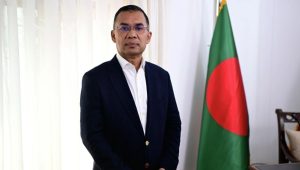
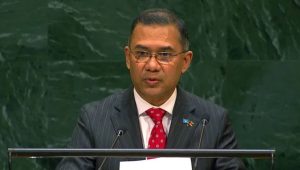
Prime Minister Tarique Rahman has urged everyone to support the establishment of a skills-oriented education system in Bangladesh.
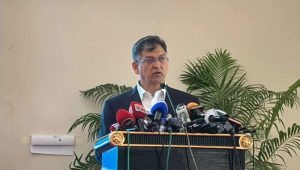
Addressing educators and students at a National University event on Sunday, he stressed that national development is a collective journey, not the work of a single individual or institution.
“The government seeks the cooperation of universities, teachers, students, parents, civil society, and the industrial sector. I firmly believe that if we work together, the progress we aspire to achieve will, God willing, remain unstoppable,” he said.
The prime minister called for an education system that goes beyond issuing certificates, one that develops skilled human resources and transforms the population into a national asset. “Education will not only produce employees but also new entrepreneurs. It will lay the foundation for economic growth and social transformation, accelerating national prosperity,” he added.
Outlining his government’s vision, he emphasised the creation of a knowledge- and skill-based society. “The core of a knowledge-based society is an environment where education, research, talent, competence, and creativity are given the highest priority,” he said.

The prime minister made these remarks while inaugurating a national training programme, titled “Inclusion of Skills-Based Education in National University Curriculum”, at the Bangladesh-China Friendship Conference Centre in the capital.
The prime minister inaugurated a teacher training programme, presenting a commemorative memento and a tree sapling as gifts. Under the initiative, 12,000 teachers across the country will be trained in practical and skills-oriented education. The programme’s theme is: “Acquire skills, work globally.”


Youth as builders of a prosperous nation
Tarique Rahman said transforming the youth into technologically and scientifically skilled human resources could make Bangladesh a prosperous, self-reliant global model. He urged students to prepare themselves to become the builders of a thriving, humane nation, stressing the importance of both technical knowledge and moral, social, and religious values.
On language education, he said proficiency in Bengali, English, and a third language would ensure employment opportunities both at home and abroad. “The government is committed to building a knowledge- and skill-based society where education, research, talent, and creativity are prioritised. With determination, God willing, we will succeed,” he said.
Turning the page on past failures
Criticising the deterioration of the education system under past authoritarian rule, the Prime Minister said, “It is now our turn to revive education in democratic Bangladesh. Recognising the vast potential before us strengthens our resolve. God willing, we will rise again.” He paid tribute to those who fought for democracy and the country’s independence, noting that a knowledge-based society is essential to honour their sacrifices.
On the role of National University
The PM said the National University plays a crucial role in expanding modern, technology-driven higher education. With over 2,000 affiliated colleges and around 4 million students, the university has already enabled more than one million students to pursue higher education since its establishment by former Prime Minister Begum Khaleda Zia in 1992.
Preparing for the AI challenge
The prime minister highlighted the Fourth Industrial Revolution and the rise of artificial intelligence, noting that traditional certificate-based education is no longer sufficient. He called for a skills-oriented, technology-driven, and practical education system incorporating AI, cyber security, forensic science, programming, digital entrepreneurship, cognitive empowerment, leadership, financial literacy, and other soft skills.
Emerging fields such as genetic engineering, biotechnology, quantum computing, industrial Internet of Things, material science, nanotechnology, 3D printing, and fifth-generation wireless technology must also be addressed.
Education reform and moral training
He said the government has already begun reforming curricula from primary to tertiary levels to make them practical, skills-based, and technology-driven. He stressed stronger links between universities and the industrial sector, including internships and industry-academia partnerships. He also highlighted the importance of ethical education, urging students to prioritise ethics, mental health, social inclusion, and environmental awareness alongside modern skills.
Addressing graduate unemployment
The PM noted that millions of students graduate annually, but many remain unemployed due to a lack of practical and technical skills. To address this, the government is expanding apprenticeships, internships, and industry-academia collaboration. Initiatives to foster entrepreneurship on campuses include seed funding and innovation grants to commercialise business ideas, allowing students to generate employment for themselves and others.
He emphasised that the success of the education system depends on teachers’ knowledge, competence, integrity, and dedication. Teachers must serve as role models and guides for social transformation.
The event was presided over by National University Vice-Chancellor Professor ASM Amanullah, with Education Minister Anm Ehsanul Haq Milan, Prime Minister’s Adviser Mahadi Amin, Education Secretary Abdul Khalek, and Pro-Vice-Chancellor Professor Md Lutfor Rahman delivering remarks.