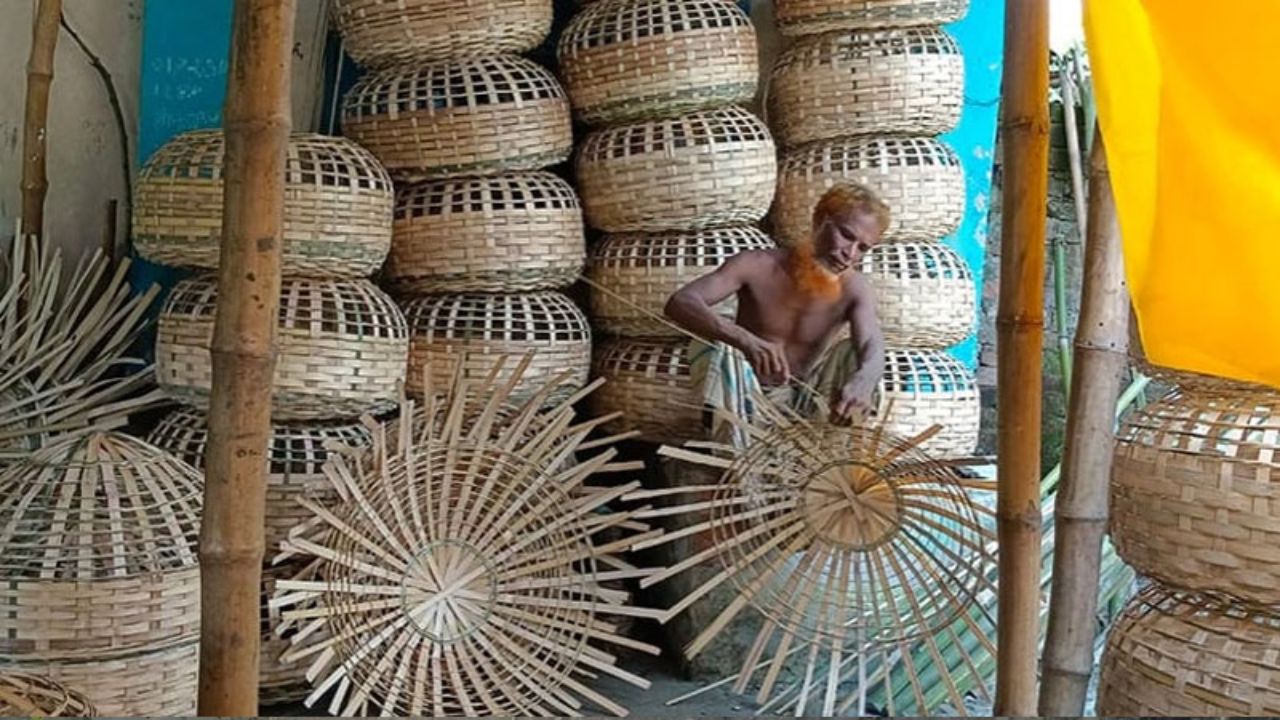



Bamboo tools such as hand fans, winnowing fans (kula), baskets, and fish traps (darki) were once an inseparable part of rural life. However, under the wave of modern touches and cheap plastic products, Dinajpur’s traditional bamboo industry is now on the brink of extinction.
Artisans say soaring bamboo prices, weak market access and poor returns have made it increasingly difficult to earn a living, leaving the district’s traditional cottage industry on the brink of extinction.
A visit to the historic Setabganj Haat in Bochaganj upazila found sales of bamboo products, including hand fans, winnowing fans, baskets and fish traps, had fallen sharply.
Craftsmen said the rising cost of bamboo, coupled with marketing challenges, meant many were unable to recover even their production costs. As a result, many have left the profession to work as day labourers or easy-bike drivers in search of more stable incomes.

Biplob Pal, who has worked as a bamboo artisan for 40 years, said families once lived comfortably from the trade, but those days are gone.
He said younger family members no longer wanted to learn the craft and were instead pursuing other occupations.
Mahesh Chandra Roy, who has spent three decades in the profession, and veteran artisan Anil Pal echoed the same concern. They said they continued making bamboo products despite minimal profits only to preserve their ancestors’ heritage.




Nikhil Sarkar, another artisan, said financial hardship had forced him to steer his eldest son towards a different profession.
Despite the challenges, some craftsmen are adapting to changing consumer tastes.
Shafiqul Islam said introducing modern designs and colourful bamboo products had helped attract younger buyers, leading to stronger sales and better profits.
Young entrepreneur Arif Hossain said the bamboo industry represented not only an important source of income but also a valuable part of Bangladesh’s cultural heritage.
He said the sector could be revived through proper planning, modern product designs and stronger government support.
Artisans and local experts called for training programmes to help craftsmen produce higher-quality products that meet modern consumer demand. They also urged the introduction of easy-term loans for marginal artisans and greater encouragement for commercial bamboo cultivation to ensure a stable supply of raw materials.
Md Jahedul Islam, deputy general manager of the Bangladesh Small and Cottage Industries Corporation (BSCIC) in Dinajpur, said modernisation was essential to keeping the industry alive.
He said BSCIC offers training programmes of at least three months to improve artisans’ skills and could help make the industry sustainable through loan support and regular monitoring.
Artisans warned that without effective government intervention and sustained support from BSCIC, Dinajpur’s traditional bamboo industry could soon disappear, taking with it a craft that has been part of the region’s rural heritage for generations.