
Ali Riaz, special assistant to the chief adviser, has stated that there is no legal obstacle preventing government employees from campaigning for ‘Yes’ vote in the upcoming referendum.
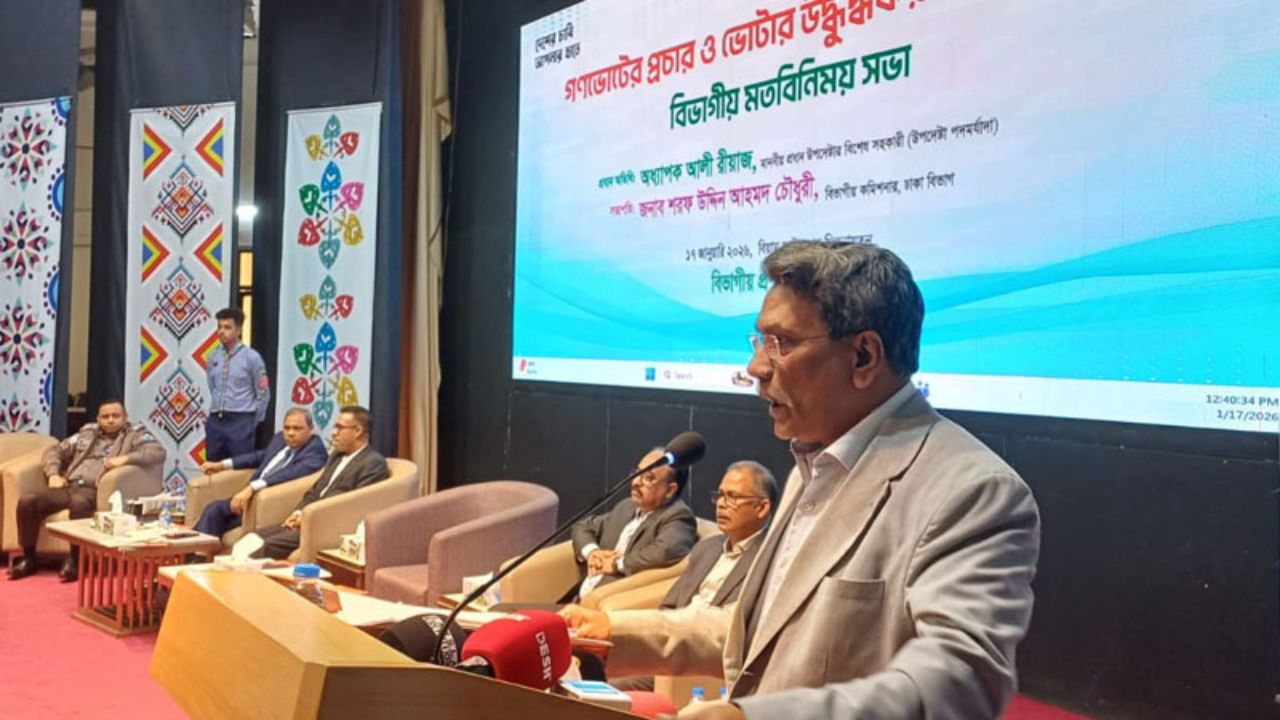
Speaking as the chief guest at a discussion on Saturday, Riaz clarified that the referendum is not an agenda to install any specific party in power or to block any party from it.
Instead, he described it as a state reconstruction agenda based on the “July National Charter” written in blood, representing the aspirations of all Bangladeshis to determine the nation’s future path.
The event, organised by the Dhaka Divisional Administration at the BIAM Foundation auditorium, was held to discuss the promotion of referendum and voter encouragement. It was chaired by Dhaka Divisional Commissioner Sharf Uddin Ahmed Choudhury.
Legal clarification and civic duty
Riaz noted that after consultations with constitutional experts, former judges, and relevant lawyers, there was a unanimous opinion that no legal prohibition exists against government employees campaigning for the “Yes” vote.

He asserted that those claiming otherwise are either spreading confusion or acting with ulterior motives.
Riaz further emphasised that the government employees are not merely officials but citizens as well.
Citing Article 21 of the Constitution, which mandates that those in the service of the republic must always strive to serve the people, Riaz argued that motivating and making people aware of their right to vote is a part of their civic duty.
Historical context and reform
Reflecting on the “individualistic autocratic system” that persisted from 2009 to 2024, Professor Riaz stated that the current interim government is working under three mandates: reform, justice, and election.




He explained that while the government creates a conducive environment, the Election Commission conducts polls, and the courts handle the judiciary.
Criticising past constitutional changes, he highlighted how the 15th Amendment was enacted based on the sole decision of one individual, despite a parliamentary committee – composed entirely of Awami League members – initially deciding to retain the caretaker government system.
He stressed the need to prevent the Constitution from being treated like “child’s plaything” in the future.
‘Are you for or against July uprising?’
Special Guest Monir Haider, special assistant to the chief adviser (consensus), informed the meeting that 48 recommendations for constitutional reform across four categories will be presented in the referendum.
He stated that the fundamental question for the public is effectively, “Are you for or against the July uprising?”
Haider claimed that if the referendum fails, fascism could return with unimaginable cruelty.
He reminded the audience that while the goal of the Liberation War was a state based on equality, human dignity, and social justice, these goals were not achieved over the last 54 years due to abuse by individuals and groups.
Haider described the July uprising as a new opportunity to achieve those original goals.
Operational logistics
Speakers at the meeting acknowledged that due to a long-standing lack of trust in the voting system, the referendum might be a new experience for many.
They stressed the importance of educating the public on how to use the “tick mark” on the ballot and explaining the implications of both “Yes” and “No” votes.
The meeting was attended by special guests including Public Works Secretary and President of the Bangladesh Administrative Service Association (BASA), Md Nazrul Islam, and DIG of Dhaka Range Rezaul Karim Mallik.
Deputy commissioners, superintendents of police, and various district-level officials from the Dhaka division were also present.