
There is a particular kind of exhaustion that doesn’t show up in the photos I send home. My mother sees a graduation cap, a tidy apartment, a job title that sounds impressive translated into Bangla.
What she doesn’t see is the spreadsheet I keep of my bank balance against my rent due date, or the three months last year I spent applying to jobs every single day while my OPT (Optional Practical Training) clock quietly ran down, wondering what I would tell my family if I had to come home.
I did not understand, before I came here, how much of an international student’s life in America is decided by numbers you don’t control. A master’s degree gives you two chances at the H-1B visa lottery instead of one – roughly a 46 per cent shot at selection, against 26 per cent for a bachelor’s alone – which sounds almost reasonable until you remember it means more than half of us, even with every advantage on paper, simply don’t get picked.

Last year, over 3,40,000 people registered for just 1,20,000 spots. This year, the rules changed again, weighting selection toward higher salaries, which means the entry-level jobs most new graduates can actually get now come with worse odds attached, not better. And hanging over anyone whose petition doesn’t go through a straightforward change of status is a new $1,00,000 fee that didn’t exist when I first arrived, not something I would owe as a student adjusting status from inside the country, my lawyer tells me, but a number I now do the mental math around every time I think about visiting home and coming back.
None of this was in the brochure. Neither was the loneliness of a Bangladeshi Eid spent alone in a dingy 3-bedroom apartment shared between six people, talking on the phone with my mother, timing the call around her lunch and my work shift. Nor the guilt of missing my grandmother’s funeral because a re-entry permit hadn’t cleared in time.




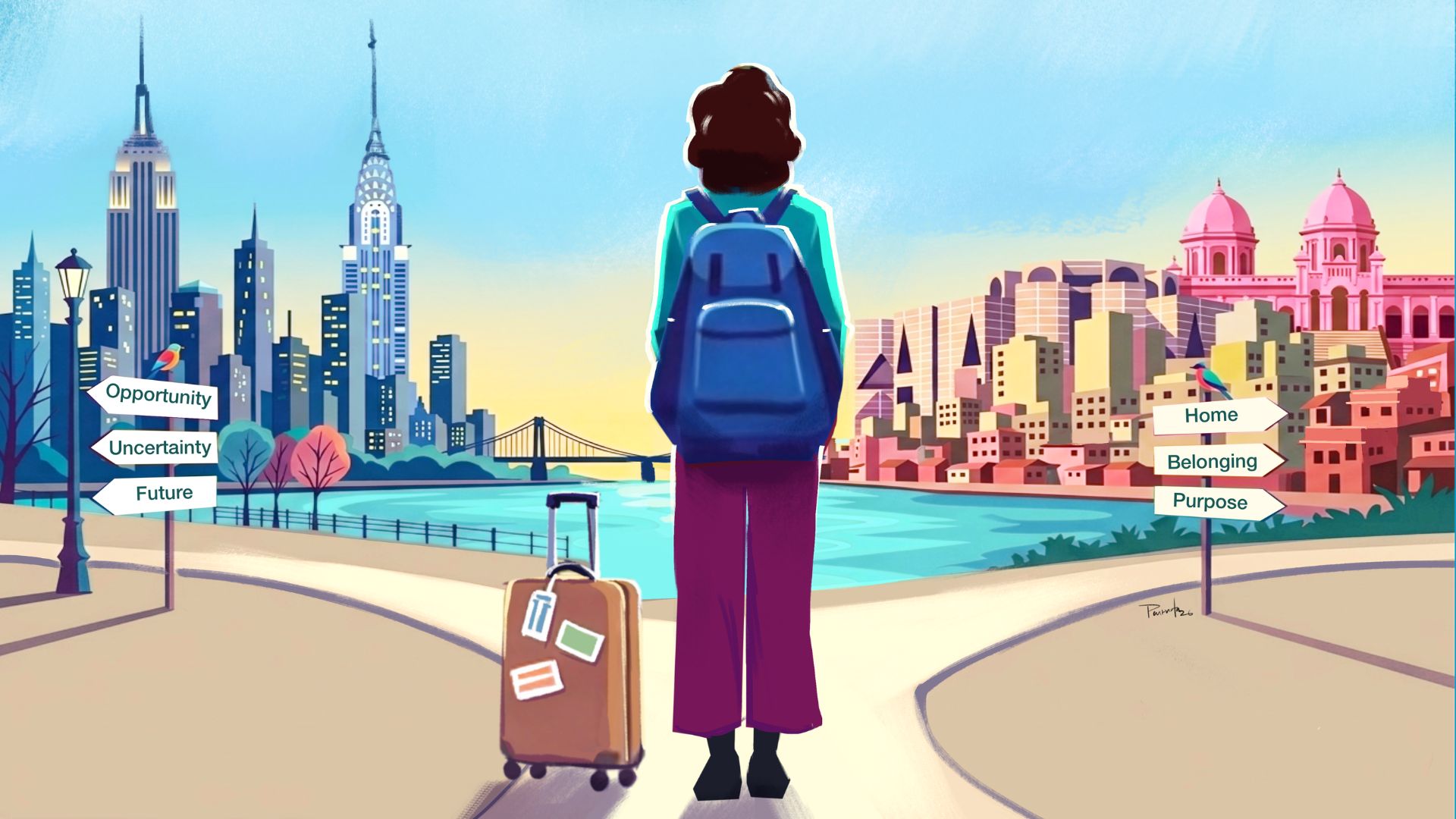
I ask myself this more often than I let on. The honest answer isn’t romantic. It isn’t the skyline or the paycheck, though the paycheck matters more than I’d like to admit (I currently work for a Swedish-owned software company as a junior developer).
But it’s more than money; it’s that here, for the first time, my work gets judged mostly on the work itself, not on whose nephew I am or which university’s alumni network I can call in a favour from, a meritocracy that’s far from perfect, but still more real than what waited for me at home, where even friends with strong degrees spend a year or more unemployed for reasons that have nothing to do with their ability.
Networking matters here, too, but in Bangladesh, my friends tell me that, without someone recommending you, you don’t even get called for an interview. And perhaps, tragically, most importantly, as a woman, for the most part, workplace sexism is close to non-existent, and I don’t have to constantly prove myself to be competent and knowledgeable regarding the work I do. Especially in a field as technical and as dominated by men as software engineering.
People back home sometimes talk about those of us who stayed as though we made one decision, years ago, and now simply live inside it. That’s not how it feels from here. I re-make this choice every visa renewal, every Eid, every summer.
The honest version of my answer is that, coming back, no matter how much my mother assures me otherwise, would be seen by my entire family as nothing short of failure. What I do know is that the difficulty was never a reason to leave. It was simply the cost of the life I decided, and hopefully one day it will amount to a life that is worth building.
Read the second part of the series here.