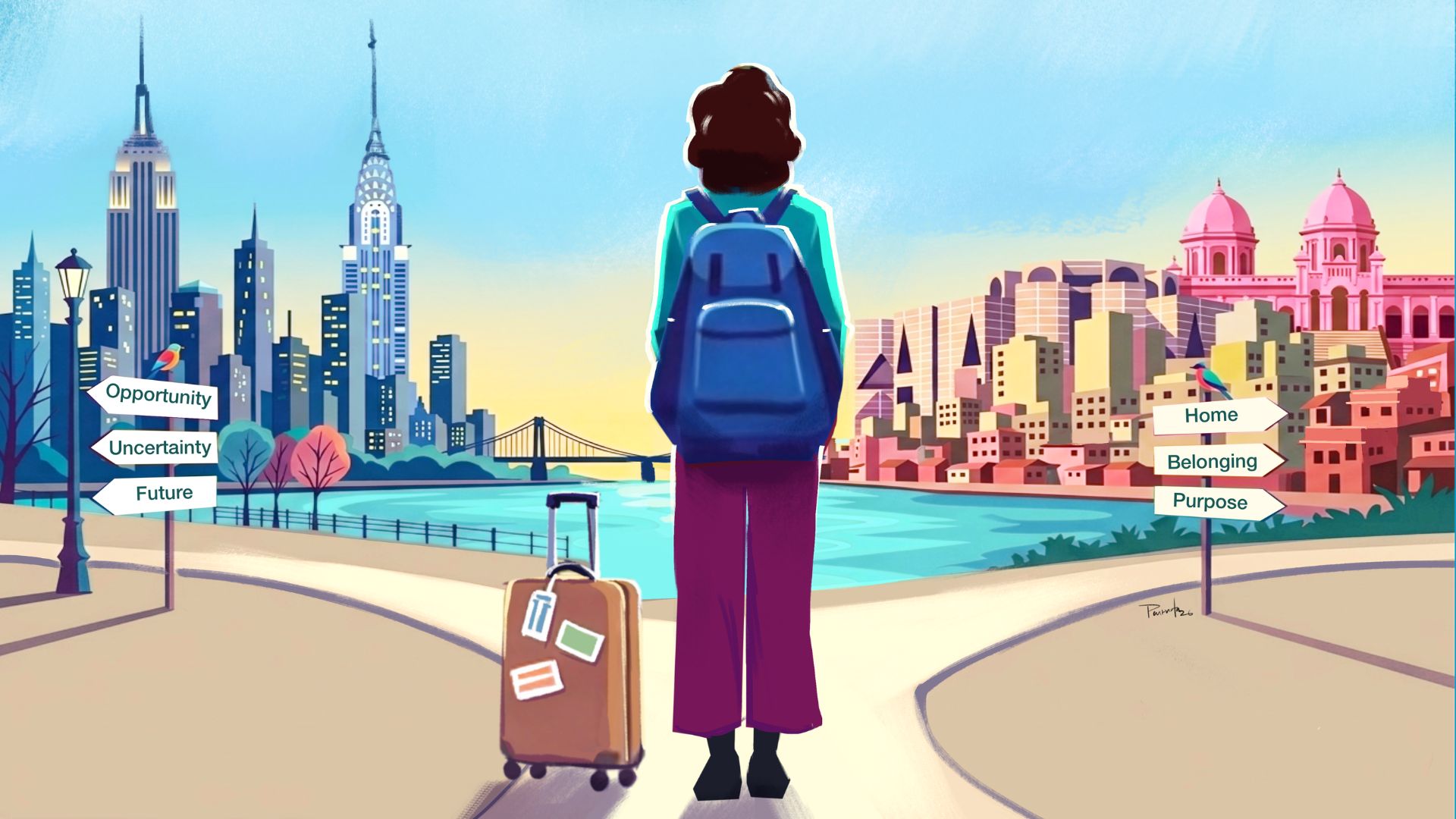

That’s the thing: As far as decisions go, and as much as I would love to provide you with a list of selfless and, perhaps, crowd-pleasing and self-aggrandising patriotic reasons why I “chose” to leave behind the land of our former colonial masters, none of this was the case.
That is not to say no decision was made on my part; there was. But the decision was not a clear one, nor one filled with conviction; I was no self-assured individual coming to a satisfying conclusion, having followed a clear path based on personal preference and principle. In my early 20s, with the expiration of my visa slowly drawing near after having spent around 5 years in London pursuing both a Bachelor’s and a Master’s degree to completion, as a person, I was anything but complete.
Filled with self-doubt and scared to death of change, having become accustomed to the life of a lowly immigrant in the land of Great Britain, initially, I could hardly fathom such a thought. I had this rather overwhelming feeling that I would return to my home country to disappear.
After all, I thought, who “sees” Bangladesh? Whose eyes, while skirting across the multitudinous and diverse landscapes of this God’s green earth, pause for a second to gaze upon the lowly, polluted, riverine land of tiny Bangladesh? Who would notice me, no matter how “different” I thought myself to be from my fellow countrymen, amongst the crores of bobbing brown heads that litter this most irrelevant delta land?

These are not thoughts that I am proud of. But, at this stage in life, I consider them to be essential stepping stones to the person I am today. If you’ve ever been on a flight headed west of the Middle East, and you have felt ashamed of being a Bangladeshi during the first leg before the transit in Dubai or Jeddah or Riyadh because of the way the “labour” class was behaving, then you may somewhat understand the internal turmoil a journey back home had provoked in me.
As the date of my visa expiry came closer, with each desperate neuron fired in my brain, I tried to figure out a way to stay back. I had already been rejected for a PhD program (with each application costing somewhere between $50 and $100, I could only apply to about two), so the most legitimate option was out the window. There were others who had succeeded, other third-world natives, who had enrolled in “visa colleges” in order to further extend their visas by a year or two, and have kept repeating these dodgy tactics. Could I do the same?




Further research into the matter brought me another option: I could join the Her Majesty’s Armed Forces! That would be a direct path to citizenship, desperate as the crown was able bodies to throw at the front lines in order to please the gods of the military-industrial complex and continue to pretend there was a war on terror. Why not sacrifice myself at the altar of the children of those who had once colonised and dehumanised my forefathers and, by doing so, continue that vicious cycle as so many of us continue to do?
This is where I stopped (I couldn’t have joined the army anyway, by the way, since I needed to have stayed in the United Kingdom for 5 years straight, and I had spent long summer vacations during each year of my undergrad). Had I not dehumanised my fellow passengers every year, desperate for the orientalists’ eyes not to recognise me as a Bengali?
To what extent had we castrated our cultural identity in the temple of the West that we would be ashamed of who we were, only to continue to function as second-class citizens in a country that would never allow me to call it home? To what end was I willing to sacrifice my self-respect and dignity, so that the perpetrators of continuous colonisation and genocide would validate me with a temporary permit to stay? To what divine creature was I trying so desperately to prove myself as worthy, worthy enough to be accepted and belong?
“The longest way round is the shortest way home,” as they say, and looking back home, I realised, despite the plethora of relentless anxiety and bureaucracy and inconvenience that Bangladesh as a nation encapsulated, it was my home. Crude, imperfect, but it was the exact opposite of what I had initially imagined: Things I do, the impact I could have (and would have), would be exponentially higher than if I had decided to stay back.
Nowhere else could I be more “seen” than by the people who have shared similar experiences as I have had, and in turn, I could “see” them too.
So, when people ask, as they often do: “Why did you decide to come back?” I tell them I didn’t. I say that I decided that coming back home was so much better than leaving myself behind.
Read the first part of the series here.