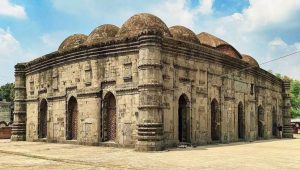
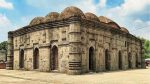
The historic Nayabad Mosque, located in Nayabad village of Ramchandrapur Union under Kaharol Upazila, stands as a silent witness to centuries of history, barely one kilometre from the famed Kantaji Temple in Dinajpur.
The mosque dates back to 1722, during the reign of Dinajpur Maharaja Pran Nath. At that time, the ruler brought a group of highly skilled architectural artisans from Egypt to build the Kantaji Temple in what is now Kantanagar village of Kaharol Upazila.
The artisans were Muslims and devout in their faith. Despite being engaged in temple construction, they continued to practise their religion and initially offered prayers in the open field beside the construction site.
Over time, the chief mason, Niyaz, also known as Kalua Mistry, approached the Maharaja’s court seeking a designated place for accommodation and religious worship for the workers.

In response, the Maharaja allocated 1.15 bighas of land in Nayabad village, along the western bank of the Dhepa River, around one kilometre away from the temple, for the construction of a mosque. He also instructed that houses be built beside it for the artisans’ residence.
Following the royal order, the workers continued construction of both the temple and the mosque simultaneously. After the Nayabad Mosque was completed, they regularly performed the daily prayers there.

Historical accounts say that after the death of Maharaja Pran Nath, temple construction was completed during the reign of his adopted son, Maharaja Ram Nath, around 1715.
By that time, work on the mosque had also been completed. Once the temple was finished, most of the artisans returned to their homeland, but Niyaz or Kalua Mistry and his younger brother Niamul Haque chose to remain.
Kalua Mistry again sought the Maharaja’s permission, this time requesting land for permanent settlement and livelihood through farming. The Maharaja granted land to the two brothers, who spent the rest of their lives cultivating crops there.
Hafez Mawlana Md Raihanul Islam said that after their deaths, both brothers were buried beside the Nayabad Mosque. Over time, the area came to be known as Nayabad Mistrypara, named after the artisans. Descendants of the chief mason and his brother still live in the locality.
Family members of Kalua or Niyaz Mistry said that although their ancestors are no longer alive, the Nayabad Mosque remains as a powerful reminder of their legacy. Visitors from home and abroad who come to see Kantaji Temple also visit the mosque, drawn by its unique historical connection.
They said the number of visitors to the mosque has been rising steadily, while attendance at daily prayers has also increased. Villagers often respond to questions from tourists eager to learn about the relationship between the mosque and the temple, with many expressing satisfaction after learning the full history.
Kaharol Upazila Nirbahi Officer Mokleda Khatun Mim said tourist interest in visiting the Nayabad Mosque alongside Kantaji Temple has been growing. She added that a proposal has long existed to bring the historic mosque under formal tourism coverage, noting that it is currently maintained by local residents.