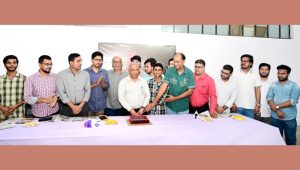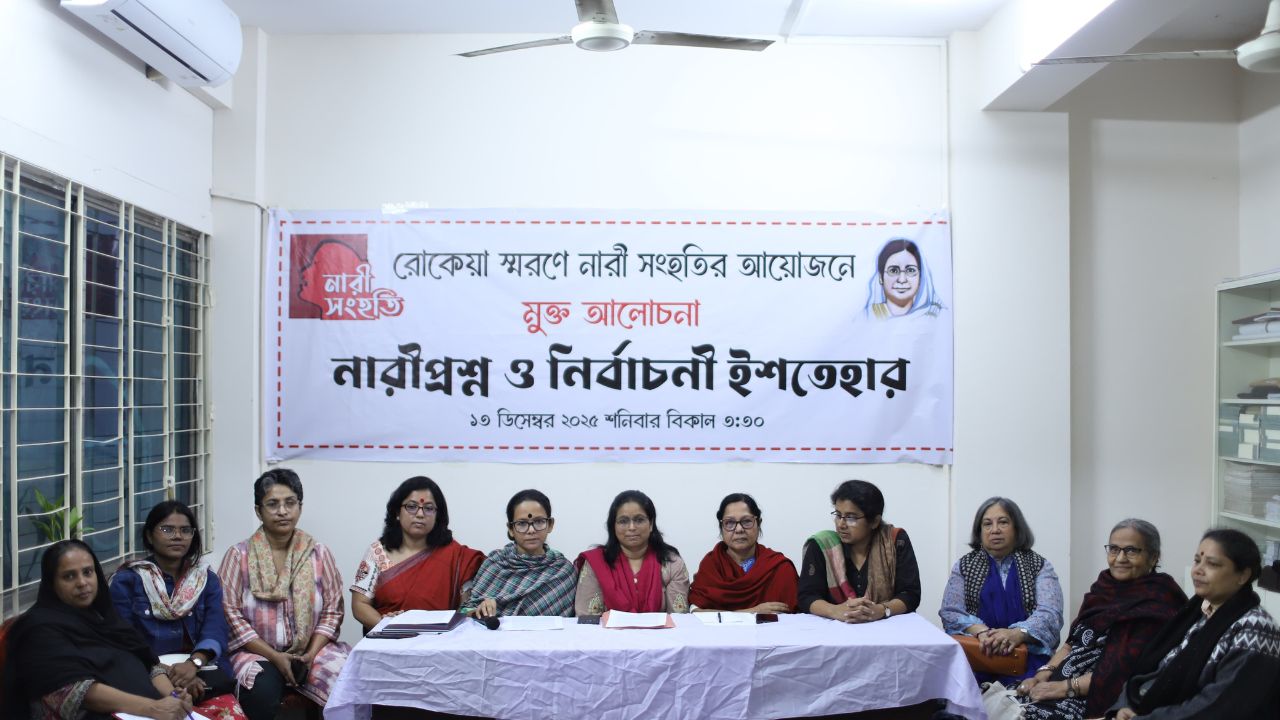

Nari Samhati organised an open discussion marking Rokeya Day, focusing on women’s participation in the upcoming national elections.
The discussion titled “Women’s Issues and Election Manifestos,” was held on Saturday at 4:00pm at Rose View Plaza in the capital’s Hatirpool area, according to a press release.
The discussion highlighted the responsibility of political parties to commit to and implement women-friendly election manifestos to ensure equality, justice and security for women in all spheres of life.
The meeting was chaired by Nari Samhati President Shyamoli Shil, while the draft manifesto was presented by General Secretary Aparajita Chanda.
A draft document outlining Nari Samhati’s expectations from political parties regarding their election manifestos was formally placed before the discussion.

Speakers noted that although Article 28(2) of the constitution guarantees equal rights for women and men in all spheres of state and public life, women continue to be deprived of equal citizenship through various laws.
References were made to inheritance laws, family court laws, guardianship and custody laws, marriage and divorce laws, the Prevention of Women and Children Repression Act and several provisions of the citizenship law that contradict constitutional guarantees.
Political parties claiming to uphold equal citizenship must clearly reflect their positions and commitments in their election manifestos, according to Nari Samhati.



The discussion also stressed the need to ensure equal rights to inheritance property. 54 years after independence, women hold only 4 to 5 percent of effective land ownership in Bangladesh despite constituting more than half of the population.
Participants said a clear declaration to establish equality in inheritance laws is therefore essential in election manifestos.
Equal participation of women in politics and state power was another major focus of the discussion.
Speakers said temporary state measures are necessary to ensure women receive opportunities equal to men in the political arena.
Nari Samhati reiterated its demand for increasing women’s representation in parliament through direct elections and for ensuring at least 33 percent women’s nominations.
Expressing disappointment that most political parties have failed to meet these expectations, the organisation renewed its call for commitments to ensure at least 33 percent women’s representation in parliament, and the increase of reserved women’s seats to 100 for the next two to three elections, to be filled through direct elections.
The discussion further called for ensuring women’s security and access to justice through a zero-tolerance policy against all forms of violence against women.
Proposals included the establishment of fast-track special courts to complete investigations and trials within 30 to 90 days for cases of rape, sexual harassment, domestic violence and other forms of violence against women.
Participants also demanded mandatory women’s safety desks and investigation units at every police station, district-based state legal aid, adequate and safe shelters, and mental rehabilitation centres for survivours.
The introduction of multiple toll-free hotlines and user-friendly applications to strengthen women’s safety was also emphasised.
Other issues raised during the discussion included the enactment of a uniform family code and full recognition of the CEDAW convention, measures to increase women’s participation in the economy, maternity and paternity leave and maternal protection, formulation of a childcare centre policy, fair wages and equal opportunities for women’s labour, proper recognition of women martyrs of July uprising and support for women in impoverished martyr families, recognition and dignity of domestic work, recognition of women’s role in agriculture, the establishment of women-friendly cities with improved public transport and public toilets, development of gender-sensitive curriculum, and the provision of separate prayer facilities for women in mosques along with prayer corners for women of all religions in institutions.
The discussion was attended by Mahin Sultan, member of the Women’s Affairs Reform Commission and researcher; Taslima Akhter, member of the Political Council of Ganosamhati Andolon, president of Garments Workers Samhati, Rokeya Padak recipient and Dhaka 12 constituency election candidates; Fazila Banu Lily of Nari Pokkho; Seema Das Simu, director of Nari Granthaprobortona; Tapasi Rabeya, organiser of the Women’s Political Rights Forum; Nadira Yasmin, women’s rights organiser and teacher; Rexona Parvin Sumi, Ganosamhati Andolon candidate for Narail-2; Koli Kayej, organiser of the July uprising movement and Ganosamhati Andolon-nominated candidate for Chattogram-5; Rebeka Neela, president of Samageet Cultural Centre; along with leaders and activists of Nari Samhati.