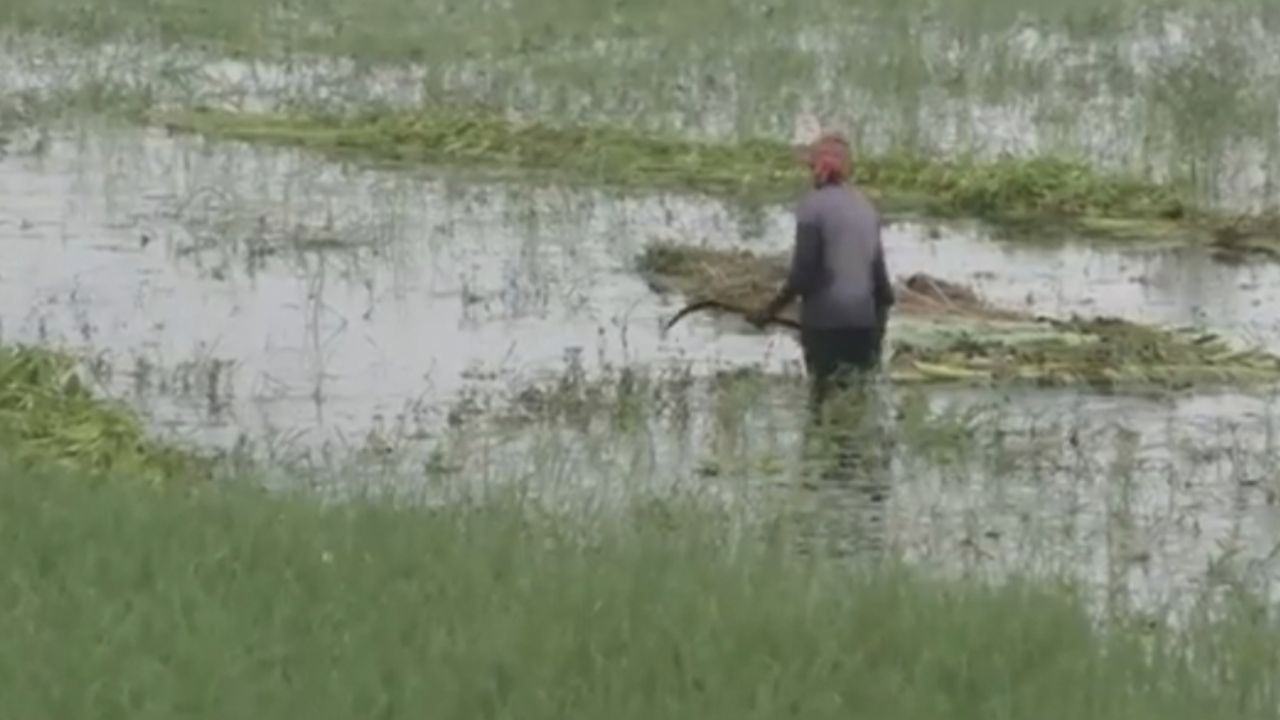



Incessant rainfall and prolonged waterlogging have devastated vast fields of Aus paddy in Narail, leaving hundreds of farmers facing severe financial losses.
Local farmers blamed unplanned fish enclosures for blocking natural drainage routes in the wetlands, and said silted canals and waterways left without maintenance worsened the disaster.
They estimated the sudden crop destruction would cause losses worth several crore Taka.
Low‑lying areas including Amadar Beel, Andharkota Beel and Kuchiyabari Beel in Lakshmipasha union under Lohagara upazila were found inundated under chest‑deep water, our correspondent reports.

Instead of golden paddy, the land is now covered with water lilies, lotuses and aquatic weeds, with flocks of ducks foraging in the empty plots.
Farmers said the low‑lying lands are highly suitable for “Ratul Aus”, a local water‑tolerant variety that grows rapidly with rising water levels.




 Encouraged by bumper harvests and good prices in previous years of moderate rainfall, they cultivated the variety extensively this season.
Beyond Lakshmipasha, Aus was planted in more than 50 beels across unions including Bashgram, Noldi, Kotakol, Kalabaria, Baoisona, Pohardanga, Khashial, Maijpara and Shekhhati.
But record continuous rainfall from mid‑July inundated the beel lands. With drainage blocked by fish enclosures, the paddy remained submerged for weeks, rotted and went to waste.
Farmers are demanding immediate removal of illegal enclosures, recovery of blocked canals and re‑excavation of connecting waterways linked to rivers to resolve the waterlogging.
According to the Narail Department of Agricultural Extension (DAE), 9,107 hectares were brought under Aus cultivation this season.
Officials claim the damage is limited, but farmers reject that, saying while some paddy on higher ground survived, most crops in low‑lying areas were ruined.
Muhammad Arifur Rahman, deputy director of the Narail DAE, said the department is coordinating with other government offices to normalise drainage and recover silted canals.
He acknowledged that permanent waterlogging in the beel regions poses a major threat to current farming practices.