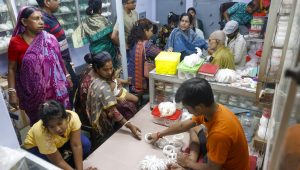
Bangladesh’s garment industry faces mounting wage pressure as workers demand higher pay to cope with rising living costs, while factory owners warn of business challenges. With the government preparing a new wage board, disagreements over wage levels and the timing of revisions are adding to tensions in the export sector.
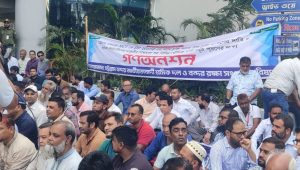
The demand for a Tk30,000 minimum monthly wage, against the current Tk12,500, has intensified amid government initiatives to raise public-sector salaries and triggered street protests in Dhaka. Labour leaders are urging collective action, while employers oppose road blockades ahead of wage negotiations.
Knowledge Hub Institute Trust President and former Centre for Policy Dialogue Research Director Khondaker Golam Moazzem said existing allowances were inadequate. Workers receive Tk1,250 for food, or roughly Tk46 a day, Tk450 for transport, or Tk15 daily, and Tk750 for healthcare, or Tk25 daily. He also proposed education and recreation allowances.
Garment Workers Trade Union Centre President Montu Ghosh said collective action was essential to securing fair wages, arguing that neither employers nor the government would voluntarily meet workers’ demands.
Bangladesh Garment Manufacturers and Exporters Association (BGMEA) President Mahmud Hasan Khan opposed disruptive protests before the wage board’s formation, calling instead for evidence-based negotiations.

He argued that dollar-based wage comparisons with Vietnam and China ignored differences in purchasing power, claiming that $115 could buy more goods and services in Bangladesh than in those countries. He also disputed claims of severe worker hardship, citing smartphone ownership and ATM use since mobile wage payments began during the pandemic.
Khan warned that excessive wage increases confined to garment factories could distort the wider labour market, potentially drawing 300 applicants for every 100 jobs and exposing surplus workers to exploitation.



Moazzem rejected the purchasing-power argument, citing daily per capita purchasing power parity of $25 in Bangladesh, against $45 in Vietnam and $72 in China. He said Bangladeshi workers struggled to afford necessities and enjoyed lower living standards.
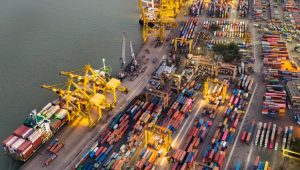
The dispute comes amid uneven export performance. Garment exports fell 3.41 per cent to $35.31 billion during July-May of FY2025-26, according to the Export Promotion Bureau. BGMEA blamed weaker global demand, war-related economic instability and US reciprocal tariffs.
The Middle East conflict has also increased energy costs and inflationary pressure in Western markets, prompting buyers to exercise caution over large orders and raising concerns about demand from the US and Europe.
A September survey by the Bangladesh Knitwear Manufacturers and Exporters Association (BKMEA), conducted between 21 August and 14 September among more than 20 per cent of its member factories in Narayanganj, Gazipur, Chattogram, Dhaka and other areas, found that energy shortages had caused order cancellations or reductions at 55 per cent of factories, partial production shutdowns at nearly 78 per cent and shipment delays at 87 per cent. Nearly 60 per cent sold goods at discounts.
However, garment exports rebounded 6.10 per cent to $10.58 billion during July-September of FY2026-27, highlighting a recovery alongside continuing difficulties at individual factories.
The government has agreed in principle to form a new minimum wage board. Labour Secretary Md Abdur Rahman Tarafdar said the process had begun and a notification would follow the nomination of employer and worker representatives. Ministry officials indicated that the process could advance this month, although discussions on the new wage have yet to begin.
The last revision, announced in November 2023 and implemented in December, raised minimum monthly wages from Tk8,000 to Tk12,500.
Amendments to labour law have since shortened the wage revision cycle from five years to three, but the two sides disagree over its starting point. Labour leaders demand a new structure this year, while employers want the period counted from the amended law’s passage.
Tarafdar said the dispute would first go to a tripartite technical committee, then the national Tripartite Consultative Council if necessary, before being referred to higher government authorities.