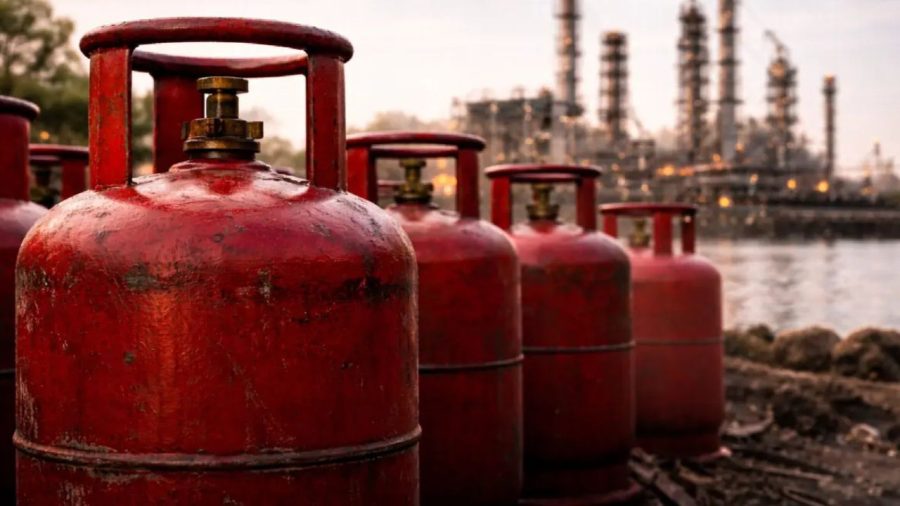



Monowara Akter went to buy a 12kg liquefied petroleum gas (LPG) cylinder in Dhaka’s Banglabazar, only to pay Tk663 more than the government-fixed price.
The Bangladesh Energy Regulatory Commission (BERC) had set the price at Tk1,837 after factoring in import costs and other expenses incurred by LPG companies. But Monowara paid Tk2,500.
Who was responsible for the extra charge? No government agency has ever tried to establish that.
At Anas Enterprise in Hatirpool, proprietor Md Sohel operates as both a distributor and a retailer, charging other retailers Tk2,500 per cylinder.
Sohel claimed that LPG from only five or six companies was available, while others had stopped supplying the fuel and were charging higher prices, forcing him to raise his prices.
In Karwan Bazar, Abdul Haque of LPG distributor Janata Traders refused to disclose what his business charged retailers or paid marketing companies.
“This is a trade secret,” he said.
Haque also sells directly to consumers, charging Tk2,100 to Tk2,200 for a 12kg cylinder, depending on his relationship with customers.
Calls to the marketing departments of Meghna and Omera went unanswered.

The LPG Operators Association of Bangladesh (LOAB), however, maintains that supplies are sufficient.
Bangladesh imported 156,000 tonnes of LPG in September, compared with 158,000 tonnes in August, according to LOAB, which considers the volume adequate to meet demand.
The association says operators, distributors and retailers selling above regulated prices should face action.
Energy expert M Tamim, however, believes a supply-demand gap is driving the price surge.
“The price fixed by BERC has never been implemented in the retail market. In the past, when the fixed price was Tk1,200, LPG was sold in the market for Tk1,300. However, the gap between the regulated price and the market price is much wider in the current situation. The reason is a supply shortage,” he said.
“When there is less product available in the market, buyers compete to purchase the limited number of cylinders,” he added.



Consumers have long struggled to buy LPG at government-announced prices. But additional charges, previously Tk50 or Tk100 per cylinder, have climbed to Tk600, Tk700 or even Tk1,000 in some cases.
For households already battered by inflation, higher cooking fuel costs mean cutting spending elsewhere. Cooking, after all, cannot stop.
“We budget carefully when buying groceries for the household, but everything costs more. How are we supposed to meet all these expenses? After buying essential items, whatever money remains is not enough to eat fish and meat regularly,” Monowara told TIMES.
Titas has suspended new residential gas connections for more than a decade because of shortages. LPG is now widely used for cooking in cities, district towns and rural areas, forcing households to budget carefully for fuel.
Years of inflated prices have fuelled consumer frustration, with complaints on social media and in news reports prompting enforcement drives against retailers nationwide.
Yet the drives have made no apparent attempt to hold major distributors or LPG marketing companies accountable.
Consumers Association of Bangladesh (CAB) General Secretary SM Nazer Hossain alleged that retailers and companies were jointly responsible.
“Retailers and companies raise prices in collusion. There is really little scope to view one separately from the other,” he told TIMES.
“The government is also playing a silent role here. Until the government takes decisive action, the situation is unlikely to improve much,” he added.
BERC Chairman Jalal Ahmed acknowledged the regulator’s limited enforcement powers.
“Because of insufficient manpower and the lack of direct law enforcement powers, BERC cannot conduct drives itself or file cases directly against anyone. In such incidents, district administrations conduct drives under the instructions of the government’s executive authorities,” he said.
Prime Minister’s Adviser on Policy and Strategy Zahed Ur Rahman said at a Secretariat press conference on Tuesday that deputy commissioners nationwide had been instructed during a virtual meeting to ensure uninterrupted LPG supplies and sales at regulated prices.
“They have been asked to collect accurate information on exactly how much LPG dealers are receiving from distributors, along with detailed identities of the individuals concerned,” he said.
Enforcement drives by the Directorate of National Consumer Rights Protection have nevertheless failed to control prices.
Amid the turmoil, the LP Gas Traders Cooperative Association has called a Thursday-Friday strike over seven demands.
The association says BERC has kept traders’ commission at Tk50 per cylinder for five years, although transportation, loading, unloading, salaries, storage and other expenses total Tk110.
Traders demand Tk150 per cylinder, including a Tk40 profit margin, or 7 per cent of the selling price.
Association President Selim Khan alleged that the consumer rights directorate and mobile courts were imposing unreasonable fines.
The association has also challenged BERC’s pricing methodology, arguing that a uniform maximum retail price ignores differences in companies’ import costs.
In a letter to BERC, it said some companies’ listed prices exceeded the regulator’s ceiling.
According to the association, companies issued price lists on the evening of the October adjustment, setting 12kg cylinder prices between Tk1,740 and Tk2,000.
BERC instead calculates the regulated price using companies’ average costs.
The regulator has adjusted private-sector LPG prices monthly since April 2021, citing changes in international propane and butane prices, shipping costs, the dollar exchange rate and diesel prices.
But questions persist over transparency. Consumer representatives are never included in BERC’s price-setting meetings, while a High Court directive requiring public hearings has gone unheeded for years.