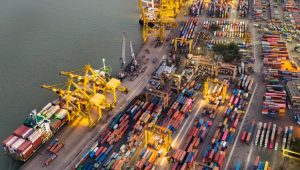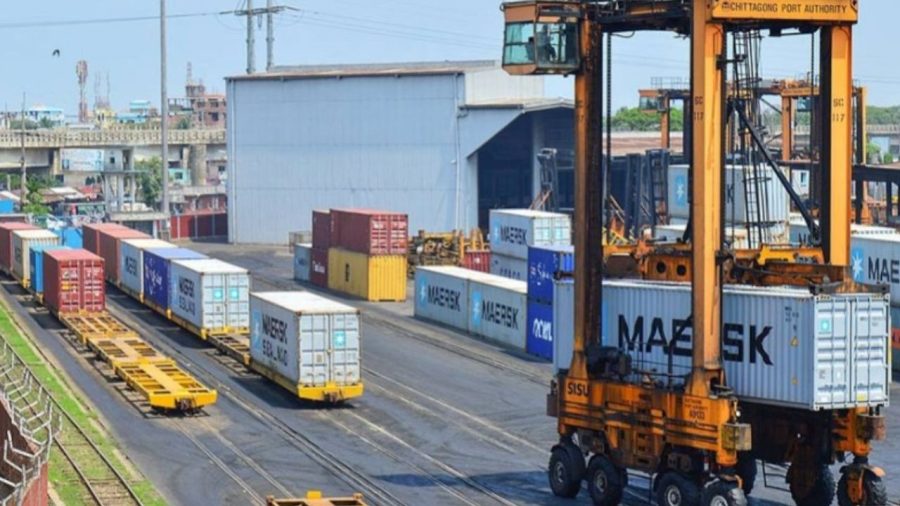



Despite assurances of job security and continued Bangladeshi control over the New Mooring Container Terminal (NCT), labour organisations at Chattogram Port are pressing ahead with protests against its 15-year concession agreement with Dubai-based DP World.
With protesters threatening a hunger strike until death from 19 October and warning of disruptions to port operations, questions have emerged over whether the agitation is driven solely by concerns about national interests or also reflects competing commercial interests.
The protests have continued despite Shipping Minister Sheikh Rabiul Alam’s assurance that existing workers would not lose their jobs.
Earlier proposals by domestic companies to operate the NCT have also drawn attention to the competing interests surrounding the terminal.
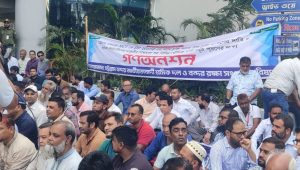
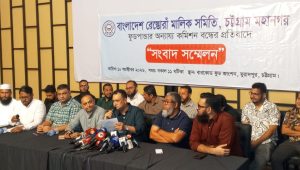
On Monday, the Chattogram Port Jatiyatabadi Sramik Dal and the Bandar Rakkha Shangram Parishad began a mass hunger strike at 11:30am in front of the port’s One-Stop Service Building.
Although scheduled to continue until 4pm, the programme ended around 1:30pm.

The organisers presented an 11-point list of demands, including cancellation of the DP World agreement, and warned of a hunger strike until death from 19 October unless tangible progress was made towards meeting their demands.
Job security assured, opposition persists
The concession agreement between the Chattogram Port Authority (CPA) and DP World was signed at the Invest Bangladesh auditorium in Dhaka on 8 October.
At the signing ceremony, the shipping minister assured stakeholders that existing port employees would not lose their jobs.
Mahfuzul Haque Shah, a former director of the Chattogram Chamber of Commerce and Industry, said domestic and foreign investment should be welcomed if it contributed to economic development and the advancement of Chattogram Port.



However, he stressed that transparent implementation was essential to improving efficiency, overcoming operational challenges and enhancing service quality.
Bangladesh Shipping Agents Association Chairman Captain Salah Uddin Chowdhury also referred to the minister’s job security assurance, saying the priority should be to reduce vessel turnaround times and ensure that cargo was handled according to bookings.
Bandar Rakkha Committee Member Secretary Fazlul Kabir Mintu said the movement was concerned not only with employment but also with protecting national assets and ensuring transparency in the agreement.
Asked whether business groups might be fuelling the protests to protect their commercial interests, he acknowledged that various syndicates could have vested interests but insisted that the movement was driven by national concerns.
Domestic proposals and competing interests
Before the DP World agreement was finalised, a consortium comprising Saif Powertec, Cosmos Enterprise and Everest Port Services proposed operating the NCT for 15 years.
Cosmos Enterprise Chairman ABM Ashraf Uddin Nizan and Everest Port Services Managing Director Shahadat Hossain Salim are both BNP members of parliament.
MGH Group, a Bangladesh-based multinational conglomerate, also submitted a proposal under the public-private partnership framework.
Saif Powertec said it employs more than 2,500 workers across the NCT and Chattogram Container Terminal (CCT).
The company has also indicated that approximately two months remain on its existing CCT operating contract.
Before the DP World agreement was signed, Saif Powertec Managing Director Tarafder Ruhul Amin told TIMES that the company relied on its competence and performance rather than political affiliation or government backing.
He declined to comment specifically on the NCT agreement or the protests.
Although the competing proposals do not establish that commercial interests are driving the agitation, the overlapping stakes have raised questions about competition for control of terminal operations.
Ibrahim Khokon, coordinator of the Bandar Rakkha Shangram Parishad and a leader of the Bangladesh Jatiyatabadi Sramik Dal, rejected suggestions that the movement was intended to benefit Saif Powertec.
“We are not working to protect the interests of any particular political party or a company like Saif Powertec. We are also opposed to Saif Powertec having exclusive operational control. Our sole objective is to safeguard the port’s sovereignty,” he said.
Under the 15-year agreement, DP World will pay an upfront fee of approximately Tk600 crore and invest more than Tk1,000 crore in modernisation, machinery and technology during the first decade.
According to an Invest Bangladesh notification, the CPA will receive between 40 and 67 per cent of revenue generated per container, depending on the terminal’s average earnings.