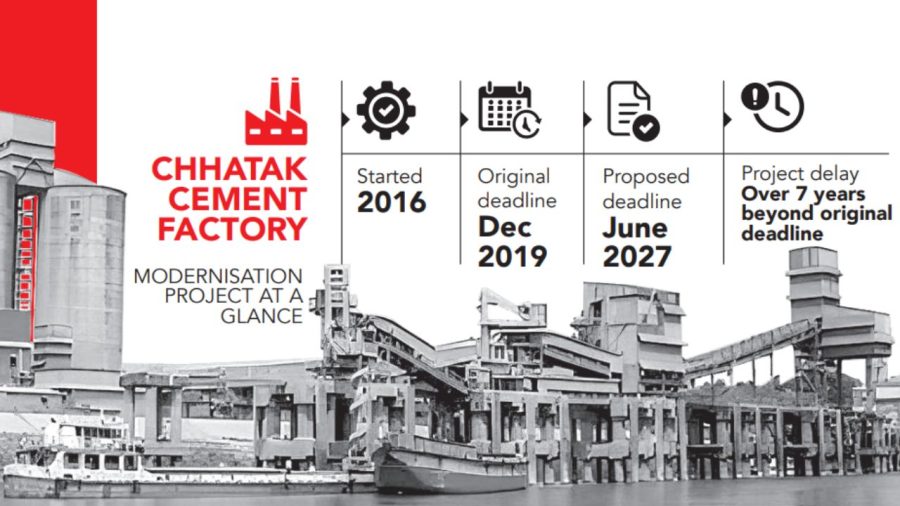

The modernisation of the country’s lone state-owned cement manufacturer Chhatak Cement Factory remains unfinished 11 years after the project began, with the government now seeking another one-and-a-half-year extension.
Launched in 2016, the project cost has more than doubled from Tk667 crore to Tk1,418 crore.
Production has been suspended for more than six years due to shortages of limestone and gas. Yet its employees continue to draw salaries, forcing the authorities to borrow money to meet the monthly payroll.
The factory has around 200 employees, with a monthly salary bill of Tk1.10–1.20 crore, according to project authorities.
Project Director Md Abdur Rahman, who is also the managing director of the factory, said production cannot resume before June 2027. Any further delay would mean continued borrowing to pay employees.
An estimated Tk86-94 crore has already been spent on salaries over the past six and a half years while the factory has remained out of production.
Regarding salary payments, the project director said the officers and employees were permanent staff and could have been transferred elsewhere. However, they were not left idle despite the suspension of production. They were assigned essential duties, including the security and maintenance of factory facilities and machinery, as well as ensuring water and electricity supplies.
He added that a significant number of employees were working in shifts, particularly to maintain the factory’s security.

The Implementation Monitoring and Evaluation Division (IMED) has criticised the project authorities for negligence and urged the government to urgently explore alternative sources of limestone rather than remain dependent on a single country.
It has also warned that the prolonged delay is costing the government around Tk22.50 crore a year as the project has failed to meet its targets on time.
The project was approved by the Executive Committee of the National Economic Council in March 2016, with completion scheduled for December 2019. The deadline was extended three times, eventually to June 2026, and is now proposed to be extended by another one and a half years.
Physical progress stands at 92 per cent, while financial progress is 77.46 per cent.
Despite the high level of progress, the modernised factory, completed in March 2023, remains idle three and a half years later. A section of the limestone transport ropeway in India has not been built, while the required gas pipeline in Bangladesh is also yet to be installed.
The ropeway is about 17 kilometres long, with 11 kilometres in Bangladesh and six kilometres in India. Work on the Bangladesh section is under way, but construction of the Indian section has yet to begin.




Chinese contractor Nanjing C-Hope Cement Engineering Group Co Ltd is working on the factory modernisation. But the Indian government did not allow the Chinese company to construct the Indian section, stalling the project, according to factory sources.
The Bangladesh government and the main contractor later agreed that Indian company Komorrah Limestone Mining Company Ltd (KLMC) would build the Indian section as a subcontractor.
Relevant sources said that at a tripartite meeting on 5 April, KLMC said the process of obtaining a mining lease was under way and that ropeway installation could begin once the lease was secured.
Abdur Rahman said a two-member team had travelled to India to expedite the process and was told that the work would be completed quickly.
The new factory can produce 1,500 tonnes of clinker and 500 tonnes of cement a day, almost three times the capacity of the old plant. It will, however, require more gas to operate.
Jalalabad Gas Transmission and Distribution System Ltd previously supplied gas to the old factory from its mainline in the Chhatak area. The new plant requires a separate gas pipeline.
A 42-kilometre gas transmission pipeline from Sylhet to the factory has been assigned to Chittagong Dry Dock Limited (CDDL), a Bangladesh Navy institution, under the supervision of Jalalabad Gas Transmission and Distribution System Ltd. CDDL has appointed a contractor, Tk136 crore has been released, and survey work has begun.
The gas pipeline was not included in the original project scope, adding to the subsequent increase in project costs.
According to the Planning Commission, the project cost was initially estimated at Tk667 crore in 2016, later revised to Tk890 crore and eventually raised to Tk1,418 crore.
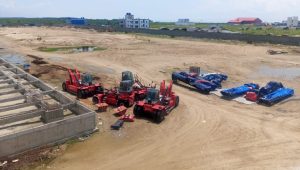
Several equipment tenders are still under process, while construction of the warehouse remains incomplete. The tender process for the STG plant is also under way.
IMED has described the continued renovation work as highly undesirable, warning that rising global equipment prices could cause further financial losses to the government and the company.
It also noted that work unrelated to the Indian section of the ropeway should have been completed much earlier. Although the project director had certified that the ropeway and other works would be completed by June 2026, the target was not met.
IMED has recommended an investigation into why the Bangladesh section of the ropeway remains unfinished despite the project running for more than 10 years, and called for those responsible to be identified.
It said the prolonged delay reflected weaknesses in project management and raised concerns over whether the latest extended deadline would be met.
The delay is particularly striking as private-sector cement producer LafargeHolcim Bangladesh Ltd, operating in the same area, has continued to produce profitably.
IMED has therefore urged the authorities to urgently explore alternative sources of limestone instead of relying on a single country.
Abdur Rahman said, “LafargeHolcim also collects limestone from Meghalaya. Their advantage is that they have their own mine there under a lease. That is why they are getting limestone and are able to produce, which we do not have.”
Bangladesh has an agreement with an Indian company to import limestone until 2033.
There has also been discussion of involving Bangladesh in the ownership of an Indian limestone company. The company is jointly owned by the Meghalaya government and a private partner, with Bangladesh offered at least a 25 per cent stake. No agreement has yet been reached.
Meanwhile, a committee is assessing the possibility of sourcing limestone from Sylhet, with a joint venture with a local company also under consideration. If successful, production could resume by June next year.
However, sourcing limestone from another country would increase transport and production costs, making it difficult for the factory to operate profitably.