
They had queued up to buy subsidised essentials, hoping to ease the burden of rising household expenses. One was a cleaner, the other a rickshaw puller. Both wanted to purchase rice and lentils at lower prices for their families. But they never made it home with the goods.
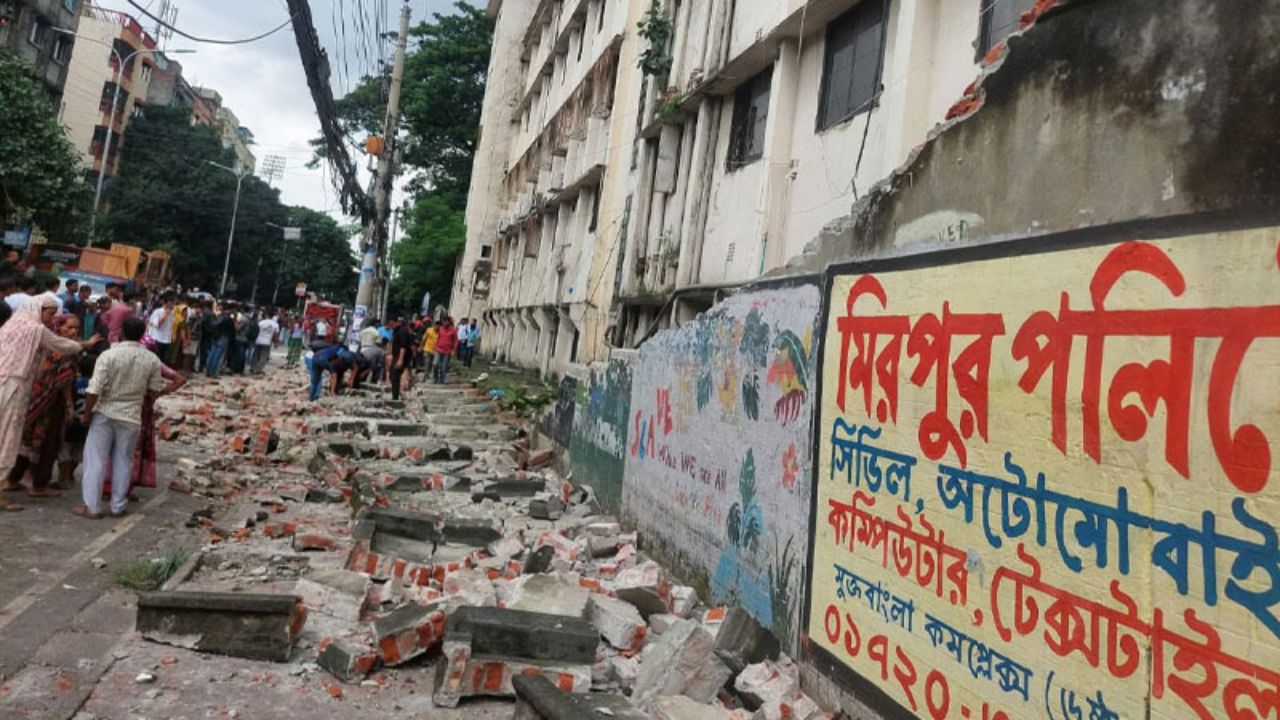
Instead, Nasima Begum, 45, and Firoz, 41, lost their lives when a boundary wall of Mirpur University College collapsed onto people waiting in line for Trading Corporation of Bangladesh (TCB) products.
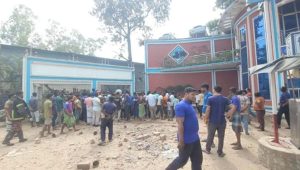
The tragic incident occurred around noon on Tuesday on Love Road in Mirpur-2. About 120 feet of the college’s approximately eight-foot-high rear boundary wall suddenly gave way. At the time, around 50 to 60 people were standing in line beside the wall to buy subsidised goods from a TCB truck.
Several people were trapped under the debris. Nasima died at the scene, while Firoz was declared dead after being taken to hospital. At least six others were injured.
Firoz was his family’s only breadwinner
Firoz’s wife, Shahida Akter, identified his body at Dhaka Medical College Hospital on Tuesday night.
Firoz was the son of Amzad Chowdhury of Khagurkori Hatiputa village in Naogaon Sadar upazila. He lived in a tin-shed house in Mirpur-1’s Nobaberbagh area with his wife and their two daughters.

According to Shahida, she and her husband had both left for work on Tuesday morning. Firoz had planned to return home in the afternoon. She came home around noon to cook when neighbours informed her that her husband had been taken to hospital. After searching several hospitals, she finally found and identified his body at Dhaka Medical College Hospital that night.
A relative told TIMES of Bangladesh, “Firoz was a very poor man. Almost every day he had lunch provided by volunteers on the road behind Mirpur College.”
Firoz is survived by his daughters – seven-year-old Firoza and five-year-old Priya. The elder daughter lives with her grandmother to attend school, while the younger one stayed with her parents.
The family said they had not yet received any contact or assistance from the government.



Nasima’s home remains locked
Nasima Begum, the other victim, lived in a tin-shed house in the Janata Housing area of Mirpur-2.
When this correspondent visited her home on Wednesday, it was locked. Neighbours said her mother, Shahida Begum, had not returned home since the tragedy.
According to neighbours, Nasima worked as a cleaner for a private company and lived with her mother. She had a son and a daughter, both married.
Her husband, Abdul Hanif, is currently working in Kuwait. Six months ago, Nasima borrowed money to send him abroad, but after falling ill there, he was unable to send money home regularly. Nasima’s income covered the family’s rent, loan repayments, household expenses and her mother’s living costs.
Neighbour Taslima Begum said Nasima had rushed out after hearing that a TCB truck had arrived. To save time, she skipped lunch and joined the queue.
Who will take responsibility?
Local residents question why the unsafe wall had not been repaired despite its visibly poor condition. Abir Hossain, a local resident, told TIMES that the wall had been unstable for a long time and had leaned further after a recent earthquake. “We repeatedly asked the college authorities to repair it, but they took no initiative,” he said.
Following the incident, Dhaka North City Corporation (DNCC) Administrator Md Shafiqul Islam Khan said a probe committee comprising officials from the Public Works Department and DNCC would be formed. Legal action would be taken against those responsible based on the investigation findings.
Speaking to reporters after visiting the site on Tuesday afternoon, he said preliminary findings suggested that the wall, built in 2014, had not met proper construction standards. Instead of reinforced cement concrete (RCC), it had been built using only brick masonry, which is believed to have contributed to the collapse.
Shafiqul added that the remaining boundary walls would be inspected and reinforced in consultation with the college authorities to prevent similar accidents.
He also said that the government would provide financial assistance to those injured. According to him, free medical treatment had been arranged for the injured under the prime minister’s directive.
Later that night, Health Minister Sardar Md Sakhawat Hossain visited the National Institute of Traumatology and Orthopaedic Rehabilitation (Nitor) to inquire about the condition of the injured.
He said that the government would bear all treatment costs, including expenses for medicines or medical equipment that might need to be imported from abroad. Doctors had also been instructed to ensure the highest standard of care.
After visiting the hospital, he said eight people had been admitted following the collapse. One person died at the scene, while another succumbed to injuries in the intensive care unit. Of the remaining six injured, one had been transferred to Dhaka Medical College Hospital for advanced treatment.
He added that the five patients still undergoing treatment at Nitor had all undergone their initial surgeries.