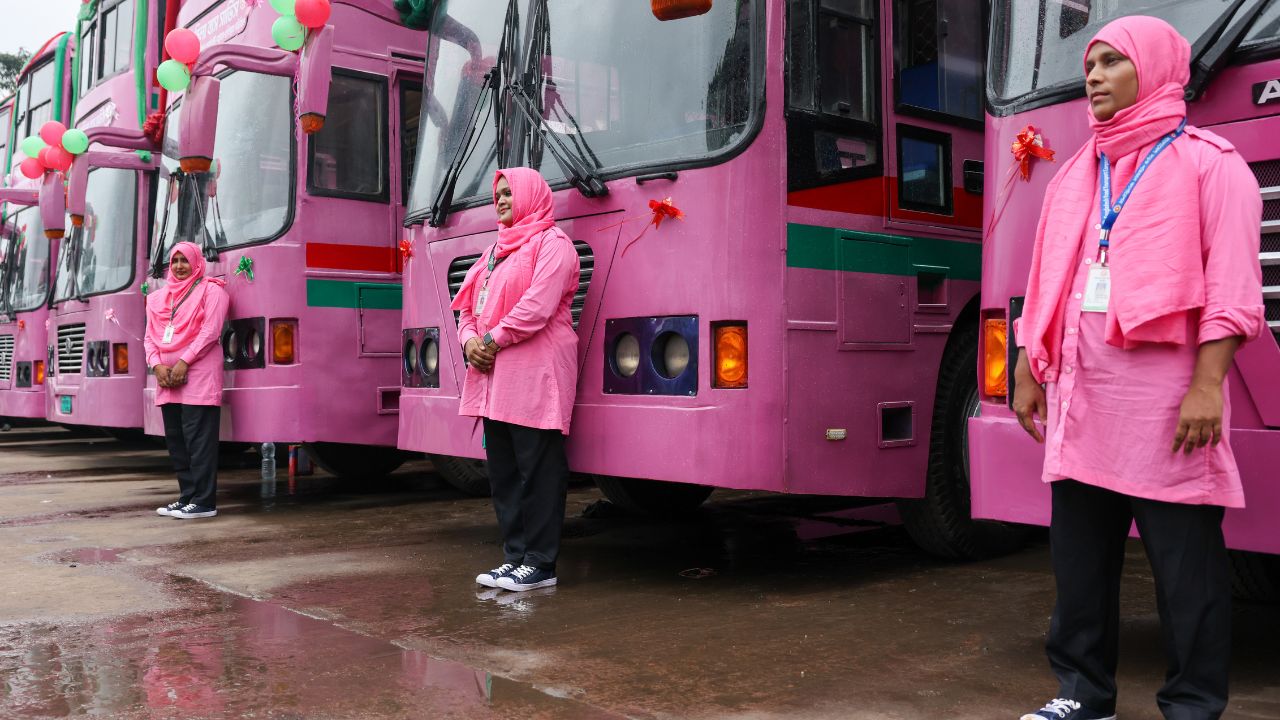

A pink bus reserved for women left the Bangladesh Road Transport Corporation’s Kamalapur depot for Mirpur-12 at 3:40pm on Wednesday.
But by the time the 75-seat bus reached its destination at 6:20pm, no more than 15 passengers were on board.
The bus had travelled through Motijheel, Paltan, Press Club, Shahbagh, Banglamotor, Farmgate, Asad Gate, Kallyanpur and Mirpur.
The same pattern is being seen across all 10 routes in Dhaka where the women-only service operates, with BRTC losing about Tk6,000 per bus each day on average.
Launched on 18 August with women drivers and female assistants, the service was presented by the government as a step towards safer and more convenient public transport for women.
There were also plans to expand the number of buses.
But a month after the launch, the service has struggled to attract enough passengers.
Commuters say one of the main problems is the limited timetable, with only two trips a day – one in the morning and another in the afternoon.
Missing the single scheduled trip often means passengers cannot afford to wait and instead have to use regular buses or other forms of transport.
Atika Akter, who travels from Asad Gate to her office in Banglamotor, said she welcomed the service and had even taken the bus assistant’s phone number so she could find out where the bus was.

“The bus starts from Mirpur. Due to traffic congestion, it does not always reach Asad Gate on time. There can be a delay of even 20 minutes. Anyone wanting to board the bus has to wait. If the only bus is missed, eventually one has to take a regular bus,” she told TIMES.
She said an app-based live-tracking system could help passengers check the location of the bus instead of having to make phone calls.
Another woman who regularly travels between Mohammadpur and Mirpur said she had heard about the pink buses but had never used them because the service did not operate on her route and the timetable did not suit her needs.
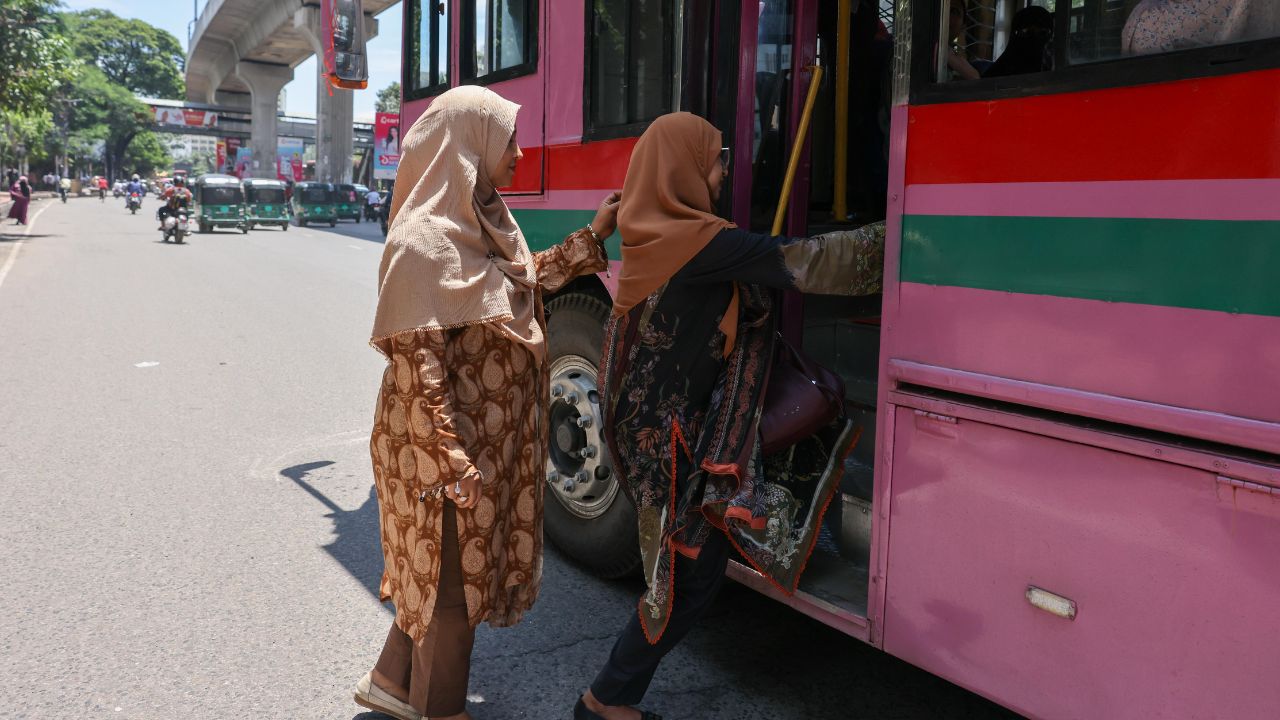
Commuters said the limited number of routes and the lack of schedules matching office and educational hours were major obstacles.
Women also often travel with family members, making a women-only bus unsuitable for some journeys.
Sumaiya Akter Shimu, a student at Tejgaon College, boarded the pink bus from Farmgate for the first time.
She regularly travels between Farmgate and Kalyanpur but said she had never noticed the pink bus operating on the route despite commuting there every day.



She usually relies on local buses or rickshaws.
“I felt good travelling on the pink bus, but I did not know this route had the service,” she said.
Two schoolgirls from BADC High School in Mirpur-1 also boarded the bus while returning home after their day-shift examinations.
They said they had seen the pink bus on the route twice before, but this was the first time they had travelled on it.
They said they hoped the service would run regularly so they could use it for their daily journeys.
The students got off at Mirpur-10.
They usually travel by their father’s motorcycle, rickshaw or local bus and said they were pleased to have what they regarded as a safer travel option.
Bangladesh University of Engineering and Technology Professor and transport expert Hadiuzzaman said the initiative had been launched without sufficient planning.
“Before launching the service, fieldwork should have been conducted considering the reasons why previous women-only bus services failed and were discontinued,” he told TIMES.
Fourth attempt
The latest initiative is BRTC’s fourth attempt to operate a dedicated bus service for women in Dhaka.
The corporation launched its first such service in 1998 and expanded it to Dhaka and surrounding areas in 2001 before discontinuing it.
The service was revived in 2009 but was shut down again in 2015 because of financial losses.
In 2018, BRTC and private operator Rangs launched another women-only service called Dolanchapa, which was discontinued in 2022.

The current service operates on 10 routes in Dhaka: Notun Bazar (Coca-Cola)-Motijheel, Taltola-Motijheel, Demra Staff Quarter-GPO, Mirpur-10-Motijheel, Mirpur-Motijheel, Mirpur-12-Motijheel, Narayanganj-Motijheel, Mohammadpur-Motijheel, Abdullahpur-Motijheel and Airport-Gazipur.
Outside Dhaka, the service operates on two routes in Bogura – Sherpur-Matidali and Banani-Mokamtola – and on one route in Chattogram, from Kalurghat to Patenga.
Passengers Tahmina Tasrif and Marjia Bhuiyan Tabenda said double-decker buses should be replaced with minibuses and the service expanded to more routes.
They said more frequent trips would allow passengers to catch another bus if they missed one and could encourage more women to use the service.
Losses mount
The service has also added to the financial pressure on BRTC, which is already facing financial difficulties.
A senior BRTC official told TIMES that the organisation was losing an average of Tk50,000 to Tk60,000 a day from the service.
On 27 and 30 August, 14 pink buses from 10 depots operated a total of 30 trips.
They sold 1,792 tickets and earned Tk27,042.
Fuel, tolls, salaries and other operating costs totalled Tk149,149 over the two days, resulting in a loss of Tk122,107.
That amounted to an average daily loss of about Tk61,000.
Passenger numbers have risen slightly but remain low.
On 19 August, 12 buses carried 669 passengers. On 16 September, 13 buses carried 1,035 passengers.
Revenue, however, remained modest.
On 19 August, the service earned Tk10,075, equivalent to Tk15 per passenger and Tk839 per bus.
On 16 September, revenue rose to Tk14,914, with average earnings of Tk14.40 per passenger and Tk1,147 per bus.