A rapidly escalating measles outbreak across the country has reached what experts describe as epidemic proportions, with no immediate signs of slowing and at least 206 deaths reported since it began.
Public health specialists say it could take at least two more months before ongoing vaccination efforts begin to curb transmission.
Public health expert Be-Nazir Ahmed warned that the situation is unlikely to come under control quickly, citing continued widespread transmission among children.
He said thousands of infected children are still spreading the virus, while the disease’s 10 to 12-day incubation period is allowing successive waves of infection to emerge before earlier ones subside.
“At this rate of vaccination, the infection will not decrease right now,” he said, adding that it may take around two months to achieve a level of herd immunity sufficient to slow the outbreak.
Md Halimur Rashid, director (Disease Control) at the Directorate General of Health Services (DGHS), said the current vaccination campaign is due to conclude on 20 May, with a decline in cases expected roughly two weeks later.
According to DGHS data, Bangladesh has recorded 23,417 suspected and confirmed measles cases as of 16 April, including 3,065 laboratory-confirmed infections.
The outbreak has resulted in 206 deaths, among them 34 confirmed measles-related fatalities.
In the past 24 hours alone, 1,191 new suspected cases and 92 confirmed infections were reported, indicating ongoing transmission across multiple regions.

Hospitals remain under sustained pressure, with 13,129 suspected patients admitted and 10,496 discharged after recovery, reflecting a continuous flow of cases.
Dhaka Division is the worst affected, reporting 8,759 suspected cases and 20 confirmed deaths, driven in part by high population density and mobility.
Rajshahi Division follows, with 3,954 suspected cases and 65 suspected deaths, making it another major hotspot in terms of both infections and mortality.
According to the World Health Organization, measles requires around 95% vaccination coverage to achieve herd immunity due to its high transmissibility.
Bangladesh had aimed to eliminate measles and rubella by 2026 in coordination with other countries in the Asia region. However, the current outbreak has disrupted that trajectory.
The measles incidence rate per million population stood at 1.41 in 2022, 1.60 in 2023, 1.43 in 2024 and 0.72 in 2025. It has now surged sharply to 16.8.


Experts attribute the outbreak largely to a sharp decline in vaccination coverage in 2025, which dropped to 56.2%, leaving 43.8% of children unvaccinated—the lowest level in nearly a decade.
By contrast, coverage had remained consistently high in previous years: 98.9% in 2024, 97.3% in 2023, 93.8% in 2022, 99.7% in 2021, 93.2% in 2020, 98.9% in 2019 and 98% in 2018.
Be-Nazir Ahmed said herd immunity has not yet been achieved at upazila, district or city corporation levels.
He added that immunity takes between 7 and 25 days to develop after vaccination, although booster doses can act more quickly. A child’s nutritional status and overall health also influence the strength of the immune response.
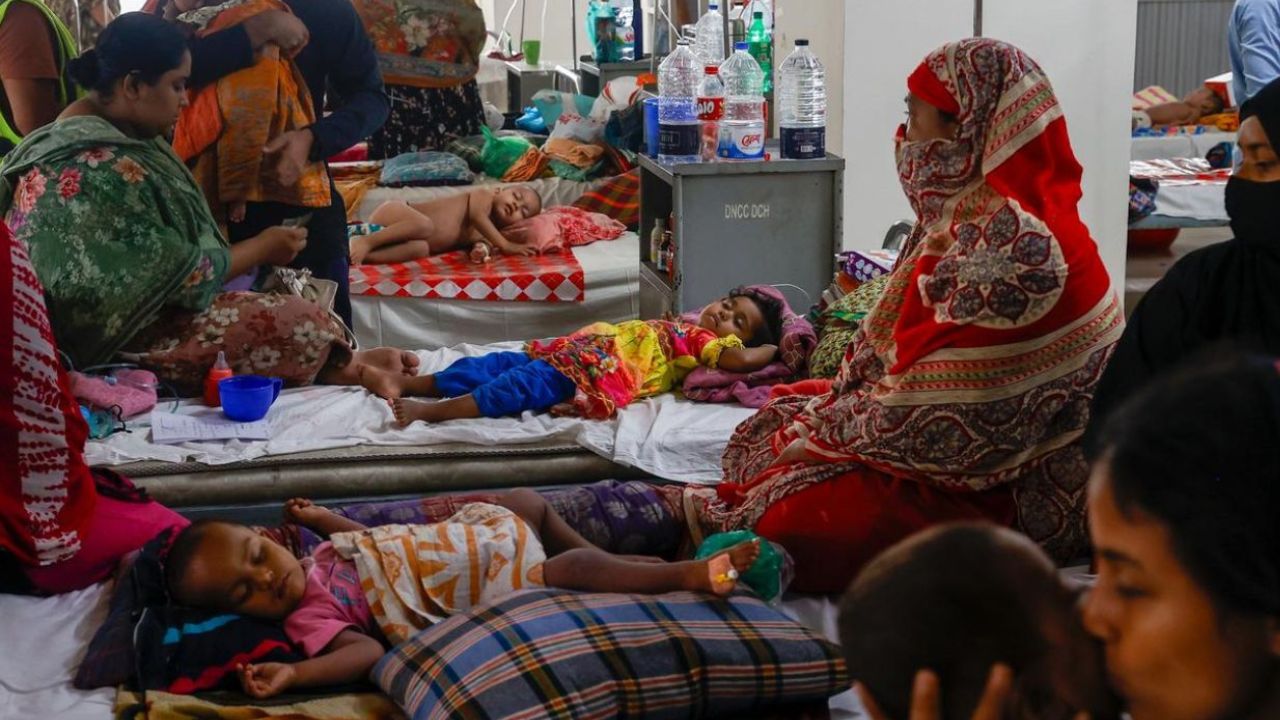
Doctors at Dhaka North City Corporation Hospital, one of the main treatment centres, say most admitted patients are children under the age of two, who face the highest risk and account for the majority of confirmed cases.
They report that severe cases are also concentrated in this age group, particularly among malnourished children and those with underlying health conditions.
These include pneumonia, eye infections and congenital heart defects, all of which significantly increase the likelihood of complications.
Experts say the severity of the outbreak is closely linked to children’s nutritional status.
Professor Abu Torab Md Abdur Rahim of Dhaka University said a lack of breast milk weakens immune development, particularly among children in low-income families, with lasting effects on both immunity and cognitive growth.
The government has launched a nationwide vaccination campaign in response to the outbreak.
The drive began on 5 April in 30 upazilas across 18 high-risk districts, before expanding to four city corporations from 12 April.
Under the Measles-Rubella Campaign 2026, a total of 1,131,128 people have been vaccinated so far—equivalent to 107% of the target for the current reporting phase.
Among city corporations, Mymensingh has achieved 120% coverage, while Dhaka North has reached 92% and Dhaka South 94%.
Out of a total target of 2,180,105 vaccinations, approximately 51.9% has been achieved to date.
Health authorities plan to expand the campaign nationwide from 20 April.
A month-long measles-rubella vaccination campaign will also run in Chattogram City Corporation from 20 April to 20 May, targeting around 303,000 children aged between six and 59 months across 41 wards.
The programme will operate daily from 08:00 to 17:00, except on Fridays and public holidays, and will be formally inaugurated at Chattogram City Corporation General Hospital.
Authorities say 48 fixed teams, 205 temporary teams, 41 mop-up teams and 14 evening teams will be deployed.
Despite these efforts, experts warn the current response remains insufficient.
Be-Nazir Ahmed stressed that vaccination must be expanded rapidly to cover as many children as possible, arguing that the outbreak can only be controlled once a large majority are immunised.
He also highlighted the need for proper isolation of infected children, warning that inadequate isolation in both hospitals and homes is sustaining transmission.
In addition, he called for stronger hygiene measures, including handwashing and mask use.
He criticised the broader response, saying an official epidemic declaration, dedicated budget allocation, national guidelines and more robust public awareness campaigns were urgently needed.
Without a rapid scale-up, he warned, achieving the 95% vaccination threshold required to halt transmission will remain difficult.