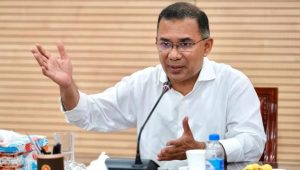
Law Minister Md Asaduzzaman has warned that it is impossible to run Law and Justice Division on “a budget of Tk1”, stating that such a scenario would turn the country into a “police state”.
The minister made these remarks on Tuesday in Parliament during a session presided over by Deputy Speaker Kayser Kamal that focused on the budget allocation for the Law and Justice Division and the cut motions proposed against it.
Minister Asaduzzaman placed a demand for a grant of Tk2,187.58 crore for his ministry. However, several opposition members of Parliament proposed reducing this allocation to a nominal Tk1, citing various crises within the judiciary.
Participating in the discussion on the cut motions, MP Al Faruq Abdul Latif argued that despite the separation of lower courts, the judiciary cannot function independently because the government retains control over promotions and transfers.

He also criticised the prevailing judge shortage, the massive backlog of cases, and ongoing human rights violations.
Mohammad Nazibur Rahman, lawmaker from Pabna-1, described the proposed allocation as “extremely inadequate,” noting that more than 25 lakh cases remain pending across the country. He further highlighted a lack of clear planning for the establishment of High Court benches in divisional cities or the transition to a paperless judiciary.




Adding to the criticism, Mohammad Keramat Ali, lawmaker from Chapainawabganj-1, raised concerns regarding the harassment of ordinary citizens through police activities and the inherent weaknesses in the investigation process.
Rumeen Farhana, independent lawmaker from Brahmanbaria-2, pointed out that the allocation for the judiciary constitutes only 0.3 per cent of the GDP, which she noted is less than the budget for Bangladesh Television (BTV).


She said there are over 50 lakh pending cases and described the “inhumane” living conditions of both veteran and apprentice lawyers.
In his rebuttal, Law Minister Asaduzzaman said that while lawmakers usually provide their own logic for demands, in this instance, it seemed as though they had “hired lawyers in uniform”.
The minister further characterised the lawmakers’ demands as “popular” but “misconceived” (under Rule 118 of the Rules of Procedure), noting that no alternative policy was provided to explain how the entire judiciary could function on such a negligible sum.
While acknowledging that the current allocation is indeed inadequate for the judiciary’s needs, he maintained there is currently no alternative and urged the Parliament to reject the cut motions and approve the original allocation.