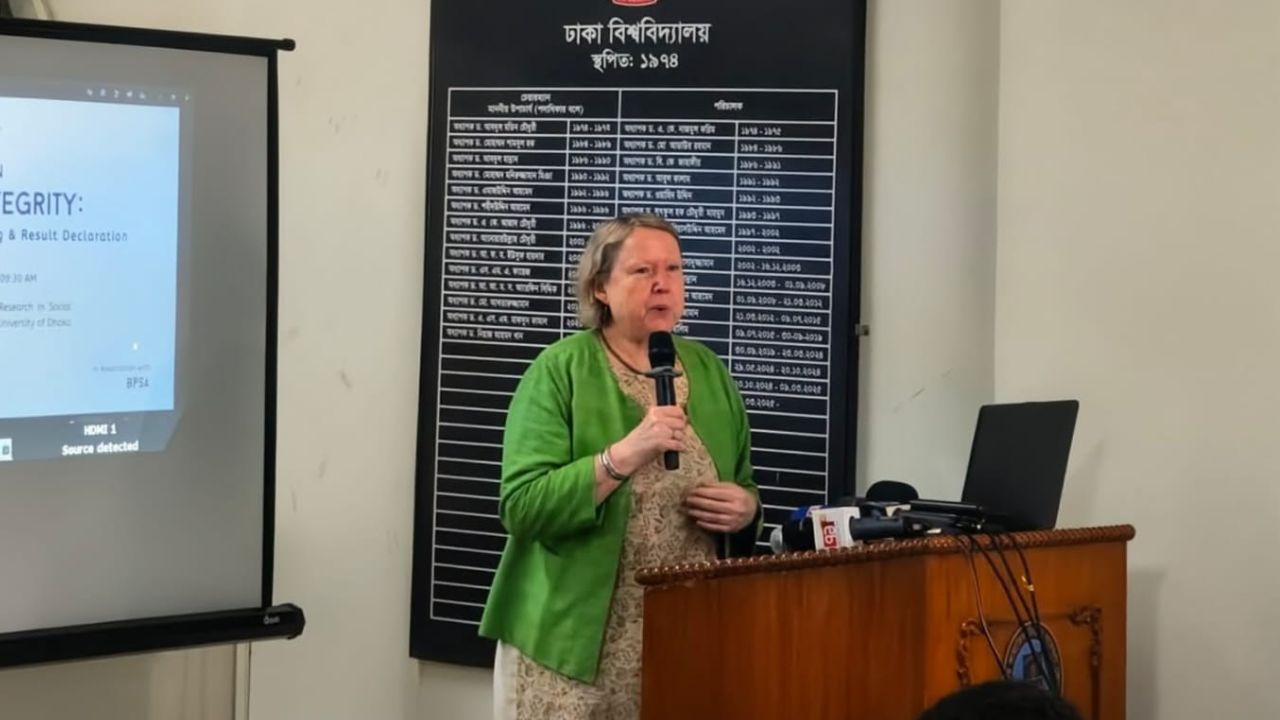

UNESCO’s Bangladesh Representative Susan Vize has said the integrity of information is crucial to ensuring a credible election and public trust in its outcome.
She said an election is not limited to polling day on 12 February. The electoral process began in August 2024 and will continue after results are declared. For that reason, the surrounding information ecosystem plays a decisive role in shaping a strong and trustworthy election.
Susan Vize made the remarks on Thursday while speaking at a seminar titled The electoral integrity: from campaigning to vote counting and the result declaration, organised by the Political and Policy Science Research Foundation at Dhaka University.
She noted “The real question for Bangladesh is whether people will trust the results after 13 February.”
She also questioned whether citizens would trust media narratives and the next government.
“Information integrity sits at the heart of this trust because ordinary citizens do not take part in vote counting. Access to information, its reliability and people’s ability to understand it determine the strength of information integrity” she said.

Vize further said elections must reflect the voices of the people.
“When citizens see content in media or on social platforms that does not represent their voices, they are less likely to believe it. Voices today are multidimensional.
Without strong information systems and an independent media, people cannot trust those voices” she added.
Susan Vize also mentions media freedom does not mean publishing anything without responsibility.


“Media outlets must ensure their reporting is credible and based on the best available information.”
She describes “This is where the line between good media, bad media and social media often collapses. Good media verifies facts. Bad media manipulates audiences. Social media can mix fact and fiction, which weakens credibility.”
She stressed “Critical thinking and media and information literacy are essential to counter misinformation, disinformation and malinformation.”
At the seminar, Norwegian Ambassador to Bangladesh Håkon Arald Gulbrandsen said “Norway’s democratic institutions rank among the world’s strongest, but they did not emerge overnight. Centuries of reform, debate and, above all, trust shaped Norway’s democracy.”
He mentions Norway’s constitution, written in 1814, remains one of the world’s oldest still in force.
“It rests on the principles of separation of powers and popular sovereignty. Universal male suffrage began in 1898, while women gained the right to vote in 1913. Democratic practice has continued since then” he added.
The ambassador said political leaders from opposing ideologies in Norway often maintain personal friendships. He described this as unusual but vital in keeping the country peaceful and stable.
“Personal courtesy and mutual respect among political leaders of rival are essential to a healthy democracy” he said.
Gulbrandsen said “Norway does not use electronic voting machines. The country uses paper ballots for domestic voting, overseas voters and advance voting. This ensures a secure and verifiable process.”
“Authorities count all ballots at least twice, first by hand and then usually through machine scanning” he added.
He farther commented that Norway enforces strict rules on campaign donations and political financing, which remain highly transparent and ethical.
Gulbrandsen mentions “Key features of Norway’s electoral integrity include efficient and credible administration, updated electoral laws, reliable voting methods, double ballot counting, transparency in political financing and robust election observation. Central and local authorities jointly manage elections.”
He said this shared responsibility builds trust because no single central body controls the entire process.
The seminar also presented four core recommendations to strengthen Bangladesh’s democratic resilience.
These included holding transparent and impartial elections in line with international standards, taking effective measures to curb digital disinformation, ensuring strong oversight with security for domestic and international observers and party agents, and promoting inclusive dialogue involving students, civil society and all political parties.