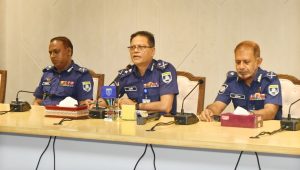
The International Crimes Tribunal (ICT) reprimanded Chief Prosecutor Tajul Islam during the hearing on charge framing in the enforced disappearance case. At this time, a tense situation arose in the courtroom. This incident occurred in the three-member International Crimes Tribunal-1, led by Justice Md Golam Mortuza Mazumder, on Tuesday, 23 December.
The court framed charges against 17 individuals, including current and former army officers, in the enforced disappearance case from the Task Force for Interrogation (TFI) cell.
Following this, lawyer Tabarak Hossain, representing the army officers, said, “The prosecution has submitted a voluminous document. It will take time to read these and prepare. We will file a review petition against the charge framing. Besides, I am ill and need treatment. We need three months’ time.”
At this time, the tribunal’s second senior member, Justice Shafiqul Alam Mahmud, said, “We will grant time if needed.”

At this point, chief prosecutor raised an objection to the court’s decision to grant time without hearing the prosecution’s arguments. He said, “It will not be proper to grant time without hearing our arguments.”
At this time, Justice Shafiqul Alam Mahmud said, “Learned Chief Prosecutor, you should not keep standing up abruptly. Do we have to act according to your words? Will you make us handicapped? Please sit down.”
Multiple lawyers present in the court informed TIMES of Bangladesh that Justice Shafiqul Alam Mahmud spoke in a more agitated tone than usual at this time.




Tajul Islam said, “If you give an opinion, the defence will take advantage, and we will be harmed; this is not justice.”
The tribunal’s second senior member said, “You keep standing up abruptly; do not do this. The defence must be given time. Have we said we will grant time? We are discussing. We haven’t given a decision yet. Can’t we speak?”
The chief prosecutor said, “You can speak, but if you make a decision based on your discussion without hearing our arguments, it creates precedent.”
He said, “The International Crimes Tribunal Act is a special law. Due to the gravity of the crime, the trial of this case is to be conducted without delay. The purpose of this law is to conclude the trial promptly, without delay. Here, it is stated that the defence should be given a minimum of three weeks after charge framing. But in this case, the defence has already received four weeks even before charge framing. Now, there is no scope to grant additional time beyond the three weeks permitted by law. Granting more than three weeks will not serve justice.”
He further said, “If the defence lawyer is ill, he should withdraw from the case. Why did he take the case if he is not fit? The court will not sit idle for him. He is representing seven accused, do we have to give separate time for each of the seven? It’s the same incident, the same charges; preparing for one means preparing for the others as well. Essentially, the defence wants to prolong the case. Witnesses are being threatened, stabbed. How will we conduct the trial if the witnesses are killed?”
Referring to statements given by the defence lawyers outside the court, the chief prosecutor told the tribunal, “The defence lawyers go outside and say, ‘Army officers are being tried.’ This is an attempt to create hype and pit them against the army. These accused were in RAB at the time of the incident; the crimes committed at that time are being tried. They did not commit these crimes while in the army, in army uniform.”
At this time, the tribunal’s chairman said, “We are not against the army; the army is not being tried here.”
Tajul said, “My witnesses are being threatened. They are being threatened with enforced disappearance. The case will be jeopardised if there are no witnesses.”
Subsequently, 21 January has been fixed as the date for the prosecution’s opening statement.