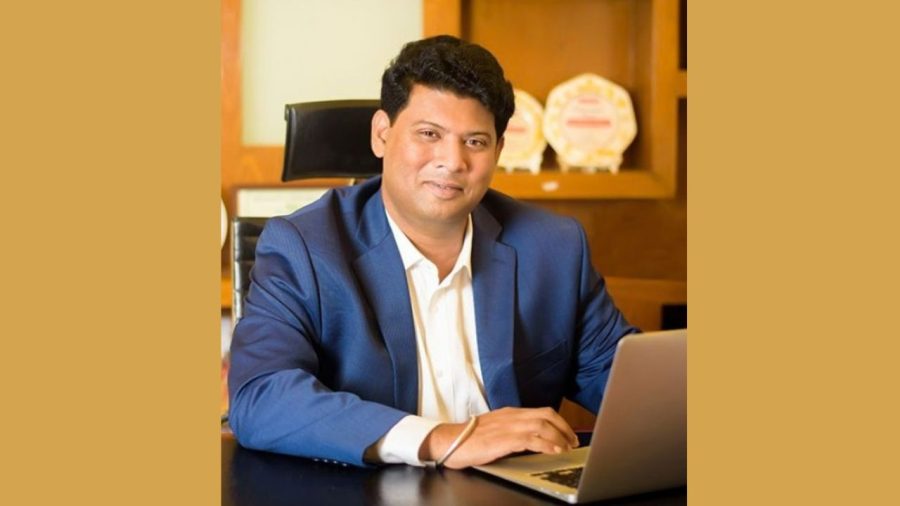



In 1999, Abul Kalam Hasan started his first business with a Tk3,000 loan from a friend, selling mobile recharge cards at a time when mobile connectivity had just started to pick up.
More than two decades later, that small trading venture has evolved into Halima Group, a local technology and consumer electronics company manufacturing mobile phones, accessories and household appliances, with a distribution network of more than 400 dealers across the country.
It even caters to 11 local handset brands through contract manufacturing, Abul Kalam Hasan, chairman of today’s Halima Group, told TIMES’ Mahfuz Ullah Babu in an interview.
The journey was built around a simple strategy: understand the market, earn customer trust, learn about quality manufacturing, and gradually move from trading to manufacturing.
“Halima is my mother’s name,” Abul Kalam Hasan said.
“She raised us with great hardship after my father passed away when I was very young. When I decided to build something of my own, I wanted her name to be associated with it.”
When Grameenphone launched prepaid services in Bangladesh, demand for SIM cards and handsets increased rapidly. Hasan saw an opportunity but lacked the capital required to maintain inventory.
He collected advance payments from customers, travelled to Dhaka and brought products back to his hometown Cumilla on the same day for delivery.
Within two days, he received around Tk35 lakh in advance orders.
At a time when shortages allowed sellers to charge higher prices, Hasan followed official pricing and earned only his fixed commission. The approach helped him build credibility among customers.

That trust became the foundation for his next move — building his own brand.
Building a Bangladeshi name
Hasan entered the accessories market after noticing that many products were imported and sold under foreign labels, despite being manufactured in similar production ecosystems.
In 2010, he travelled to China to explore manufacturing opportunities and began developing products under the Halima brand.
The transition was difficult. Consumers were accustomed to international names and often associated foreign labels with quality.
Hasan said the challenge was convincing customers that a Bangladeshi brand could offer reliable products.
Instead of competing only through pricing, Halima focused on product quality, warranty support and adapting products to local conditions.
The company later expanded into chargers, batteries, electrical products and household appliances.




Hasan believes a brand cannot be built only through advertising.
Halima Group focused on product performance, customer satisfaction and after-sales service rather than relying heavily on celebrity endorsements or large marketing campaigns.
“A brand is created when the product speaks,” he said.
He said products designed for Bangladesh must consider local realities, including weather conditions, electricity fluctuations and consumer usage patterns.
The company introduced products with warranty support and focused on improving quality control.
Halima Group expanded beyond mobile accessories into electrical items, including lights, switches, sockets, circuit breakers and emergency lights.
The company later entered home appliances such as rice cookers, blenders, kettles and induction cookers.
Hasan said the expansion followed areas connected to his existing expertise rather than unrelated business segments.
“I did not want to enter every possible business. I stayed within areas I understood,” he said.
The company also entered mobile phone manufacturing after the Covid-19 period and currently manufactures handsets under 11 different brands through contract manufacturing arrangements.
Manufacturing outside major cities
Halima Group’s mobile phone manufacturing facility is located in rural Comilla, where a large portion of the workforce consists of women.
Around 90-95 per cent of workers at the facility are women, many of whom joined without previous manufacturing experience.
Hasan said training and workplace support helped them develop technical skills.
“Women are patient and capable of doing precise technical work,” he said.
The factory has also created employment opportunities for people in surrounding communities, allowing many workers to earn regular incomes close to their homes.
Hasan describes entrepreneurship as a process of overcoming repeated challenges.
He said he faced major financial difficulties several times, including losses after two cargo vessels carrying imported goods sank while travelling from Chattogram to Pangaon.
The losses came during a period when businesses were already facing difficulties in accessing foreign currency and bank financing.
Instead of seeking additional loans, he relied on his experience and gradually rebuilt operations.
“The knowledge I gained from starting from zero, the courage and the ability to face problems helped me recover,” he said.
For Hasan, difficulties are part of an entrepreneur’s learning process.
“The biggest blessing for an entrepreneur is getting stuck. Every obstacle teaches you something,” he said.
Next phase: technology-led growth
Hasan now wants Halima Group to focus more on technology-based products and expand its manufacturing capabilities.
He believes Bangladesh has a large pool of young people with entrepreneurial potential but needs better access to finance, training and support.
“If small entrepreneurs receive support and financing, many young Bangladeshis can build successful businesses,” he said.
From a small mobile recharge business to a manufacturing company producing electronics and mobile phones, Halima Group’s growth reflects the shift of local entrepreneurs from trading towards technology and production.
For Hasan, the goal remains building products from Bangladesh that can compete beyond the domestic market.