


Bangladesh Food Safety Authority (BFSA) has proposed front-of-package warning symbols for packaged food items that exceed set limits for sugar, salt or saturated fat, to help consumers easily identify unhealthy products. But the draft regulation remains stuck in process, with no timeline for finalisation.
The draft of the “Safe Food (Packaged Food Labelling) Regulations, 2026” was sent to the Ministry of Food on 30 June. No specific timeline has been announced for its finalisation.
Under the proposed regulation, if a product contains sugar, salt or saturated fat above the prescribed limit, a warning symbol must be placed on the front main display area of the package. The draft specifies the symbol’s size, position, surrounding space and colour contrast so it catches the buyer’s eye.
Currently, many packages carry nutrition information in small letters on the back.
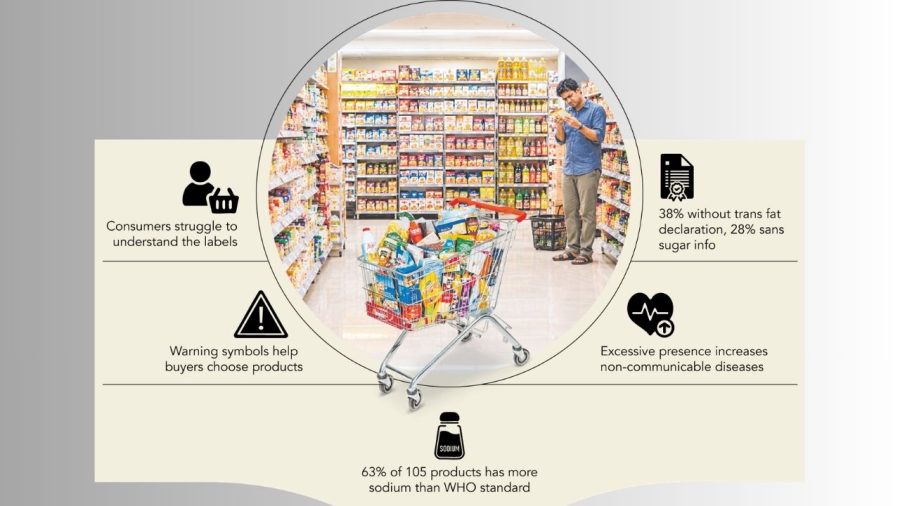
Sumaiya Jahan, a mother of three, said she struggles to understand the labels. “The writing is very small and quite difficult to read,” she said.

Mohammad Shoaib, a BFSA member, told TIMES, “We sent the draft to the food ministry on 30 June. We have received opinions from various organisations and business bodies, as well as from the WTO through the commerce ministry. After reviewing those, the ministry will send the draft to the law ministry after necessary additions and deletions.”
He said it was difficult to specify when the regulation would be finalised. Asked whether there was resistance from businesses, the BFSA member said, “No such obstacle is found yet.”
Shah Abdul Alim Khan, additional secretary of the law wing at the Ministry of Food, also said the matter is under process and work is ongoing. He could not say anything about a probable timeline.




Survey findings
A study published in the journal titled “Sodium Content and Label Discrepancies in Processed and Ultra-Processed Foods in Bangladesh: A Public Health Concern”, surveyed 974 children, adolescents and adults across eight divisions. Of them, 97 per cent said they had eaten at least one processed or ultra-processed food in the previous week. Data was collected between December 2021 and April 2022.
In the same study, 63 per cent of 105 products tested had more sodium than WHO regional or global standards for the respective food category. The result, however, is for the tested products only, not all products in Bangladesh.
A 2023 study published online and in the 2024 issue of Food Science & Nutrition found that 46 per cent of tested products did not declare saturated fat information; 38 per cent did not declare trans fat; and 21 per cent did not declare sugar and salt information. Some products’ declared amounts did not match laboratory findings.
Packaged food is not necessarily unhealthy. But if salt, sugar and unhealthy fat are regularly consumed in excess, the risk of non-communicable diseases increases.
WHO advises adults to consume less than five grams of salt per day, or about two grams of sodium. This daily limit should not be equated with the sodium value per 100 grams of any single product. According to WHO, about 71 per cent of total deaths in Bangladesh are caused by non-communicable diseases.
International experience
According to the Global Food Research Program, a survey in Uruguay after warning symbols were introduced found 77 per cent of participants had seen the symbol; 58 per cent said they changed their purchasing decision after seeing it. Changing a decision does not mean everyone stopped buying the product- some chose products without warning symbols or with fewer symbols.
In Mexico, a survey on warning symbols introduced in 2020 found 74 per cent of respondents supported the system; 72 per cent said the symbol was easy to understand and helped in product selection.
A 2023 simulation modeling study in Canada estimated that if front-of-package labelling were effective on products with excessive nutrients, 2,183 to 8,907 diet-related deaths could be prevented or delayed annually. The Canadian figure is an assumption based on simulation, not an actual observed change.
ABM Zubair, executive director of research and advocacy non-profit PROGGA, has called for finalising the regulation quickly and introducing mandatory and clear warning symbols.
According to him, this would allow buyers to know necessary information with ease before buying food.