


Several Bangladeshi mutual funds have delivered double-digit annualised returns since inception, in some cases well above typical bank deposit rates.
Yet most retail investors continue to chase speculative stocks in search of quick gains, a pattern market professionals link largely to weak financial literacy.
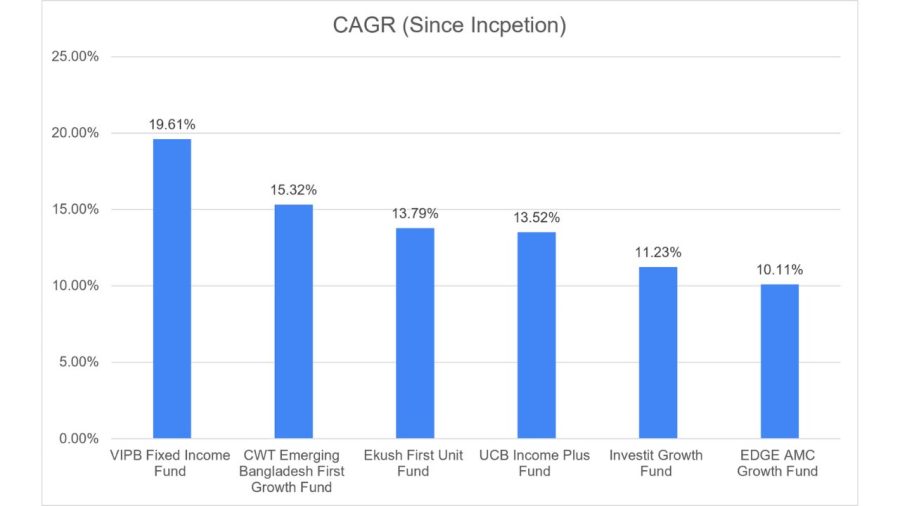
According to mutual fund tracking platform Bini, VIPB Fixed Income Fund has generated a 19.61 per cent compound annual growth rate (CAGR) since inception, followed by CWT Emerging Bangladesh First Growth Fund with 15.32 per cent and Ekush First Unit Fund with 13.79 per cent.
UCB Income Plus Fund has returned 13.52 per cent, Investit Growth Fund 11.23 per cent and EDGE AMC Growth Fund 10.11 per cent a year on a compounding basis since their inception.
Bank fixed deposits, by comparison, generally offer annual returns of around 9–10 per cent, while the broader stock market eroded capital for most of the average investors since late 2022.
However, many blue-chip stocks generated high returns for investors over the period.
This shows that retail investors have had long-term alternatives to speculative stock picking.
Most, however, still rely on tips, momentum and the hope of making large profits quickly, sometimes losing substantial portions of their capital.

That gap between available investment options and investor behaviour is at the heart of World Investor Week, which opened on Sunday with a focus on financial education, investor protection, digital fraud and investment risks.
Market professionals say better financial literacy can help investors understand risk and return, distinguish long-term investment from speculation and make more informed choices across shares, mutual funds and other financial products.
But education alone will not solve the problem.
Shahidul Islam, managing director and CEO of VIPB Asset Management Company, said lack of financial literacy was one factor behind investor losses, but not the only one.
A second problem is deep distrust of the mutual-fund industry after years of irregularities and mismanagement, he said.
“There has been a lot of looting in this sector,” Islam said, adding that the resulting loss of confidence, too, discourages investment.




Ordinary investors often view mutual funds as a place where money has been misappropriated, he said.
“If there is no trust, how will investment come?” he said.
The challenge is therefore two-sided: investors need a better understanding of how markets work, while financial institutions need to rebuild credibility.
Al-Amin, acting dean of the Faculty of Business Studies at the University of Dhaka and a capital-market analyst, said seminars and discussions would have little impact unless investors could see practical results.
He said financial education based on global standards needed to be applied to the realities of Bangladesh’s market rather than remain confined to seminars and awareness programmes.
The broader discussion at World Investor Week also turned to governance and the structure of the capital market.
Finance Minister Amir Khosru Mahmud Chowdhury said the market needed stronger governance and spontaneous self-regulation by institutions if it was to recover from its current fragile condition.
Bangladesh had made institutional and infrastructure improvements over the years, including automation and the establishment of Central Depository Bangladesh Limited, but those changes had failed to produce satisfactory results across the market, he said.
As a result, the capital market, along with the broader economy, had fallen into what he described as a “deep hole”.
The government is now trying to pull the market out of that position, he said, warning that the process would require difficult and painful decisions.
Khosru also called for a fundamental change in Bangladesh’s financing structure.
The economy has long relied heavily on bank lending, with short-term deposits often used to finance long-term investments, creating structural problems, he said.
Bangladesh therefore needs to expand long-term financing through the bond market, derivatives, securitisation and equity markets if it wants to move towards a more developed financial system.
He described that transition as a move from “High Street to Wall Street”.
Khosru said the Bangladesh Securities and Exchange Commission could not transform the market on its own.
Brokers, stock exchanges, the central depository, credit-rating agencies and the Financial Reporting Council all need to strengthen professional standards, institutional capacity and ethical conduct, he said.
Rather than waiting for regulators to dictate every step, market institutions should take responsibility for maintaining transparency, trust and discipline through self-regulation.
The finance minister said regulatory rules alone would not be enough without ethical responsibility across the market and expressed hope that Bangladesh’s capital market would look significantly different within a year.
Officials from the BSEC, finance ministry, Bangladesh Bank and National Board of Revenue, representatives of capital-market institutions and international organisations, and investors attended the World Investor Week programme.
For market professionals, the challenge extends beyond teaching investors basic financial concepts.
Unless investors learn to distinguish sustainable long-term returns from speculative bets, while fund managers and market institutions rebuild trust, retail money is likely to keep chasing quick profits instead of long-term wealth creation.