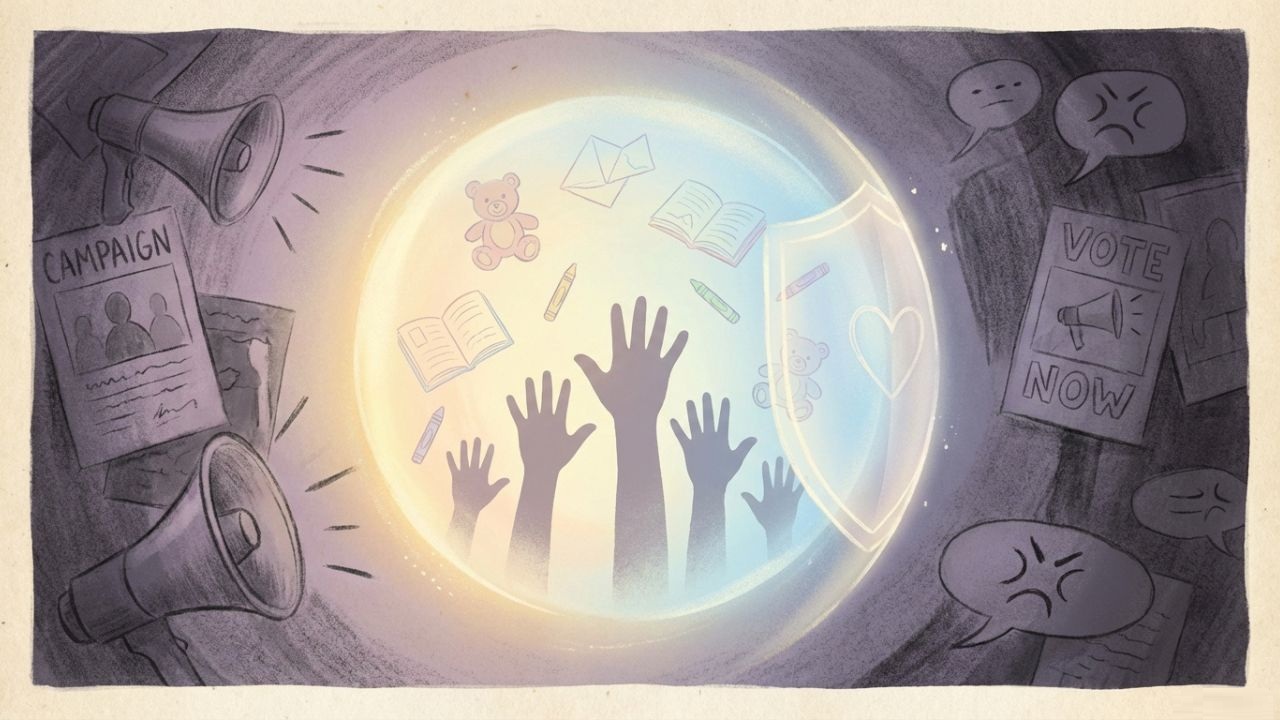

Social media platforms are increasingly being used to disseminate political propaganda involving children ahead of the 13th parliamentary election.
A recent content analysis, performed by Dismislab, reveals a disturbing trend where children are seen chanting slogans and delivering aggressive remarks against political opponents.
In many instances, parents are intentionally involving their children in these campaigns, claiming that the presence of minors generates a higher level of engagement, despite the resulting influx of hateful comments directed at the children.
Supporters of major political entities, including BNP, Jamaat-e-Islami, and National Citizen Party (NCP), have all been observed featuring children in their promotional materials.
Hate speech and scripted content
Dismislab has identified problematic content on various social media pages, most notably on a page managed by an individual named Ziaur Rahman.
One viral 22-second reel shows women campaigning for BNP candidate Mirza Abbas in the Dhaka-8 constituency, while the bottom half of the video features a child, aged approximately eight or nine, using a derogatory term to label the female activists as “residential [sex] workers.”
This video alone garnered 53,000 reactions and over 5,000 shares, with hundreds of users encouraging the child in the comments section.

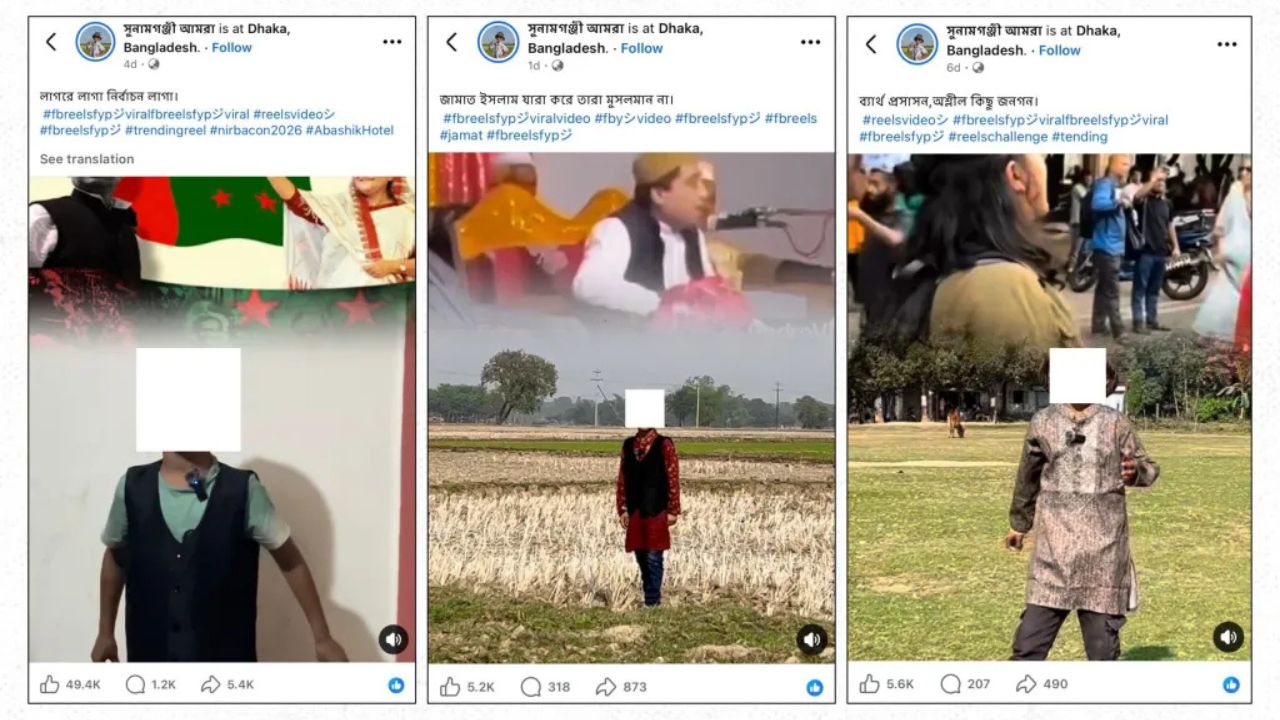
Ziaur Rahman, who identifies the child in the videos as his 14-year-old brother, admitted that the content often targets trending topics to gain an audience. He acknowledged the use of indecent language and expressed regret, promising to be more cautious in the future.
Other videos on the same page show the child suggesting that critics of Delwar Hossain Sayeedi and Mizanur Rahman Azhari should be “beaten with shoes” or attacking “protesting women” for their “shameless” attire and slogans.
Scripted videos have surfaced where children are used to provoke political reactions. In one instance, a child asks a man to vote for the “Scale” (the symbol for Jamaat-e-Islami), prompting the man to hurl abuse and a shoe at the child.
The video concludes with the child stating that the public will deliver their verdict on the 12th.




Exploitation by parental content creators
Another prominent source of such content is the “Raihan’s Kids” page, which has 98,000 followers and is managed by Shahadat Kabir Raihan. Raihan uses his four children, the eldest being in the ninth grade and the youngest in the first grade, to promote Jamaat-e-Islami and its candidates.
In one video, a child is heard requesting three specific seats – Dhaka-17 for SM Khaliduzzaman, Cox’s Bazar-1 for Abdullah Al Farukh, and Dhaka-8 for the NCP’s Muhammad Nasiruddin Patwari – promising that the party would then “gift 300 seats to the nation.”
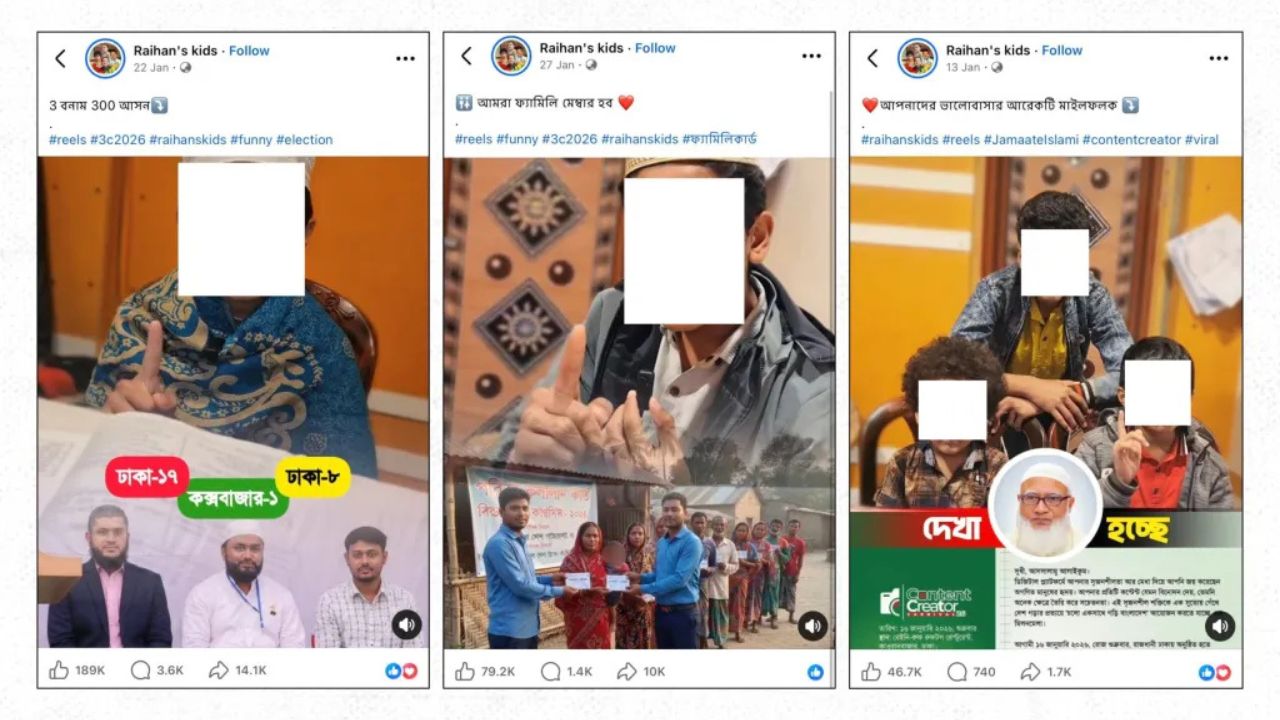
Raihan admitted to scripting these videos himself, stating that “people listen a bit more when children speak.” His content even utilises AI-generated imagery, such as a family-themed photo of the Jamaat Amir, to contrast political “family cards” with the idea of being a “family member” to the public.
Despite Raihan’s claims that his children are becoming politically aware, the comment sections of these videos are often filled with vitriol, with users calling the children “descendants of Pakistani Pharaohs.”
Similarly, a profile named Jahidul Islam features a child regularly campaigning for NCP candidate Hasnat Abdullah.
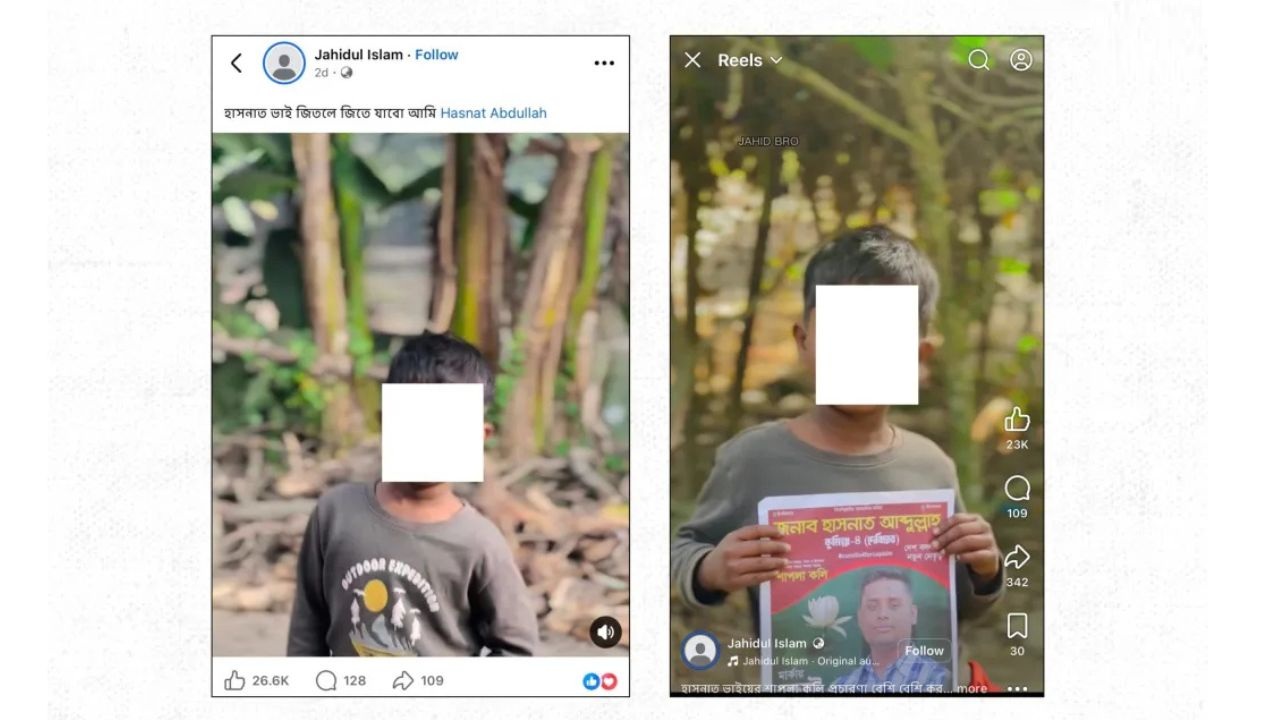
In these videos, the child declares they will not vote for BNP, Awami League, or Jamaat, but only for Hasnat Abdullah, claiming “if Hasnat brother wins, I win”. The child is also seen holding posters for the “Shapla Koli” (water lily bud) symbol and promising to go door-to-door for the campaign.
Common slogans, regional comparisons
A recurring theme across various platforms is the use of specific slogans by children in processions or scripted clips.
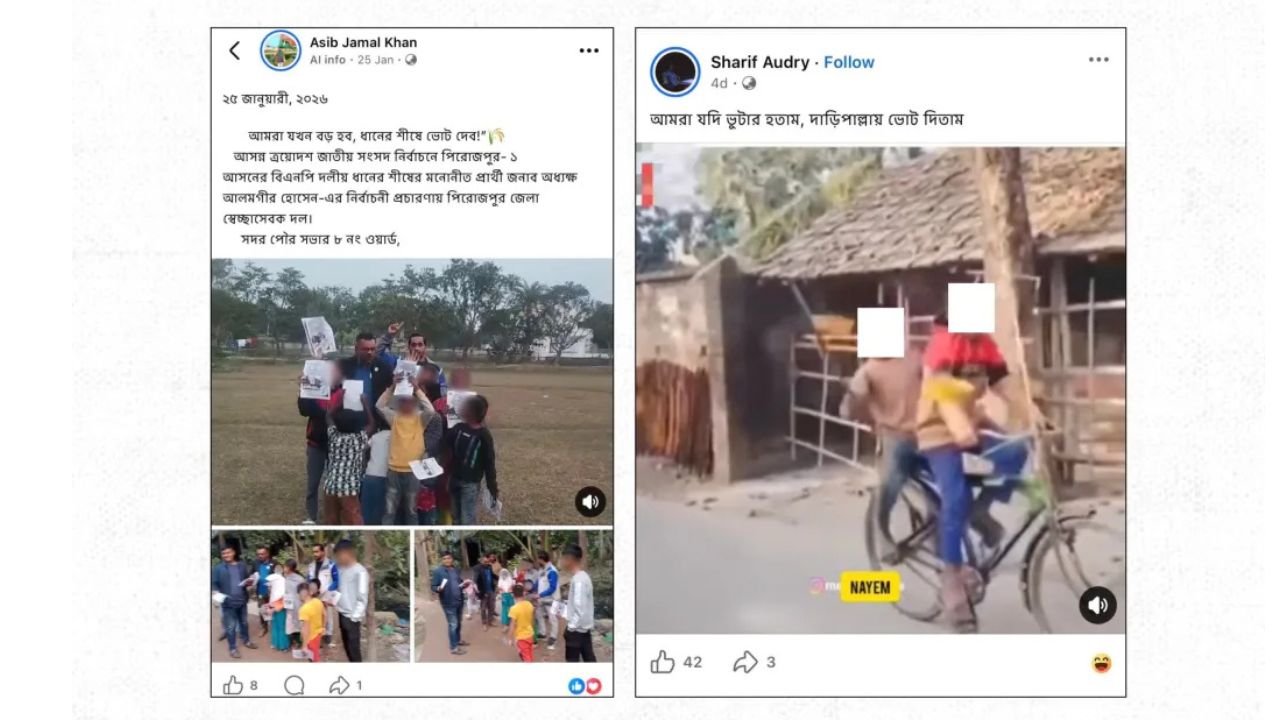
Children are frequently heard chanting, “When we grow up, we will vote for the Paddy Sheaf” in support of the BNP, or “If we were voters, we would vote for the Scale” for Jamaat-e-Islami. Some videos even show adults coaching very young children to repeat party symbols for the camera.
Experts and legal professionals have raised serious concerns regarding these practices. Barrister Priya Ahsan Chowdhury noted that using children in obscene, derogatory, or misogynistic political content clearly violates child protection policies.
While the Representation of the People Order (RPO) 1972 and electoral codes of conduct can penalise hate speech or the defamation of women with imprisonment or the cancellation of candidacy, there is no specific clause in Bangladeshi electoral law that explicitly bans the use of children in all forms of campaigning.
This stands in stark contrast to neighbouring countries.
In India, the Election Commission issued a directive on 5 February 2024, stating that involving children in any political activity – including distributing pamphlets, shouting slogans, or even carrying them in campaign vehicles – is a direct violation of child labour laws.
Nepal has also implemented a code of conduct that strictly prohibits the inclusion of children in election campaigns.
Policy gaps and child rights
Although the National Children Policy 2011 of Bangladesh (Section 6.7.4) prohibits the use of children in political activities or involving them through inducement or coercion, these guidelines are not explicitly mirrored in the Child Act 2013 or current election regulations.
Barrister Chowdhury argues that the National Children Policy should be applicable to elections, as campaigning is inherently a political activity. She suggested that the current deficiency lies not in policy, but in the absence of specific electoral directives, forcing courts to rely on constitutional ideals.
A report by the Hintalovon Child Rights Foundation emphasised that children should be educated about politics but never used as “objects” for political ends.
The foundation maintains that using a child’s image or information for propaganda is a violation of their rights, even if parental consent is obtained, as children are not public figures and often lack the capacity to understand the activities they are being drawn into.