Zahed Ur Rahman, adviser to the Ministry of Information and Broadcasting and Ministry of Cultural Affairs, has said the shared objective of the July uprising was the downfall of the then prime minister Sheikh Hasina.
The adviser made these remarks as the chief guest at a programme titled ‘Monone July’, organised by the Department of Film and Television at the central auditorium of Jagannath University on Wednesday.
Zahed noted that since the 2011 constitutional amendment which abolished the caretaker government system, it was clear which path Hasina was taking.
He mentioned that he had been vocal about this issue across various platforms, including blogs, newspaper columns, and talk shows, since that time.
Drawing from that experience, he asserted that the unified demand of the July movement was the departure of Sheikh Hasina and the creation of a democratic Bangladesh, as her greatest crime was the disenfranchisement of the people’s democratic rights.

Regarding various political thoughts in the post-movement period, he observed that different ideas have emerged following the success of the uprising.
While some have proposed an Islamic Republic, a revolutionary government, or the rewriting of the constitution, he emphasised that the primary goal must remain the establishment of a democratic Bangladesh.



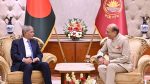
Reflecting on his experiences during the movement, Dr Zahed Ur Rahman said that while many consider him courageous, he does not view himself as such.
He recalled the intense pressure and atmosphere of fear in July, noting how difficult it would have been to imagine the consequences had the movement failed.
However, he witnessed that the people were not afraid. Those who took to the streets and sacrificed their lives showed no fear, and even those sections of society who do not typically join such movements participated.
He attributed the success of the movement to this collective power of the people.
Addressing the status of the interim government, he stated that the country is moving towards a democratic Bangladesh. He remarked that the government has been formed through a good election.
While acknowledging that the government has its faults – which he noted he also speaks about – he maintained that they are working with sincerity.
Underscoring the importance of reforming the electoral system, he said a democratic framework must be developed that upholds the spirit of July, where elections are conducted fairly.
He added that in such a system, any party could win or lose, but the democratic process itself must be sustained. He believes that if this can be achieved, a different Bangladesh will be visible within the next 15 to 20 years.
The programme was presided over by Professor Dr Shah Nistar Jahan Kabir, Chairperson of the Department of Film and Television.
Special guests in attendance included Anisur Rahman Khokon Talukdar MP (Madaripur-3), Sanjida Islam Tuli MP (Reserved Seat for women) and Coordinator of ‘Mayer Dak’, the university’s Vice-Chancellor Professor Dr Md Rais Uddin, and Treasurer Professor Dr Sabina Sharmin.