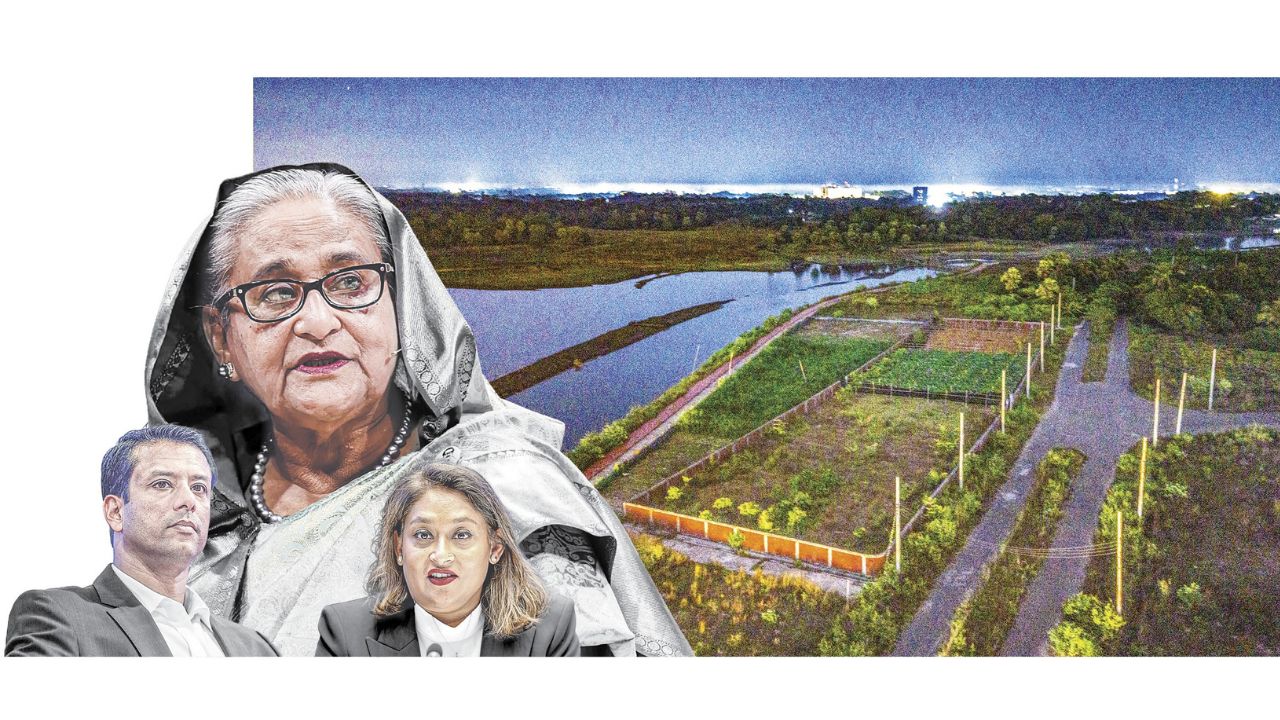

Deposed prime minister Sheikh Hasina has been sentenced to a total of 21 years in prison in three corruption cases over the controversial allocation of prized plots in the Purbachal New Town Project, marking her third conviction since fleeing the country amid mass protests last year.
Her son Sajeeb Wazed Joy and daughter Saima Wazed Putul were each handed five-year jail terms in separate cases arising from the same investigation. The verdicts were delivered by Special Judge’s Court-5 in Dhaka on Thursday, following months of hearings, dozens of witnesses, and a dramatic shift in the country’s political landscape since the collapse of the Awami League government in August 2024.
Hasina, who has been living in New Delhi since her dramatic fall on 5 August 2024, was tried in absentia. There was no legal representation for her as, under ACC rules, fugitives are not entitled to defence counsel.
Judge Mohammad Abdullah Al Mamun issued an extensive and unusually sharp set of findings that not only convicted the defendants but delivered a strong indictment of Rajdhani Unnayan Kartripakkha (Rajuk) and the Ministry of Housing and Public Works, accusing both institutions of entrenched illegality, patronage networks, and wilful violations of the law.
The court handed Hasina seven years’ imprisonment in each of the three cases, alongside Tk300,000 in fines and, in default, 18 months’ non-rigorous imprisonment. The sentences will run consecutively. Joy and Putul were each fined Tk100,000 with an additional six months’ imprisonment if unpaid.
Convicted and acquitted
Among the accused, only one was acquitted: Saiful Islam Sarkar, an administrative officer at the housing ministry, who was cleared in all three cases after the court found the allegations against him not proven beyond reasonable doubt.

Those convicted include Hasina, her son Joy and daughter Putul and several senior officials. These include former state minister for housing Sharif Ahmed, housing secretary Shahid Ulla Khandaker, and additional secretary Kazi Wasi Uddin, each handed 18-year sentences.
Former Rajuk chairman Anisur Rahman Mia was sentenced to 15 years, while former prime minister’s personal secretary Mohammad Salah Uddin received 12 years. Former Rajuk member (estate and land) Mohammad Khurshid Alam, the only accused who appeared in custody, was given a cumulative three-year sentence and sent back to prison immediately after the verdict.
In addition, multiple Rajuk members and directors were convicted across the three cases, receiving sentences ranging from one to nine years. A total of 47 accused are named across the three cases—corresponding to 22 unique individuals due to overlaps.
Court slams Hasina for ‘greed over state resources’
During delivery of the verdict, the judge made several striking remarks, saying that although Hasina had never applied for a plot under Rajuk’s rules, she applied for possession once she received one, demonstrating “a clear desire for property.”




He said Hasina took plots for herself, her son and daughter, and later for her sister Sheikh Rehana and Rehana’s two children, adding that “the nation’s resources drew her covetous attention” and that even after serving four terms as prime minister, she “could not restrain herself from acquiring public assets.”
He said the exposure of the plot irregularities had come through media reporting. “The media has acted as the fourth pillar. Without your reports, ACC would never have filed this case,” the judge said, noting that newspaper investigations had triggered the commission’s inquiry.
After Hasina’s ouster, ACC investigated six plots allotted to six members of her family—each measuring 10 kathas—and filed six cases at the start of this year after finding evidence of irregularities.
According to the prosecution, after becoming prime minister in 2009, Hasina used her influence to secure six Purbachal plots for herself and her family, concealing the fact that they already owned property in Dhaka. The plots were approved even after the deadline for applications had passed.
Judge accuses Rajuk, ministry of systemic illegality
The judge said Rajuk’s board members, including those present at the time, had knowingly approved allotments despite the absence of applications. He noted that Hasina’s affidavit falsely claimed she had no property in Dhaka, that it had not been notarised, and that procedural rules were ignored before granting her the plot in 2022.
The court also heard that former state minister Sharif Ahmed approved the allotment on 18 July 2022 without following legal provisions, and that ministry officials and Rajuk later endorsed it without compliance.
In its strongly worded judgment, the court said Rajuk had “persistently and wilfully” violated mandatory laws governing the allocation of public land. Judge Mamun said senior officials had knowingly disregarded procedural safeguards and processed applications in a manner designed to favour privileged individuals, reflecting “an institutional mindset in which statutory law is treated as irrelevant for politically powerful and influential persons.”
The verdict noted that plots were disproportionately granted to the then prime minister and her extended family, officials from the Prime Minister’s Office, ministers, ruling party leaders, senior bureaucrats and politically connected figures, converting public resources into instruments of private advantage.
The court said a limited provision allowing “special category” allotments had been repeatedly abused, with Rajuk approving applications without documentation, scrutiny or eligibility checks.
The Ministry of Housing and Public Works was also faulted for failing to supervise Rajuk, allowing irregularities to flourish and issuing politically motivated recommendations for special-category allotments that “perpetuated elite capture.” The judge said this amounted to deliberate abandonment of lawful oversight and institutional dereliction of duty.
Hasina’s third verdict deepens legal peril
State prosecutors expressed dissatisfaction with the sentences, saying they had expected maximum punishment. State lawyer Md Moinul Hasan said they would consult the ACC before deciding on an appeal.
Another prosecutor, Sultan Mahmud, said several charges under sections 161, 163, 164, 409, 420 and 109 of the Penal Code were not proven against Joy and Putul, with only section 5(2) of the ACC Act substantiated. For Hasina, only section 420 of the Penal Code and section 5(2) of the ACC Act were proven, while sections 161, 409 and 109 were not. Conviction under section 109 could have resulted in life imprisonment.
Thursday’s judgment marks Hasina’s third conviction since her fall. On 2 July 2024, the International Crimes Tribunal sentenced her to six months’ imprisonment in an early post-uprising case for contempt of court — a ruling widely viewed as a signal from the judiciary that her legal troubles were only beginning.
On 17 November 2024, she was awarded death penalty by the same court for crimes against humanity during the July 2024 uprising, a verdict that dramatically escalated the stakes of her exile.
The new Purbachal verdict is unprecedented in scope for the stature of the accused and for the court’s far-reaching institutional directives. All eyes are now expected to be on the remaining three cases against the former prime minister and others.
Whether Hasina will ever return to the country to face the outcomes of these trials remains uncertain, but the verdict, the institutional criticisms and the sweeping reform orders are expected to have significant implications for the country’s political, bureaucratic and urban governance systems.