Greenland is the largest island in the world. Geographically, it lies in the North Atlantic and the Arctic Ocean, east of the Canadian Arctic, spanning about 2.1 million km2. About 80% of the island is covered by an ice sheet. It has a population of 56,000, mostly Inuit people. Nuuk is the capital city. Fishing is the island’s primary export and the largest source of employment.
Greenland has been a Danish colony for roughly 300 years. It is about 3,000km away from Denmark. In 1953, Greenland became a part of Denmark, and the Greenlanders were granted Danish citizenship. Through a 1979 referendum on home rule, Greenland took control of its domestic policies, leaving Denmark to handle defence and foreign affairs. Finally, the Self-Governing Act of 2009 empowers Greenland to declare independence from Denmark at its discretion.
Around 84% of Greenlanders prefer independence. However, they face challenges related to environmental degradation, development needs, and the preservation of their Inuit way of life. If they become independent, they will lose the Danish subsidiaries that are essential to run the country. Greenland can improve its economy only by allowing foreign companies to mine and extract resources. But that too is a lengthy and difficult process, as the island is isolated and lacks infrastructure.
Historically, the United States was intensely interested in purchasing Greenland. For example, in 1867, the U.S. Secretary of State William H. Seward negotiated to buy Greenland from Denmark, but the deal fell through. However, the U.S. invaded Greenland and established military and radio stations across the island after Nazi Germany occupied Denmark in 1940 during World War II. In 1946, after the war ended, the U.S. offered $100 million (about $1.2 billion today) for Greenland. That offer also did not lead to an agreement; the U.S, nevertheless, did not abandon the idea of detaching from Greenland.

In 1951, a defence agreement with Denmark gave the U.S. significant power to defend the island’s security and the right to build military bases. The island proved a crucial geostrategic location during the Cold War. For instance, if Russia decided to launch a nuclear missile attack on the U.S., the fastest route would be through the North Pole and Greenland. To counter the possibility of such a Russian attack, the U.S. built its Pituffik Space Base, also known as Thule Air Base, in Greenland. The Base has been operating from there ever since.
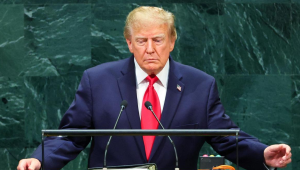
In 2019, when President Trump mentioned buying Greenland, people took it as a joke. However, after his 2024 State of the Union address, when he said, “We have to have Greenland,” hardly anyone laughed. The Danish Prime Minister, Mette Frederiksen, rejected the proposal at the time, saying, “Greenland is not for sale.” Though in recent months, she has softened her stance, suggesting the matter is up to the Greenlanders to decide. Even the Russian President Putin believed it was not some ‘extravagant talk’ of the current U.S. administration.



The U.S. wants to buy Greenland to curb the influence of China and Russia in the Arctic. Greenland holds vast reserves of critical rare-earth minerals, as well as oil and gas. China is the world’s largest importer of rare-earth minerals. The U.S. is heavily dependent on Chinese supplies of these rare-earth minerals for its automotive, computer, smartphone, and lithium battery sectors. Greenland can serve as a substitute supplier of these minerals for the U.S. and help reduce dependency on the Chinese supply chains.
The effects of climate change have led to the melting of a significant portion of the island’s ice sheet. It is a bane for the environment’s future, but a boon for trading routes. China, as a ‘near Arctic nation,’ is aiming to use the Northwest Passage as a shipping route. This will allow a 30% faster route than the traditional route connecting the Atlantic and Pacific Coasts through the Panama Canal. Furthermore, China has invested more than $2bn in Greenland and struck a free trade agreement with nearby Iceland. These developments pose a significant challenge for the U.S. in containing the Chinese footprint in the region.
The resurgence of Russia’s Arctic presence is concerning to the U.S. Russia has been pouring money into its Arctic military preparations in recent years. For instance, on Siberia’s north coast, the Nagurskoye air base houses nuclear-capable strategic bombers, missiles, and surveillance systems. Additionally, with its nuclear-powered submarines, Russia patrols the Arctic Seas. Its movements in the GIUK, open-ocean areas connecting Greenland, Iceland, and the UK, are strategically vital for NATO to monitor and contain threats.
Against this backdrop, President Trump has mobilised his MAGA base to sway public opinion in favor of his idea to purchase Greenland. It is the base’s unwavering support for his policies that keeps the administration unrestrained and buoyant. And that is what matters most as the midterm Congressional election approaches.
Hours after the U.S. yanked Maduro out of Venezuela, Katie Miller, a far-right podcast host, posted an image on X showing a map of Greenland in the colors of the Stars and Stripes with a one-word caption: “SOON.” So, the base is entirely in sync with Trump’s Greenland venture.
Trump recently appointed Louisiana Governor Jeff Landry as a special envoy to Greenland to do the diplomatic bidding. However, he has not ruled out the use of military force. To summarise, it’s all about America first and projecting its global power. Thus, in this anarchic world system, military capability determines a country’s power; in that regard, the U.S. is a powerful country that can exert its will. Venezuela is the latest example. Therefore, it would not be surprising if the U.S. took control of Greenland by means it deems necessary.
With such a possibility, however distant it may be, leaves the future of Greenland possibly in Uncle Sam’s hands!
The writer is a Doctoral Researcher, International Relations, Universiti Sains Malaysia (USM)