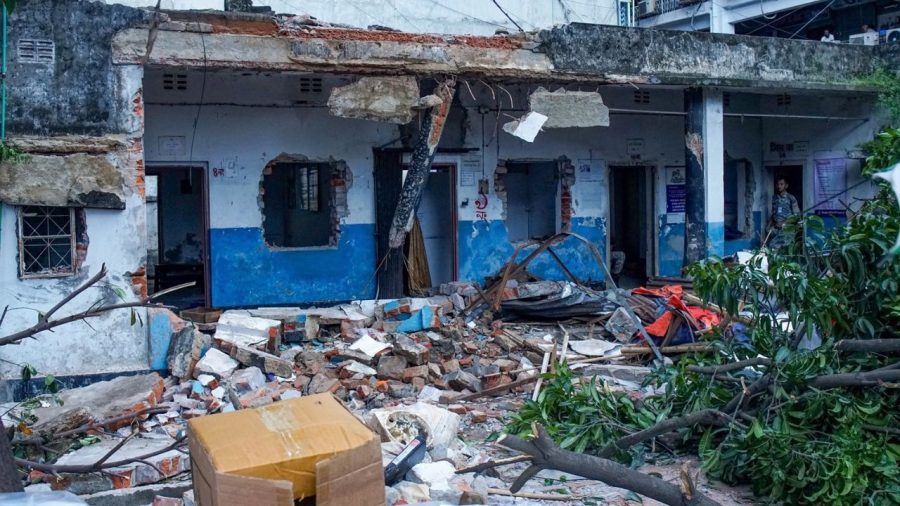



In a country where over 1,100 children have died of measles even in this modern era and counting, demolishing and forcibly attempting to occupy an institution rendering basic but important healthcare services, like maternal and child health, immunisation, reproductive health, and family planning, to the low-income and underprivileged people of Mirpur for over five decades is undoubtedly a grave crime. This kind of egregious attempt has never happened in our country before. There, apparently as a land-grabbing tactic, around two hundred masked individuals entered the centre in the dead of night, held the security guards hostage, looted medical equipment, medicines, and other materials, and later used heavy machinery to demolish various structures of the centre in the presence of the police.
It is a matter of grave concern that a healthcare institution – especially one where medical treatment for poor mothers and children and child vaccinations are conducted – was attacked in the darkness of the night in such a heinous way.
There can always be land disputes. However, established legal ways exist to resolve such disputes, not through the way it was attempted. The good news is that a case was filed in this connection and several accused have been arrested.
Following the Radda incident, the name of a local Member of Parliament from a reserved women’s seat came to light. She denied involvement in the issue even though allegations were raised against her. Authorities assured that if the allegations are found to be true during the investigation, action will be taken against all the accused as per the law. However, the Prime Minister did not wait for the full investigation report. As part of his political accountability, his step was significant. Following the Prime Minister’s direction, the local MP resigned from her parliamentary seat, and the Parliament Secretariat has already declared her seat vacant. The Prime Minister’s intervention and punitive measures serve as an important precedent and lesson for political accountability. The swift action taken at the party and political levels after such serious allegations were raised against an MP from the ruling party carries a significant message – that an identity with the ruling party or the position of a public representative must not deter the authority to take any punitive measures against the accused.

It is worth noting that no Prime Minister in the past has asked an MP to resign over involvement in such an alleged crime. This is unique and unprecedented. This step by the Prime Minister in establishing the rule of law is undoubtedly commendable. People appreciate the step by the Prime Minister for sending a serious and firm message against this unprecedented crime.
However, the resignation of a Member of Parliament is just a part of political accountability; determining criminal liability is altogether a different matter. Who gave the order, who planned it, who participated at the scene, where the looted medical equipment went, and why law enforcement agencies could not effectively protect the centre in time – all these need to be determined through a neutral investigation, and all those responsible need to be brought to accountability and justice.
People also expect that the Prime Minister similarly directs a fact-based verification of the statements brought into the public domain by another woman MP from a reserved seat, who attempted to shift the blame for the Radda incident onto other political parties or groups. If any public representative has tried to divert the investigation by providing misleading information about the involvement of rival political parties without proof, her role should also be investigated, and the Prime Minister should take proper action against her as well.



The public expects that all political parties and their workers will take the Prime Minister’s action against this unprecedented crime in the Radda case as a firm political message and determine their own duties and responsibilities accordingly.
However, the matter should not end there. Alongside political punitive measures, all other necessary measures must also be taken to establish the rule of law. Whoever the allegations of crime are made against – whether they belong to the ruling party, an opposition party, or are an influential individual without any political identity – the investigation should be conducted under the same legal standard. This should be the core principle of the rule of law.
At the same time, everyone hopes this will serve as an important political and accountability message for other political parties as well. There is no scope to view the Radda incident merely as an internal problem of the ruling party or a single party. Lessons to be learned from this for all political parties. People expect that every political party represented in the Parliament will follow the same standard regarding their own elected representatives and leaders. If credible allegations of land-grabbing, extortion, violence, or any other serious illegal activity arise against any public representative, instead of trying to protect them due to party identity, everyone should cooperate with a neutral investigation. The government should also be neutral to investigate any criminal activity without being influenced or obstructed by any influential quarter. The policy here needs to be crystal clear: evidence, not allegations; law, not political identity or affiliation.
On the flip side, the Radda incident has apparently presented the government with a good opportunity. It must grab it. The government should use this sad incident to make a clear policy declaration: party identity will offer no protection in cases of illegal occupation, extortion, looting, and political terrorism. Be it a local government representative, a Member of Parliament, or a leader of the ruling party – if credible allegations are raised against anybody, an appropriate investigation will take place, and if the crime is proven, action will be taken as per the law. However, such a policy must not merely be a declaration on paper; it must be applied consistently and without any bias. The true test of the government’s goodwill lies in whether the same policy will be followed tomorrow if similar allegations are raised against someone else, just as political action was taken against an MP from its own party today.
The demolition of the Radda Maternal, Child, and Family Planning Centre highlights an uncomfortable and inconvenient reality before us – how easily an institution dedicated to public service can be attacked using political or local influence. At the same time, the subsequent sequence of events points to a potential positive direction. If accountability is linked to power, if the law is placed above political identity, and if a culture of taking necessary action against individuals within one’s own party is established, a positive transformation in politics is possible.
The resignation of the concerned MP on the instructions of the Prime Minister does send an important political message regarding accountability. What is needed now is to bring that message to fruition – a transparent and neutral investigation, bringing the real perpetrators to justice, recovering the looted assets, rapidly reconstructing the health centre, and applying the same policy against land-grabbers and terrorists in the future, regardless of party affiliation. Our expectation is that a new political and legal culture begins from the ruins of Radda – this could be the most meaningful outcome and a loud message from this tragic incident.
At the same time, people strongly believe that the government would take all possible necessary steps to make Radda operational again, including – in addition to ensuring punishment and investigation – the most urgent matter: resuming the operation of healthcare services fully at the Radda centre, providing government grants for its repair, and officially handing over the centre to the Radda authority on a long-term or permanent basis.
The views expressed in this article are solely those of the author
The writer is a Former Secretary and Ambassador and WHO’s Senior Public Health Policy Advisor