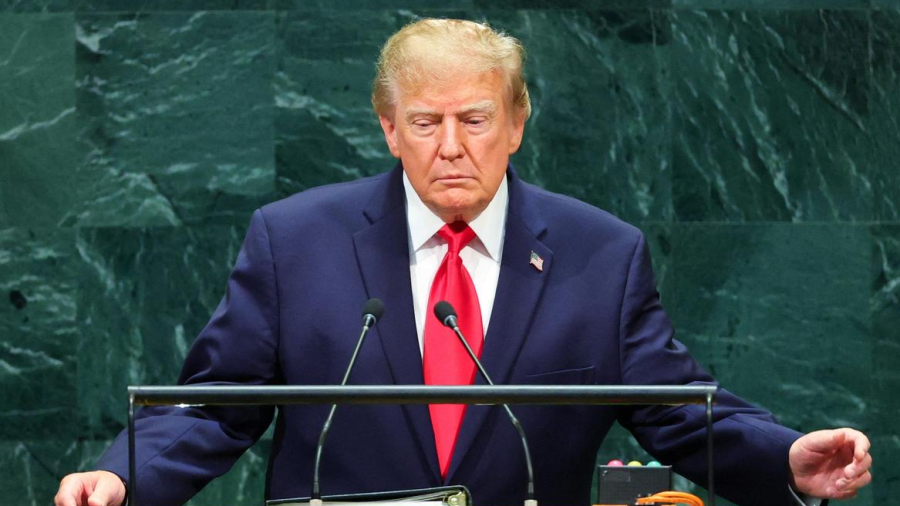



The United Nations podium has never lacked in world leaders trying to establish the issues of their time and trying to offer their future outlook. Nevertheless, in his recent visit to the UN General Assembly, President Donald Trump demonstrated a new approach to diplomacy, a model that was not based solely on foreign policy, but also on political rhetoric, national power and redefining the role of America in the world.
The speech by Trump has incorporated three common themes of his political identity, the focus on American power, the attack on international institutions and the assertion of great accomplishments under his leadership. The speech was a symbol of confidence and a definite assertion of US influence to his supporters. It was seen by his critics as an indication of an interest in confrontation and a narrow devotion to traditional multilateral diplomacy.
However, the most prominent aspect of the speech was that Trump attempted to depict himself as a peace-maker in the world. He said that his administration had contributed to the cessation of eight wars and his foreign policy strategy was one that could achieve results when earlier administrations had failed.
The assertion, however, sparked a lot of controversy among fact-checkers and analysts. There was even the question whether all the situations mentioned could be defined as conventional wars and whether there were any conflicts or disagreements that were not solved. The scandal brought out a larger aspect of new politics communication in the fact that complicated international events are often reduced to simple stories of success and failure.
Politically, such messaging can work. Peace agreements, diplomatic talks and conflict resolutions tend to be multi-actor, long-term and challenging compromises. In addition to the claims related to peace, other statements of the Trump address became a subject of questioning, such as the economic investment, crime trends and climate-related issues. Some critics claimed that certain figures and interpretations were not contextualised, and supporters, the message was bigger than the individual figures and focused more on the successes and policy priorities of the administration.

The other significant theme of the speech by Trump was competition with China in the field of artificial intelligence and technology. He introduced AI leadership as a geopolitical rivalry between Washington and Beijing and said that over-regulation will undermine American innovation. His posture is a replica of an increasingly debated issue in the world on the way governments ought to strike balance between technology development and responsible governance.
Proponents of a less restrictive policy state that over-regulation can slow down innovation and decrease competitiveness. Others such as most researchers and policymakers highlight that it is necessary to have safeguards to curb issues surrounding privacy, cyber security, misinformation and societal impacts of sophisticated technologies.




The AI debate has shown that the military and economic power will not be the only factors that define future global competition. The innovation ecosystems and data capabilities are becoming the key aspects of national influence. The developed countries that can control risks with the help of developed technologies will probably have a great influence on the international order.
Another characteristic of the speech was Trump criticising world bodies. His words were representative of his old-fashioned America First policy, in which national sovereignty and national interests take precedence over greater international obligations. He raised the question whether organisations like the United Nations and other international organisations sometimes exceed their mandates.
This discussion is not theoretical in the case of such countries as Bangladesh. The development path in Bangladesh has been deeply linked with the global collaboration in issues like climate adaptation, migration, trade and health of the population. Being a highly vulnerable country to climate change, Bangladesh is highly interested in having proper international forums where developing countries can voice their concerns and demand joint solutions.
Alteration of the foreign policy path of key powers, especially the United States, may have an impact on climate financing, development aid, trade relations and global relations. As much as nations should safeguard their national interests, numerous issues in the world cannot be won using a one-man effort.
The greater importance of the Trump address to the UN is the way it shows how the world politics is evolving. The world is gradually experiencing a discussion of two conflicting approaches. One is the dominance of national sovereignty, the strategy of competition and domestic interests. The other is concerned with international collaboration and collective responsibility towards international challenges.
The first approach was evident in the speech of Trump. His idea was that American power, economic potential and technological dominance are to be the main element of the world influence. Proponents consider this a claim of national confidence, and critics believe that multilateral issues that other countries face need more collaboration between countries.
The significance of the speech is, in the end, not only in the policies that it was talking about, but also in the manner in which global politics is becoming more and more influenced by stories. International forums like UN general assembly are now arenas where leaders vie not only to gain diplomatic influence but also to gain popularity.
This dual reality was again proved by the appearance of Trump at the UN. It depicted a world that was in conflict to juggle national interests and collective responsibilities. In the case of nations like Bangladesh, the dilemma is simple; how to deal with a shifting world order and at the same time properly pursues cooperation in matters that cannot be handled by individual nations.
The views expressed in this article are solely those of the author
The writer is an Associate Professor, Department of Public Administration, University of Rajshahi. E-mail: [email protected]