
Persistent low pipeline pressure and prolonged gas disruptions are driving households towards electric cookers, with retailers reporting rising sales as consumers look for more reliable cooking options.
Farzana Begum, a housewife, bought an electric cooker from the Nawabpur electronics market after repeated interruptions to her piped gas supply.
“Although we have piped gas at home, the pressure is often very low or the supply is completely cut off. I had been planning to buy an electric cooker for quite some time. This time, I finally bought one,” she told TIMES of Bangladesh.
For more than 10 days, many areas of Dhaka have received little or no pipeline gas during the day, with supply returning only late at night. As LPG cylinders are more expensive and inconvenient, many families are turning to electric appliances.
The shift comes amid a widening gas supply gap. Bangladesh’s daily demand stands at around 3,800-4,000 million cubic feet per day (mmcfd), while supply remains between 2,500 and 2,800 mmcfd, leaving a shortfall of 1,000-1,400 mmcfd.
The crisis worsened after an FSRU at Maheshkhali in Cox’s Bazar stopped operations on 21 July following a boiler fault and fire, cutting national gas supply by around 450 mmcfd.

Lower running costs
Shimul Mahmud, a private job holder, said electric cookers were cheaper for his household than LPG cylinders. Using a prepaid electricity meter, he found that his daily electricity cost increased by only Tk26-Tk28 after using an electric cooker.
Newer models have also improved significantly, with many now compatible with ordinary cookware and some offering a flame-like heating effect.
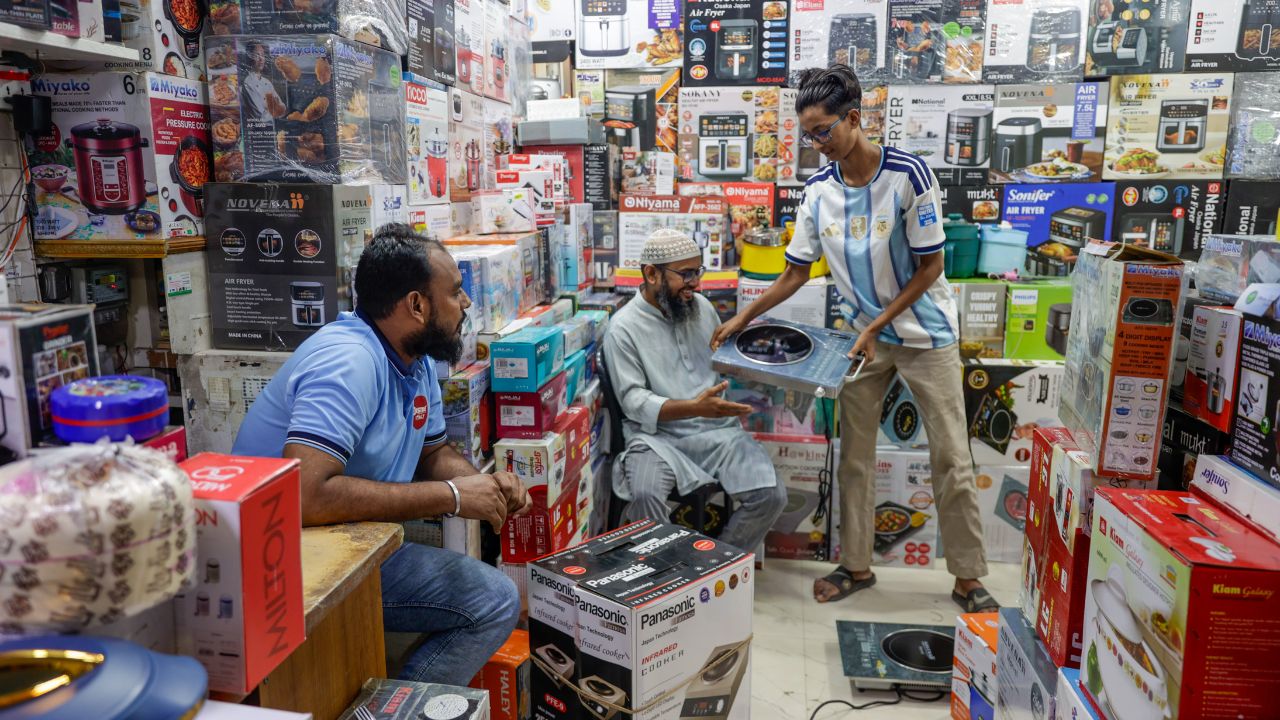
Nawabpur traders said demand had been rising steadily and could grow further if the gas shortage continues.
Nazmul Haque, proprietor of Gomoti Enterprise, said higher import costs could eventually push up retail prices.




“When importers place new orders, suppliers may increase prices. As a result, retail prices will also rise,” he said.
Trader Kamruzzaman said electric cookers were gaining popularity in rural areas, while Gulistan retailer Mohammad Mahim said sales had increased in recent days.
Induction or infrared
Two types of electric cookers dominate the Bangladeshi market: induction and infrared.
Induction cookers consume less electricity and cook faster but require magnetic cookware. Infrared cookers can be used with almost all types of pots but consume more electricity and remain hot after use.
Single-burner models cost between Tk2,800 and Tk9,000, while dual-burner models range from Tk7,000 to Tk13,000.
Retailers said Miyako, Walton and Vision were popular among middle-income consumers, while premium Philips models also had demand.
Structural gas weakness
Energy expert M Tamim said the shortage reflected deeper weaknesses in the gas supply system rather than merely a technical failure.
He said Bangladesh’s two FSRUs provided little backup when one unit went offline. Routine maintenance also requires an FSRU to remain unavailable for 15-20 days each year.
Tamim said Bangladesh needed additional FSRUs and stronger domestic gas exploration to prevent similar crises.
Domestic production expands
The electric cooker market, once dominated by imports, is seeing growing participation from local manufacturers.
Manufacturers estimate that around 100,000 electric cookers are now sold every month.
Md Abdullah-Al-Zunaid, chief business officer of Walton Home and Kitchen Appliances, said annual demand had reached 800,000-900,000 units.
“Walton currently meets around 20 per cent of that demand. Compared with previous years, demand for Walton electric cookers has increased by approximately 62 per cent,” he said.
Walton currently offers around 15 induction and infrared models priced between Tk3,890 and Tk5,590.