
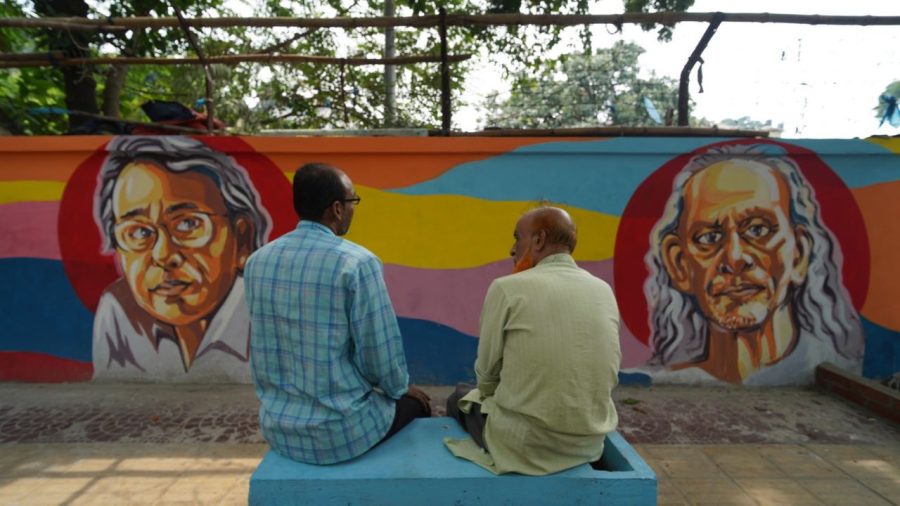



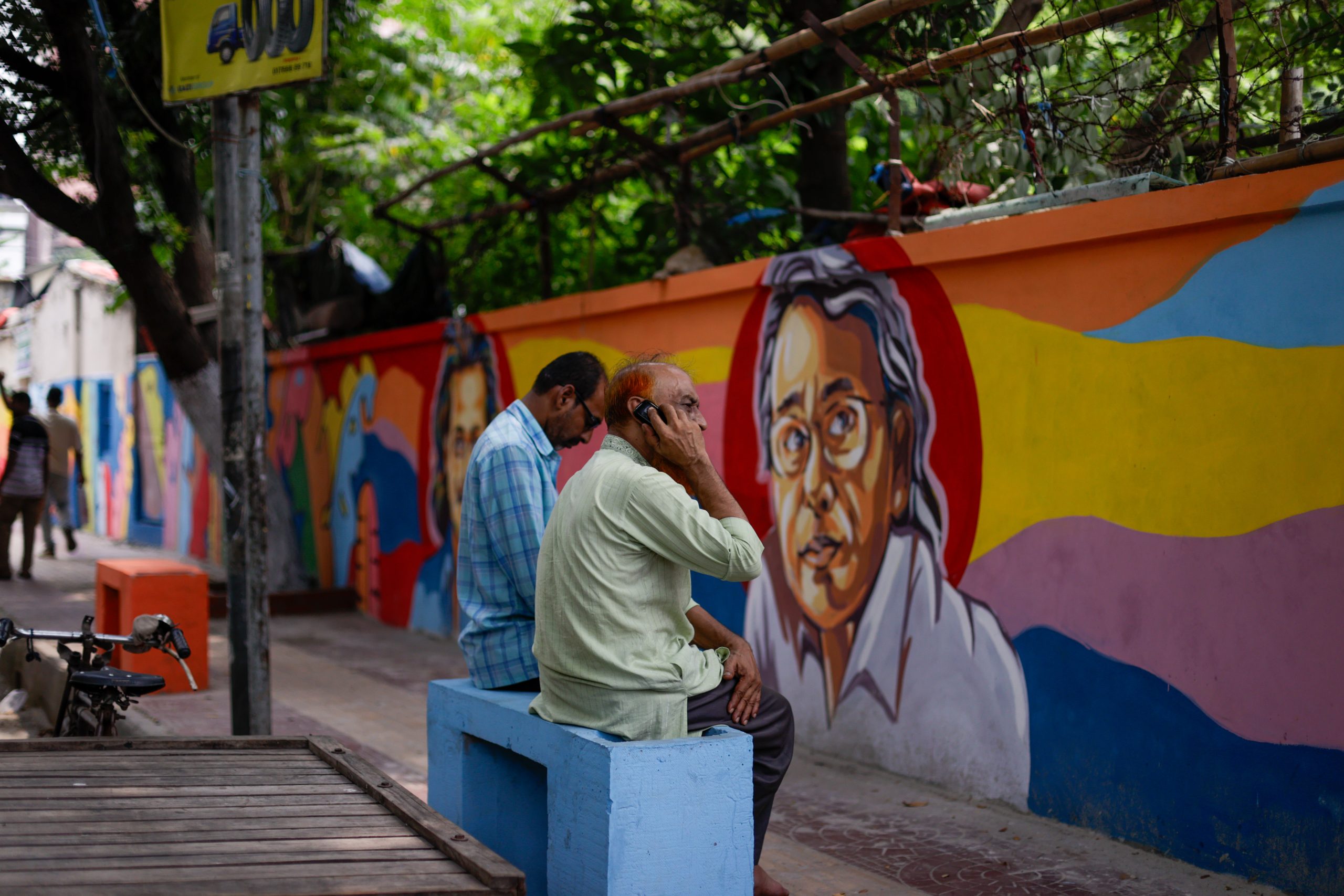
The footpath in front of Shilpakala Academy has undergone a striking transformation, with hawker stalls and rubbish replaced by open walking space, new dustbins, and graffiti depicting some of Bengal’s most celebrated cultural figures.
The roadside wall now features portraits of Zainul Abedin, Satyajit Ray, Rabindranath Tagore, and Kazi Nazrul Islam, alongside six other eminent personalities.
Only days ago, the same stretch in Segunbagicha was crowded with makeshift shops, pedestrians, and litter. Many people were forced to step onto the main road because there was virtually no room left on the pavement.
Dhaka South City Corporation (DSCC) cleared the footpath during an eviction drive and subsequently set about rejuvenating the space rather than leaving it bare. The boundary wall was renovated, artwork painted, and new dustbins installed.
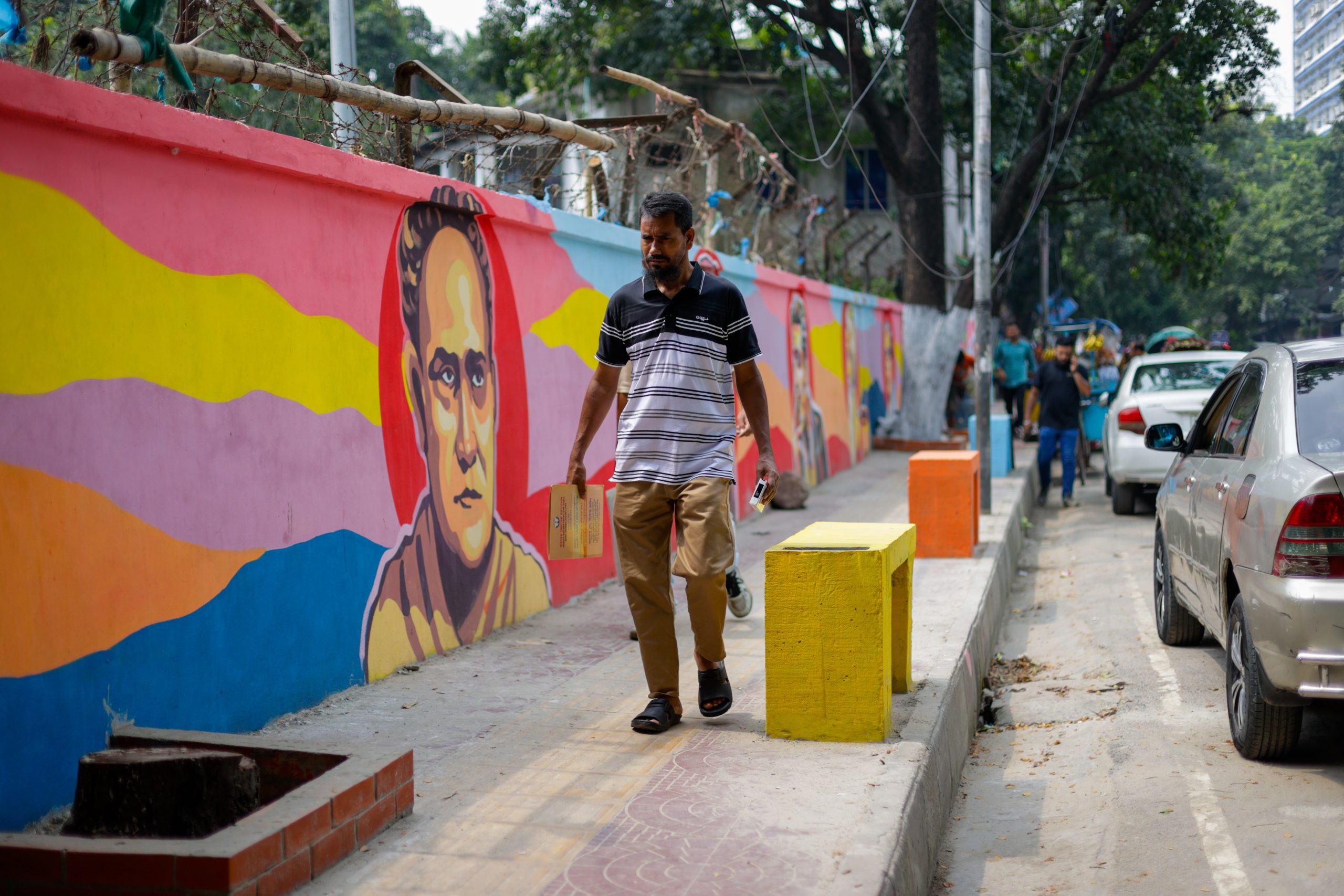
Local resident Aminul Islam noted that the difference was remarkable. “Earlier, there was hardly any space to walk and rubbish used to pile up here. Now it is clean and much more comfortable for pedestrians,” he said.

Another pedestrian, Shefali Rahman, remarked that the beautification was particularly fitting for the concourse outside one of the country’s premier cultural institutions. She pointed out that the High Court, Matsya Bhaban, and several other prominent establishments were nearby, emphasising that the pavement must remain clear for the public.
Several residents admitted they had rarely seen such initiatives in the southern part of the city, warmly welcoming the effort to uplift a key cultural precinct.
However, the makeover has revived a familiar concern: how long will it last?




Clearing stalls, painting murals, and installing street furniture can be executed swiftly; preventing street vendors from returning months later is a far more formidable task.
DSCC Administrator Md Abdus Salam assured that the corporation would take a firm stance against renewed encroachment, whilst stressing that their intention was not to destroy hawkers’ livelihoods.
City authorities confirmed that alternative arrangements had been established following several rounds of consultation. A dedicated “holiday market” will operate near Pir Yameni Mazar on Fridays and Saturdays. On other days, hawkers will be permitted to trade along the pavement opposite Ideal School.
No stalls will be tolerated outside these designated zones, nor will blocking main thoroughfares or occupying unauthorised footpaths be permitted.
Abdus Salam warned that goods would be confiscated and legal proceedings initiated if vendors returned to unauthorised spots.
Yet, urban experts argue the challenge extends far beyond enforcement.
Adil Muhammad Khan, a professor of Urban and Regional Planning at Jahangirnagar University and executive director of the Institute for Planning and Development, emphasised that whilst footpaths must primarily serve pedestrians, eviction drives alone cannot offer a permanent remedy.
He stressed that street vendors’ livelihoods must be integrated into proper urban management schemes.
“Determining where hawkers can operate, how many are permitted, and under what rules should all form part of broader urban planning,” he said, adding that authorities must conduct regular monitoring of cleared zones to prevent vendor creep.
DSCC confirmed that cleaning staff would maintain the area outside Shilpakala Academy on a routine basis.
For the moment, the stretch has been dramatically transformed. Whether it remains that way will depend on sustained enforcement, viable economic alternatives for hawkers, and consistent oversight.