


French ministers are scrambling to appease high school students following 10 days of protests and school blockades over the poor state of the national education system, which have left hundreds of people injured across the country.
High school students have again blockaded schools and marched through cities across France, promising to continue their campaign despite government efforts.
In a television interview on TF1 on Thursday night, Education Minister Édouard Geffray announced that 3,000 substitute teachers would be deployed between Friday and Tuesday to approximately 100 high schools identified as having particularly acute teacher shortages.
Minister Geffray added that he would authorise the recruitment of “several hundred” new teachers, reports Guardian.
Meanwhile, Prime Minister Sébastien Lecornu said the government would propose amendments to 2027 budget to “translate some of the students’ demands into concrete measures, particularly regarding teacher replacements.”

Economy Minister Roland Lescure said this week that room exists within 2027 budget to address demands for additional school resources. In current draft budget, schools receive the second-largest funding increase after defence, with a 1.4 per cent hike to €90.9 billion.
Despite government promises, more than 71,000 protesters took to the streets on Thursday in mainly peaceful demonstrations in cities including Lille, Rennes, Nantes, Lyon, Toulon, and Marseille, as well as Paris.
In the capital, an estimated 25,000 students gathered at the Place de la Bastille, where some climbed July Column monument commemorating France’s 1830 July revolution, waving the tricolour flag and singing Marseillaise.
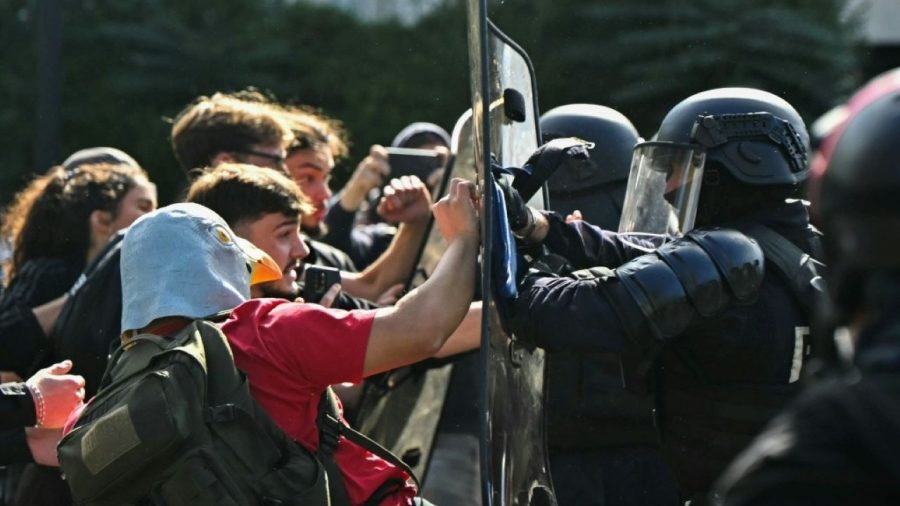
As evening set in, riot police deployed tear gas, crowd-dispersal rounds, and repeated baton charges to clear demonstrators, who hurled bottles, paving stones, and other projectiles at heavily armoured police squads.




Clashes with police also took place around school barricades in Paris and Nantes, while riot officers in Rennes used water cannon to disperse crowds. Over the past two weeks, some demonstrators have set dustbins on fire outside schools, destroyed bus shelters, and thrown projectiles at riot police.
At least 215 teenagers, 89 school staff, and 761 police officers have been injured since the demonstrations began, triggered by chronic teacher shortages, crowded classes, dilapidated buildings, and long school days.
On Wednesday, the government suspended the use of stun grenades by police after a teenager’s hand was blown off, though officials claimed it was “excessive” to speak of “police repression” and denied officers had orders to confront young protesters.
Student banners condemned the heavy-handed police response, with one reading, “Too young to be listened to, but old enough to be teargassed.”
Student representatives rejected the government’s response as insufficient. Ryad Rani, president of one high school students’ union, said protesters heard “no concrete measures whatsoever, no response to our demands” and confirmed that the movement “will continue.”
Sabrine Kharbach, from another students’ association, declared that protests over teacher shortages, long school hours, and dilapidated buildings would last “for as long as €10 billion hasn’t been put on the table”, referring to the sum students and left-wing politicians say is urgently needed for France’s schools.
Eliane, a 16-year-old pupil on Paris march, called the demonstration “magnificent” and stated she had come to “defend and encourage high schools in an even worse state than mine”, planning to protest until concrete progress is achieved.
The Education Ministry reported that 224 high schools were closed on Thursday morning and 157 by lunchtime, meaning about 95 per cent of high schools remained at least partly open.
According to an Elabe poll for BFM TV, 72 per cent of French people consider the students’ demands legitimate, though 55 per cent believe the protests should stop.
Trade unions, which alongside parents and teachers have backed the students, have called for another National Day of Action next Tuesday.
The protests have rocked a government caught between popular demands for investment in deteriorating public services and market pressure to reduce France’s ballooning budget deficit and debt mountain, which are among the highest in European Union.
Six months ahead of a crucial presidential election to replace Emmanuel Macron, politicians are seeking to exploit the unrest, Marine Le Pen highlighted damage to schools and called for parents to foot repair bills, whereas her hard-left opponent, Jean-Luc Mélenchon, praised the student protesters as “incredible” and denounced police brutality.