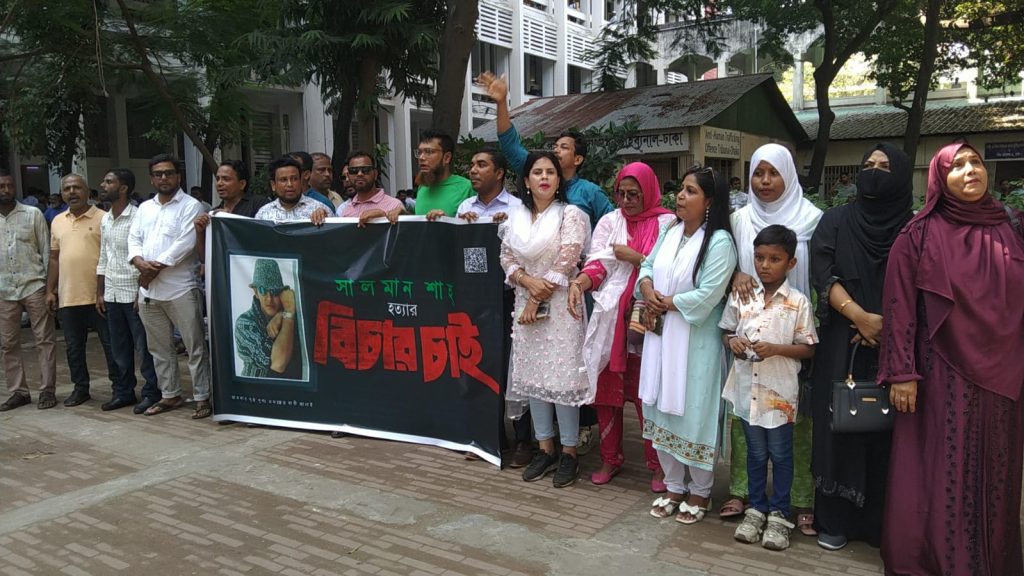
Nearly three decades after the death of Bangladeshi film icon Salman Shah, his devoted fans continue to reject the official claim that the actor took his own life. According to them, it was murder, and on Monday (20 October), they gathered once again to demand justice.
Hundreds of fans from across the country formed a human chain outside the Dhaka Metropolitan Sessions Judge Court, urging authorities to reopen the case and deliver what they believe to be long-overdue justice.
Masud Rana Noqib, one of the organisers, said, “Salman Shah was repeatedly threatened and even physically attacked. He was not someone who would commit suicide. We believe he was murdered in a planned way.”

The demonstration coincided with a new court order related to the case. On the same day, the Dhaka court directed the officer-in-charge of Ramna Police Station to register and investigate a murder case over the actor’s death.
The order was issued after Judge Md Jannatul Ferdous Ibne Haque, of the Sixth Additional Metropolitan Sessions Judge Court, accepted a revision petition filed by the plaintiff. State prosecutor Md Habibur Rahman confirmed the development.




Salman Shah was found dead at his residence in Eskaton, Dhaka, on September 6, 1996. His father, Kamaruddin Ahmed Chowdhury, initially filed an unnatural death case.
A year later, on July 24, 1997, he petitioned to have the case converted into a murder investigation, prompting the court to assign the Criminal Investigation Department (CID) to look into it.
The CID’s final report, submitted on November 3, 1997, ruled the death as suicide and later that month, the Dhaka CMM Court accepted the report. Kamaruddin, however, rejected the findings and filed a revision petition, which led the court to order a judicial inquiry in May 2003.
After more than a decade, Metropolitan Magistrate Imdadul Haque submitted his findings on August 3, 2014, again concluding that the actor’s death was a suicide.
Following Kamaruddin’s death, Salman’s mother, Neela Chowdhury, became the complainant. On February 10, 2015, she filed an objection to the judicial inquiry report.
The case was later reinvestigated by the Police Bureau of Investigation (PBI), whose report, also classifying the death as suicide, was accepted by the court on October 31, 2021, effectively closing the case.
However, the plaintiff’s side filed another revision petition on June 12, 2022, challenging that decision, extending a legal battle that has now lasted 29 years and shows no sign of ending soon.