Bangladesh’s export performance continued its decline in September 2025, marking the second consecutive month of contraction, according to data from the Export Promotion Bureau (EPB) released on Sunday.
This came after a strong start to the fiscal year in July, when exports grew by 24.93% year on year to $4,770.59 million, driven by US buyers rushing to secure Bangladeshi apparel before the reciprocal tariff took effect in early August.
However, the momentum could not be sustained, as exports fell in both August and September, compared to the previous month and the same period last year.
EPB data reveals that August exports dropped by 2.93% year on year to $3,915.00 million, and September saw a sharper decline of 4.61% year on year, reaching $3,627.58 million.
Exporters blamed the cautious approach of US buyers in placing new shipments, fearing a slowdown in demand due to higher retail prices caused by the new tariff.

Despite the downturn, total exports for the July–September quarter amounted to $12.31 billion, still 5.64% higher than the same period last year, which had been severely affected by political unrest.
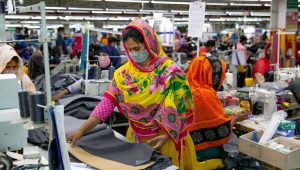
The ready-made garments (RMG) sector, which is a cornerstone of Bangladesh’s exports, saw a 5.66% year-on-year decline to $2,839.75 million in September.
Both sub-segments of RMG were affected, with knitwear exports falling by 5.75% to $1,630.14 million, and woven garments dropping by 5.54% to $1,209.61 million.




Home textiles saw a slight decline of 0.54% to $67.60 million.
Mohammad Hatem, president of the Bangladesh Knitwear Manufacturers and Exporters Association (BKMEA), explained that the decline in the apparel sector reflects the impact of recent US tariff shocks.
He pointed out that fewer orders were placed during this period, and buyers attempted to transfer part of the additional 20% tariff burden onto Bangladeshi suppliers, which further exacerbated the difficulties exporters are facing.
Shams Mahmud, Managing Director of Shasha Denims, attributed the slower exports in September to both local and international factors, including banking-related challenges and labour unrest in industrial zones.
He highlighted issues such as the devaluation of letters of credit (LC) limits, the shutdown of major factories, sluggish economic conditions in key export markets, and lingering uncertainty over US tariffs until August.
Despite these challenges, Mahmud expressed optimism, stating that export growth is expected to pick up in the coming months, as the flow of orders increased in September and will be delivered later.
How the other sectors fared in September
In other sectors, leather and leather goods grew by 3.55% to $90.98 million, while pharmaceutical exports fell by 8.46% to $18.08 million. Primary commodities exports rose by 1.39% year on year to $147.79 million, with frozen and live fish exports showing a strong 12.01% increase to $44.57 million. However, animal-origin exports fell by 16.98% to $1.32 million, and agricultural products saw a 2.37% decline to $101.90 million.
Several other sectors also saw declines. Chemical products exports fell by 10.39% to $31.49 million, plastic products dropped by 9.15% to $26.91 million, and rubber exports plummeted by 29.28%, totaling $4.71 million.
Wood and wood products experienced the steepest decline, falling by 43.75% to $0.18 million. Handicrafts, paper and paper products, cotton, jute, and other segments also experienced varying degrees of contraction.
On a positive note, carpets surged by 21.67% to $3.20 million, while wigs and human hair grew modestly by 0.54% to $9.30 million.
The engineering products sector experienced the highest growth among key segments, increasing by 36.43% to $60.59 million in September. Bicycle exports grew by an impressive 98% year on year, reaching nearly $15 million.