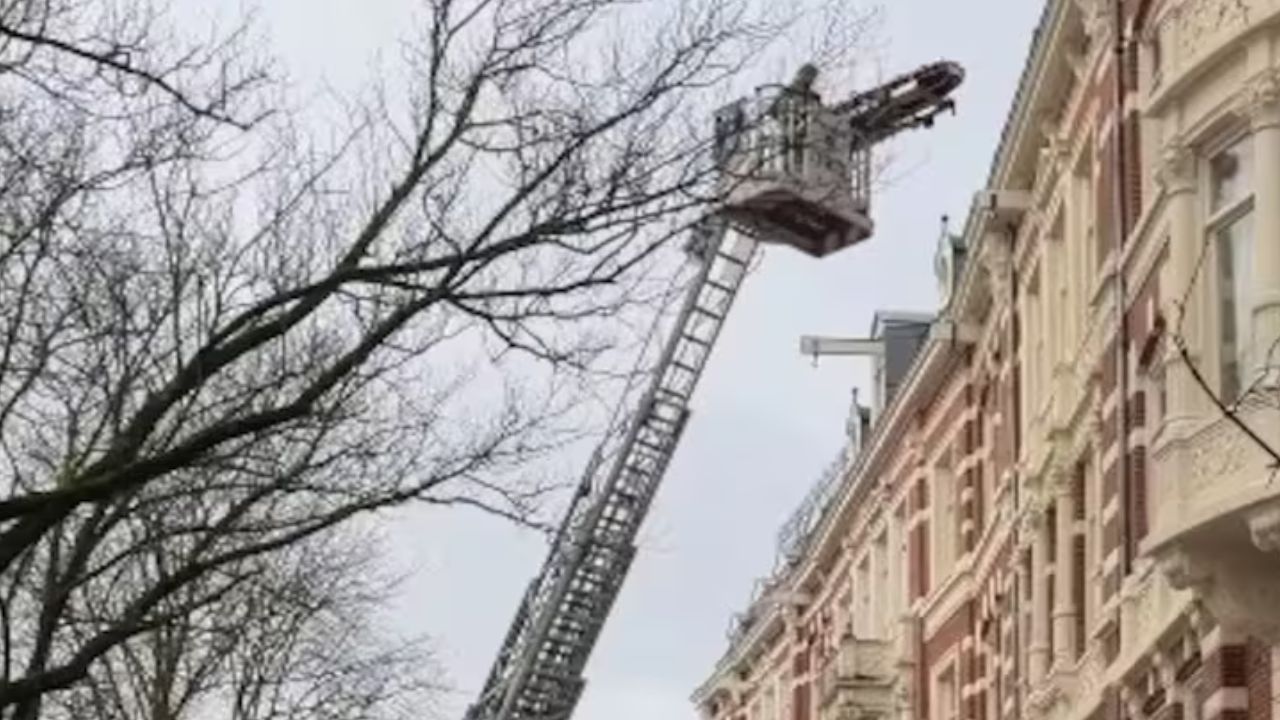

An Indian woman in Amsterdam was astonished after witnessing Dutch emergency responders carry out a high-level medical evacuation using a crane, a moment she recorded and shared online.
The footage highlights the speed and precision with which firefighters in the Netherlands handle challenging rescue situations, reports NDTV.
The clip shows a fire engine extending a mechanical crane toward an upper floor of a residential block. The building did not have a lift, and its internal staircases were said to be too narrow or sharply angled to allow a patient to be moved safely on a stretcher.
To overcome this, trained rescue personnel secured the patient and carefully lowered them to the ground using the crane.

The woman who filmed the scene, Swati, could be heard expressing admiration for the operation, noting how effortlessly such complex rescues appear to be managed in the Netherlands. She later shared the video with the simple caption, “The Dutch are so resourceful.”




Online viewers responded positively, applauding the calm and well-coordinated approach of the emergency team. Several commenters explained that crane-assisted evacuations are not unusual in Europe, particularly in older buildings that were constructed before elevators became standard and often feature very narrow stairways.
The video also prompted broader conversations about how different countries adapt emergency responses to architectural limitations.
One user wrote, “It’s routine here in historic buildings. Lifts weren’t common when they were built, and staircases are often too tight for safe movement.”
Another added, “This method is mainly used in historic buildings. When these were built, lifts were not common. The stairwells are often so narrow that moving the stretcher is possible, but not safe.”
A third clarified, “They also do it when there is a lift/elevator. It has to do with having to be transported in a horizontal position, as some lifts aren’t long enough.”